21 citations
,
January 2020 in “Conservation Physiology” Hair follicles increase hair cortisol levels, so consistent hair collection methods are important.
January 2016 in “Lithuanian University of Health Sciences” Different diseases cause specific skin and hair follicle changes in dogs with alopecia.
 21 citations
,
October 2013 in “Molecular Biology of the Cell”
21 citations
,
October 2013 in “Molecular Biology of the Cell” The protein CCN2 controls hair growth by affecting hair follicle formation and stem cell activity in mice.
 April 2018 in “Journal of Investigative Dermatology”
 Macrophages are more involved in Lichen planopilaris than in Frontal fibrosing alopecia.
20 citations
,
January 1997 in “Dermatology” The patient with EEC syndrome had scarring alopecia due to deep folliculitis, possibly linked to abnormal hair structure.
50 citations
,
February 2016 in “Journal of Investigative Dermatology” A mutation in the KRT25 gene causes a rare hair disorder with thin, woolly hair.
 August 2016 in “Journal of Investigative Dermatology”
 Researchers found a new genetic mutation linked to a hair condition in a Japanese boy.
 7 citations
,
June 2022 in “Frontiers in Veterinary Science”
7 citations
,
June 2022 in “Frontiers in Veterinary Science” Researchers found genes linked to hair growth cycles in Inner Mongolia cashmere goats, which could help understand and treat hair loss.
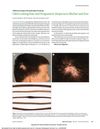 May 2014 in “JAMA Dermatology”
 Mother and son diagnosed with a rare genetic hair loss condition with no effective treatment.
January 2025 in “LUMEN ET VIRTUS” Orchiectomy and melatonin helped a German Spitz regrow hair lost due to alopecia X.
Trichorrhexis nodosa causes hair to break easily, often affecting young to middle-aged black women.
 August 2020 in “Textile research journal”
 The model helps understand how wool fiber structure affects its strength and flexibility.
35 citations
,
November 2019 in “Journal of the American Academy of Dermatology” A new variant of lichen planopilaris causing diffuse hair thinning was identified.
February 2026 in “Revista Saber Digital” Deslorelin effectively treats alopecia X in dogs.
 November 2023 in “Journal of animal science/Journal of animal science ... and ASAS reference compendium”
 SLICK cattle have better heat tolerance due to specific gene expression and pathway differences.
July 2004 in “TSpace (University of Toronto)” A rare case showed alopecia areata and lichen planus occurring together in one person.
February 2013 in “Journal of the American Academy of Dermatology” 43 citations
,
April 2010 in “Developmental Biology” Sebaceous glands can form new hair follicles when activated, but hair follicle bulges cannot.
 170 citations
,
July 2012 in “Journal of Investigative Dermatology”
170 citations
,
July 2012 in “Journal of Investigative Dermatology” Wnt ligands are crucial for hair growth and repair.
112 citations
,
September 1968 in “PubMed” Hot comb use can cause permanent hair loss on the scalp.
 August 2023 in “The journal of investigative dermatology/Journal of investigative dermatology”
 Ixekizumab may be an effective first treatment for a rare skin condition causing hair loss.
13 citations
,
January 2002 in “Clinics in dermatology” A mushroom extract might reduce hair loss and liver damage caused by certain chemotherapy drugs in animals.
 March 2021 in “CRC Press eBooks”
 Trichoscopy helps tell apart Lichen planopilaris and Frontal fibrosing alopecia from other hair loss conditions.
June 2020 in “Research Square (Research Square)” The study found key long non-coding RNAs involved in yak hair growth cycles.
 5 citations
,
September 2012 in “Journal of Investigative Dermatology”
5 citations
,
September 2012 in “Journal of Investigative Dermatology” Scientists can mimic hair disorders by altering genes in lab-grown human hair follicles, but these follicles lack some features of natural ones.
7 citations
,
December 2015 in “PloS one” Cryopreserved mouse whisker follicles can grow hair when transplanted into nude mice.
 September 2024 in “Portuguese Journal of Dermatology and Venereology”
 CCCA and LPP may be related hair loss conditions influenced by genetics and environment, needing early treatment.
4 citations
,
May 2024 in “Cytotechnology” 39 citations
,
May 2013 in “Optometry and vision science” A new way to find eyelash mites without pulling out eyelashes.
 January 2015 in “Journal of clinical and investigative dermatology”
 Clipping is the best method to prepare rats for studying hair loss from chemotherapy because it causes less skin damage and effectively gets hair to the right growth phase.