 1 citations
,
July 2019 in “Microscopy Today”
1 citations
,
July 2019 in “Microscopy Today” Microfluorometry effectively measures how much polymer coats and penetrates hair, useful for evaluating hair products.
1 citations
,
July 2017 in “Microscopy and Microanalysis” Iron oxide nanoparticles mainly enter the skin through hair follicles and sebocytes, not the dermis.
 1 citations
,
May 2009 in “Annales de Dermatologie et de Vénéréologie”
1 citations
,
May 2009 in “Annales de Dermatologie et de Vénéréologie” Environmental factors like smoking, UV exposure, and poor diet contribute to hair loss and graying, and lifestyle changes can help manage it.
May 2026 in “Journal of Photochemistry and Photobiology” Solar radiation and pollution damage hair, especially light-colored and bleached hair.
 July 2025 in “Scientific Reports”
 Fermented grapeseed oil effectively repairs and protects chemically damaged hair.
 June 2025 in “Current Issues in Molecular Biology”
 Minoxidil, caffeine, and biotin can improve hair shine by restoring certain genes.
 November 2024 in “Journal of Cosmetic Dermatology”
 MSC exosome therapy improved hair quality in patients with acquired trichorrhexis nodosa.
October 2024 in “UNESP Institutional Repository (São Paulo State University)” Straightening and dyeing damage hair structure.
 April 2024 in “Advances in Redox Research”
 Human hair strength and health are linked to sulfur compounds that can be reduced by stress but improved with sulfur supplements.
 March 2024 in “Nihon Keshouhin Gijutsushakaishi/Journal of S C C./Nihon Keshouhin Gijutsushakai kaishi”
 Hair becomes less stiff as we age because of a decrease in zinc, which is linked to lower levels of the protein TG3.
 November 2023 in “Borneo Journal of Pharmacy”
 Sappan wood hair tonic helps protect and repair damaged hair.
 October 2021 in “Dermatology practical & conceptual”
 A Saudi girl was diagnosed with Loose Anagen Hair Syndrome, a rare condition causing easy hair loss without scarring.
 August 2021 in “Han'gug miyong haghoeji/Journal of the Korean society of cosmetology”
 Using natural polyphenol cross-linkers like tannic acid and green tea extract in perm treatments improves curling and protects hair.
Children with chronic kidney disease often have skin, hair, and nail problems.
Loose anagen syndrome causes easy hair shedding in children, often resolving on its own.
 April 2018 in “bioRxiv (Cold Spring Harbor Laboratory)”
 A gene variant causes patched hair loss in mice, similar to alopecia areata in humans.
 September 2017 in “Journal of Investigative Dermatology”
 Hair care products used for 4 weeks made hair smoother.
March 2016 in “The Korean Society of Beauty and Art” MSG-based hair hardener improves hair thickness, strength, and wave retention after perms.
September 2011 in “Daehan miyong hakoeji” Henna orange powder, especially with alkali, protects and colors hair better than oxidizing colorants.
April 2007 in “Linchuang pifuke zazhi” TGF-β1 and 2 may play a role in hair loss in AGA.
TGF-β1 and 2 in hair follicles may be linked to hair loss in AGA.
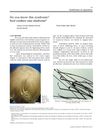
The document concludes that Loose Anagen Hair Syndrome is a benign condition where hair is thin and easily pulled out, often improving with age.
January 2006 in “DOAJ (DOAJ: Directory of Open Access Journals)” Loose anagen hair syndrome causes easily pulled, thin hair in kids but is harmless and temporary.
January 2004 in “Laboratory Animal Science and Administration” The hairless mutant gene causes early hair loss and affects skin and thymus development in mice.
March 2003 in “中華皮膚科醫學雜誌” Trichothiodystrophy causes unusual hair and developmental issues.
January 2000 in “Zhongguo yixue wulixue zazhi” Different human hair keratin types have unique structures that affect how they dissolve and can be used to create self-tendons.
Hair germ cells differ from epidermal cells in keratin expression, and specific keratins form after hair differentiation.
 42 citations
,
June 2012 in “Clinical and Experimental Dermatology”
42 citations
,
June 2012 in “Clinical and Experimental Dermatology” Black dots under trichoscopy can appear in different hair and scalp conditions, not just in alopecia areata.
10 citations
,
October 2018 in “JDDG Journal der Deutschen Dermatologischen Gesellschaft” Most skin conditions in Down syndrome are benign and involve dry or thickened skin.
 December 2020 in “TURKDERM”
 A 3-year-old boy was diagnosed with a rare, non-scarring hair loss condition called temporal triangular alopecia.