 15 citations
,
August 2015 in “Scanning”
15 citations
,
August 2015 in “Scanning” Corkscrew and cigarette-ash-shaped hairs in tinea capitis are caused by internal hair degradation and external resistance.
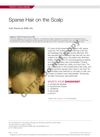
A 5-year-old girl has sparse, dry, and brittle hair but is otherwise healthy.
 5 citations
,
March 2001 in “Journal of biomechanics”
5 citations
,
March 2001 in “Journal of biomechanics” Growing hairs are easier to pull out than resting hairs due to different anchorage strengths.
23 citations
,
February 2004 in “British Journal of Dermatology” Keratin in mouse hair follicles is complex and plays specific roles.
33 citations
,
October 1996 in “Journal of Investigative Dermatology” 21 citations
,
December 2015 in “European journal of cell biology” Tight junctions create a barrier in pig hair follicles that controls what can enter the skin.
1 citations
,
August 1981 in “The Journal of Dermatology” All major hair defects involve cuticle abnormalities.
86 citations
,
June 1998 in “Journal of Investigative Dermatology” The hairless gene mutation causes baldness by disrupting hair follicle structure.
57 citations
,
August 1999 in “Archives of dermatology” Hair follicles grow hair and release it through the skin.
34 citations
,
December 1984 in “Journal of Cutaneous Pathology” Monilethrix hair issues are due to problems in the hair's internodes.
9 citations
,
June 2024 in “Cell Reports” Hair follicles play a crucial role in regulating skin barrier function.
 19 citations
,
January 2009 in “International review of cell and molecular biology”
19 citations
,
January 2009 in “International review of cell and molecular biology” Hair's strength and flexibility come from its protein structure and molecular interactions.
28 citations
,
October 1985 in “The Journal of Cell Biology” Researchers isolated and identified structural components of human hair follicles, providing a model for studying hair formation.
 May 2022 in “Experimental dermatology”
 Trichothiodystrophy hair is structurally abnormal with protein and organization issues.
13 citations
,
December 1983 in “Canadian journal of zoology” Heterotypic cell contacts likely help hair matrix cells differentiate during mouse hair follicle development.
13 citations
,
April 2016 in “Journal of Visualized Experiments” The method successfully isolates hair follicle stem cells and skin cells from mice for research.
 9 citations
,
April 2019 in “Journal of structural biology”
9 citations
,
April 2019 in “Journal of structural biology” Hair's internal fibers are arranged in a pattern that doesn't let much water in, and treatments like oils and heat change how much water hair can absorb.
 40 citations
,
June 2013 in “Biomaterials”
40 citations
,
June 2013 in “Biomaterials” Scientists created 3D hair-like structures that could help study hair growth and test treatments.
5 citations
,
March 1943 in “Archives of Dermatology and Syphilology” A rare case of severe scalp hair loss and nail issues in keratosis follicularis was observed.
15 citations
,
December 1972 in “Journal of Investigative Dermatology” 7 citations
,
January 1990 4 citations
,
August 2013 in “Pediatric dermatology” Hair casts can be treated with physical removal and special shampoos.
3 citations
,
July 2019 in “Fibers And Polymers/Fibers and polymers” Hair dysplasias involve various hair disorders causing fragility, breakage, and poor hair adhesion.
2 citations
,
May 2022 in “International journal of trichology” Plica neuropathica is a tangled hair condition that may be caused by hair damage or psychiatric issues and is treated by cutting the hair and addressing mental health.
 5 citations
,
October 2020 in “Experimental dermatology”
5 citations
,
October 2020 in “Experimental dermatology” A specific type of skin cell creates an opening for hair to grow out, and problems with this process can lead to skin conditions.
 February 2019 in “PubMed”
 The research found that twisting hair fibers can show changes in stiffness and damage, and help tell apart different hair treatments.
11 citations
,
May 2013 in “Journal of Investigative Dermatology” KRTAP10 proteins help form the hair shaft's tough outer layer by interacting with specific hair keratins.
21 citations
,
April 2004 in “Australasian Journal of Dermatology” A 3-year-old girl has a rare condition causing sparse hair and nail issues, with minimal improvement from treatment.
March 1997 in “Medical Molecular Morphology” Zinc deficiency causes early scalp hair damage that recovers slower than skin symptoms.