30 citations
,
January 2001 in “Journal of the American Veterinary Medical Association” High adrenal sex hormones in dogs with hypercortisolemia can mislead adrenal hyperplasia diagnosis.
April 2020 in “Journal of the Endocrine Society” Taking thyroid medication reduced the patient's pituitary gland swelling and improved her symptoms.
 1 citations
,
September 2022 in “Problems of Endocrinology”
1 citations
,
September 2022 in “Problems of Endocrinology” Dutasteride shows promise as a potential treatment for Parkinson's disease.
24 citations
,
October 2018 in “Addiction Biology” Alcohol dependence affects stress hormone levels more than childhood maltreatment.
 2 citations
,
May 2013 in “The primary care companion for CNS disorders”
2 citations
,
May 2013 in “The primary care companion for CNS disorders” A teenage girl's excessive hair growth was caused by a medication for mania, but improved after stopping the medication.
 23 citations
,
February 1979 in “Veterinary Clinics of North America: Small Animal Practice”
23 citations
,
February 1979 in “Veterinary Clinics of North America: Small Animal Practice” Treatment can improve survival and symptoms in dogs with Cushing's disease, but outcomes are unpredictable.
 13 citations
,
December 2010 in “Nature Reviews Endocrinology”
13 citations
,
December 2010 in “Nature Reviews Endocrinology” A young man with an eating disorder had a life-threatening adrenal crisis due to an autoimmune condition, highlighting the need for better education on managing hormone treatments.
140 citations
,
February 2014 in “Neuron” Delta opioid receptors help regulate touch sensation by reducing neurotransmitter release in the spinal cord.
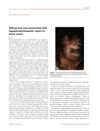 2 citations
,
February 2014 in “Journal of the European Academy of Dermatology and Venereology”
2 citations
,
February 2014 in “Journal of the European Academy of Dermatology and Venereology” High levels of prolactin in the blood can be linked to widespread hair loss.
26 citations
,
January 1992 in “Carcinogenesis” TPA strongly increases ODC activity in certain skin cells, potentially aiding tumor growth.
3 citations
,
February 2013 in “Actas dermo-sifiliográficas/Actas dermo-sifiliográficas” A 6-year-old boy developed excessive hair growth after taking diazoxide for low blood sugar.
22 citations
,
April 2004 in “Journal of Neurochemistry” Acute stress increases Y1 receptor gene expression in certain brain areas, but repeated stress does not.
 November 2022 in “Journal of the Endocrine Society”
 Immunotherapy for cancer caused a patient to develop a condition affecting hormone production, requiring ongoing hormone replacement therapy.
 March 2002 in “Clin-Alert”
 In 2002, various drugs caused serious side effects, including vitamin B12 deficiency, heart issues, blindness, hypersexuality, allergic reactions, blood clotting problems, pupil dilation, capillary leak syndrome, muscle breakdown, hepatitis, skin reactions, and lupus.
 51 citations
,
July 2010 in “Trends in Endocrinology and Metabolism”
51 citations
,
July 2010 in “Trends in Endocrinology and Metabolism” Prolactin may play a significant role in skin and hair health and could be a target for treating skin and hair disorders.
 47 citations
,
March 2017 in “Clinical, cosmetic and investigational dermatology”
47 citations
,
March 2017 in “Clinical, cosmetic and investigational dermatology” Certain skin conditions may indicate or increase the risk of Parkinson's disease.
 47 citations
,
June 2011 in “Movement Disorders”
47 citations
,
June 2011 in “Movement Disorders” The LRRK2-G2019S mutation in Parkinson's disease has a lifetime penetrance of 25-35%, and finasteride may help reduce symptoms in adult male Tourette syndrome patients.
 47 citations
,
November 2002 in “Journal of Neurochemistry”
47 citations
,
November 2002 in “Journal of Neurochemistry” Progesterone boosts alcohol's effect on brain, finasteride counters it.
 46 citations
,
May 2011 in “Movement Disorders”
46 citations
,
May 2011 in “Movement Disorders” Finasteride reduces Tourette syndrome symptoms, but results may be limited due to potential biases.
 39 citations
,
May 2011 in “Movement Disorders”
39 citations
,
May 2011 in “Movement Disorders” Finasteride may help reduce symptoms in male Tourette syndrome patients.
 37 citations
,
March 2010 in “British Journal of Dermatology”
37 citations
,
March 2010 in “British Journal of Dermatology” Oestrogen and thyrotropin-releasing hormone affect prolactin and its receptor in human skin and hair, suggesting new treatment options for related conditions.
 28 citations
,
July 2022 in “Endocrine”
28 citations
,
July 2022 in “Endocrine” Low prolactin in young women may increase heart and metabolism risks.
 24 citations
,
May 2015 in “Schizophrenia Research”
24 citations
,
May 2015 in “Schizophrenia Research” A drug improved schizophrenia-like symptoms in stressed rats by changing brain steroid levels.
 17 citations
,
May 2011 in “Movement Disorders”
17 citations
,
May 2011 in “Movement Disorders” Finasteride significantly reduced tics and obsessive-compulsive symptoms in patients with Tourette syndrome.
 13 citations
,
October 2010 in “Seizure”
13 citations
,
October 2010 in “Seizure” Extended-release valproate effectively reduced seizures and improved quality of life in epilepsy patients over 6 months, with some side effects.
 12 citations
,
May 2012 in “Endocrinology and metabolism/American journal of physiology: endocrinology and metabolism”
12 citations
,
May 2012 in “Endocrinology and metabolism/American journal of physiology: endocrinology and metabolism” Human scalp hair follicles can be used to study how prolactin affects hair growth and cell death.
 10 citations
,
June 2011 in “Movement Disorders”
10 citations
,
June 2011 in “Movement Disorders” THAP1 gene changes do not affect DYT1 dystonia; finasteride may help reduce tics and OCD in Tourette syndrome.
 8 citations
,
July 2018 in “Current Sexual Health Reports”
8 citations
,
July 2018 in “Current Sexual Health Reports” Finasteride can cause lasting sexual dysfunction, depression, and other side effects, needing more research for treatment.
 6 citations
,
July 2018 in “Scientific Reports”
6 citations
,
July 2018 in “Scientific Reports” Methamphetamine affects gene expression in rat whisker follicles, with key genes linked to addiction.
 5 citations
,
May 2011 in “Movement Disorders”
5 citations
,
May 2011 in “Movement Disorders” Finasteride significantly reduced tics and obsessive-compulsive symptoms in Tourette syndrome patients.