232 citations
,
January 2002 in “Mechanisms of development” Different enzymes are active in different parts of developing mouse organs.
 106 citations
,
April 2013 in “Dermatologic Surgery”
106 citations
,
April 2013 in “Dermatologic Surgery” Low-level light therapy safely improves hair growth and thickness for androgenetic alopecia.
 April 2023 in “The journal of investigative dermatology/Journal of investigative dermatology”
 Folliculotropic mycosis fungoides has unique molecular features and cell interactions that could guide targeted therapy.
 January 2025 in “BMC Genomics”
 Long non-coding RNAs help regulate wool fineness in Gansu alpine fine-wool sheep.
 September 2023 in “Medicina Estética Revista Científica de la Sociedad Española de Medicina Estética (SEME)”
 The FDA approved Litfulo® for treating severe alopecia areata in people aged 12 and older.
 July 2022 in “The journal of investigative dermatology/Journal of investigative dermatology”
 Tet2 and Tet3 enzymes are essential for controlling hair growth by affecting DNA demethylation and gene expression in mice.
A new genetic mutation was found causing hair and eye issues in a boy.
6 citations
,
December 2021 in “Journal of Clinical Medicine” LiPADI is a useful tool for monitoring the severity and treatment of lichen planus.
 April 2019 in “Journal of Investigative Dermatology”
 Non-coding RNA boosts retinoic acid production and signaling, aiding regeneration.
 December 2025 in “Meditsinskiy sovet = Medical Council”
 Early diagnosis and multidisciplinary care are crucial for managing CNOT3 syndrome.
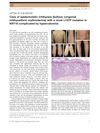 October 2011 in “Journal of dermatology”
 A man with a rare skin condition and a new gene mutation developed high calcium levels due to his treatment.
16 citations
,
February 2005 in “British journal of dermatology/British journal of dermatology, Supplement” Lack of Vitamin D receptor changes skin structure and increases certain immune cells in the skin.
 15 citations
,
May 2017 in “Lasers in Medical Science”
15 citations
,
May 2017 in “Lasers in Medical Science” Low-level laser treatment helps mice grow hair by increasing certain protein levels linked to hair growth.
68 citations
,
August 2009 in “American Journal of Medical Genetics Part A” A new classification for trichothiodystrophy helps identify genetic causes and potential treatments.
 1 citations
,
June 2022 in “JCRPE”
1 citations
,
June 2022 in “JCRPE” Metreleptin treatment significantly improved metabolic health in a boy with congenital generalized lipodystrophy.
 February 2026 in “Indian Journal of Dermatology”
 Upadacitinib may effectively treat twenty-nail dystrophy without causing pain.

MLO proteins are crucial for root hair growth by regulating calcium and ROS levels.
2 citations
,
October 2016 in “OPAL (Open@LaTrobe) (La Trobe University)” The Swedish neonatal screening program effectively detects PKU, galactosaemia, and biotinidase deficiency with low false positives.
 September 2013 in “Metal Powder Report”
 Dynamet Technology won an award for its advanced titanium technology.
122 citations
,
June 1998 in “PubMed” Neurotrophins regulate nerve growth by balancing promotion and suppression.
 1 citations
,
July 2025 in “Scientific Reports”
1 citations
,
July 2025 in “Scientific Reports” Diagonal earlobe crease and lipoprotein(a) together help diagnose coronary heart disease.
 9 citations
,
October 2022 in “Nature Communications”
9 citations
,
October 2022 in “Nature Communications” The DiLiCre mouse model is an effective tool for precise genome editing using light.
 April 2015 in “Plastic and Reconstructive Surgery”
 Activating TLR3 helps improve skin and hair follicle regeneration after wounds.
 61 citations
,
March 2009 in “The Journal of the American Board of Family Medicine”
61 citations
,
March 2009 in “The Journal of the American Board of Family Medicine” Early diagnosis and treatment of discoid lupus erythematosus improve outcomes.
November 2019 in “Harper's Textbook of Pediatric Dermatology” Netherton syndrome is a genetic skin disorder causing severe skin issues and requires careful treatment to protect the skin barrier.
 6 citations
,
November 2018 in “Photodiagnosis and Photodynamic Therapy”
6 citations
,
November 2018 in “Photodiagnosis and Photodynamic Therapy” A wearable cap-like device using light therapy reduced scalp skin lesions by 71% and was painless.
June 2026 in “Strathprints: The University of Strathclyde institutional repository (University of Strathclyde)” Topical IKKα inhibitors may help prevent CCS tumours.
3 citations
,
December 2024 in “Journal of Animal Science” LncRNA MSTRG.14227.1 hinders hair follicle development in cashmere goats, affecting cashmere quality.
 November 2024 in “Skin Appendage Disorders”
 Telogen effluvium most affects quality of life in alopecia patients.
 December 2023 in “International journal of high dilution research”
 Melatonin and Lissotriton improved hair quality and increased activity in mice.