9 citations
,
November 2024 in “Journal of Wound Management Official journal of the European Wound Management Association” Cold Plasma shows promise for healing wounds by killing bacteria and helping tissue grow.
5 citations
,
May 2024 in “Molecules” Glycyrrhetinic acid from licorice may help treat acne by reducing inflammation and oil production.
5 citations
,
July 2023 in “Journal of Autonomous Intelligence” Artificial neural networks can accurately diagnose Alopecia Areata.
4 citations
,
January 2023 in “Journal of Clinical Investigation” Specific mutations in a receptor cause facial abnormalities and hair loss.
2 citations
,
September 2024 in “Diagnostics” A new method accurately measures cell changes in breast cancer.
July 2026 in “Advanced Science” A new adhesive coating from scallop protein boosts hair growth better than minoxidil.
February 2026 in “Advanced Sensor Research” Advanced technologies can improve understanding and monitoring of skin-brain interactions.
January 2026 in “Open Science Framework” AI in alopecia research needs better tools for predicting treatment outcomes and ensuring fairness.
November 2025 in “Agriculture” Machine learning can effectively identify genes to improve wool quality in sheep.
 March 2024 in “EMBO molecular medicine”
 Antiviral drugs, especially daclatasvir, may be a new treatment for a rare skin disease, improving survival and reducing symptoms in mice.
26 citations
,
May 2024 in “Molecular Neurodegeneration” H1 increases risk for neurodegenerative diseases, while H2 offers protection but is linked to other disorders.
9 citations
,
January 2014 in “Molecular Genetics and Metabolism Reports” The rhg mutation in mice affects the Oat gene, causing hair growth issues and other symptoms.
4 citations
,
September 2024 in “Development” Researchers converted human embryonic stem cells into trophoblast stem cells using specific transcription factors.
December 2025 in “FEBS Open Bio” Long-term skin biopsy cultures can produce many fibroblasts that remain functional and can be reprogrammed.
November 2025 in “Clinical and Translational Medicine” DNAJB9 cfRNA could help diagnose and treat female hair loss.
 February 2025 in “Journal of Investigative Dermatology”
 The ZIP13 variant is linked to abnormal hair quality.
 November 2023 in “Scientific Reports”
 A gene mutation in Lama3 is linked to a common type of hair loss.
 November 2023 in “Advanced Science”
 A specific hair protein variant increases the spread of breast cancer and is linked to worse survival rates.
110 citations
,
February 2024 in “Journal of Chemical Information and Modeling” PandaOmics uses AI to find new disease treatment targets and biomarkers.
 40 citations
,
June 2013 in “Scientific Reports”
40 citations
,
June 2013 in “Scientific Reports” A gene variant in KRT71 causes the curly fur in Selkirk Rex cats.
 February 2011 in “Annales de dermatologie et de vénéréologie”
 Tofacitinib shows promise for treating severe alopecia areata with good safety and effectiveness.
A machine-learning test using hair can help detect autism early in infants.
 39 citations
,
December 2018 in “Methods in molecular biology”
39 citations
,
December 2018 in “Methods in molecular biology” The document concludes that computational methods using networks and various data can improve the process of finding new uses for existing drugs.
 11 citations
,
September 2012 in “Journal of obstetrics and gynaecology Canada”
11 citations
,
September 2012 in “Journal of obstetrics and gynaecology Canada” Testosterone therapy seems safe for short-term use in postmenopausal women with low sexual desire, but more research on long-term effects is needed.
 6 citations
,
February 2025 in “Scientific Reports”
6 citations
,
February 2025 in “Scientific Reports” MEGA PROTAC improves prediction and ranking of protein complexes better than existing methods.
 2 citations
,
January 2019 in “Medizinische Genetik”
2 citations
,
January 2019 in “Medizinische Genetik” The document reports findings on genetic research, including ethical concerns about genome editing, improved diagnosis of mitochondrial mutations, solving inherited eye diseases, confirming gene roles in epilepsy, linking a gene to aneurysms, and identifying genes associated with age-related macular degeneration.
 11 citations
,
August 2024 in “Nature Communications”
11 citations
,
August 2024 in “Nature Communications” Quiescent cells have increased mitochondrial activity and ECM gene expression, but reduced glycolysis.
 10 citations
,
March 2019 in “Human Genetics”
10 citations
,
March 2019 in “Human Genetics” A genetic mutation in the SGK3 gene causes hairlessness in Scottish Deerhounds and may relate to human hair loss.
 9 citations
,
January 2017 in “Annals of Dermatology”
9 citations
,
January 2017 in “Annals of Dermatology” The study found genetic differences related to hair development that may explain hair loss in a patient with Trichorhinophalangeal syndrome type I.
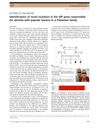 5 citations
,
September 2013 in “The Journal of Dermatology”
5 citations
,
September 2013 in “The Journal of Dermatology” Researchers found a new mutation in the HR gene causing hair loss and skin bumps in a Pakistani family.