 3 citations
,
January 2019 in “Journal of Dermatology”
3 citations
,
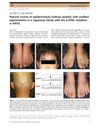
January 2019 in “Journal of Dermatology” The p.P25L mutation in the KRT5 gene causes a rare skin condition that worsens over time and may lead to hair loss starting in young adulthood.
August 2021 in “Journal of Investigative Dermatology” Adjusting polyamine levels could help treat skin disorders like psoriasis and skin cancer.
6 citations
,
October 2003 in “Journal of applied polymer science” A new method using poly(ethylene imine) improves hair dyeing at lower temperatures with better color retention.
November 2025 in “Journal of Investigative Dermatology” Tanning ability is linked to specific DNA changes in skin genes.
August 1989 in “Proceedings ... annual meeting, Electron Microscopy Society of America/Proceedings, annual meeting, Electron Microscopy Society of America” The research provided a detailed view of the non-keratinous parts of human hair fibers.
21 citations
,
November 1969 in “Journal of Investigative Dermatology” A new staining method clearly shows nerves around eyebrow hair follicles.
11 citations
,
January 2010 in “Current problems in dermatology” Ichthyoses are genetic skin disorders that affect the skin's barrier function.
20 citations
,
October 1995 in “Biochimica et Biophysica Acta (BBA) - Gene Structure and Expression” hHb1, hHb3, and hHb6 mRNAs start expressing at the same time in hair follicles.
277 citations
,
October 1982 in “The Journal of Cell Biology” Basal-cell epitheliomas and the pilosebaceous tract share a unique keratin, distinguishing them from other skin areas.
 7 citations
,
October 2018 in “BMC genomics”
7 citations
,
October 2018 in “BMC genomics” Key genes can rewire networks, changing skin appendage types.
 November 2022 in “The journal of investigative dermatology/Journal of investigative dermatology”
 The study suggests a link between varicella-zoster virus and segmental vitiligo, with evidence of the virus disrupting skin pigment cells.
48 citations
,
March 2007 in “The journal of investigative dermatology/Journal of investigative dermatology” Retinoic acid production and signaling in hair follicles are regulated by location and timing, affecting hair growth and cycling.
2 citations
,
June 2013 in “In Vitro Cellular & Developmental Biology - Animal” Melanocytes from human fetal hair follicles were successfully cultured, showing potential for hair disease research and clinical use.
 January 2024 in “International Journal of Herbal Medicine”
 Melanin is important for hair color, health, and UV protection.
3 citations
,
December 1967 in “Australasian Journal of Dermatology” Becker's Melanosis and Hypertrichosis mainly affects young males, causing brown skin patches and extra hair on one side of the upper body.
January 2020 in “Archivio Istituzionale della Ricerca (Universita Degli Studi Di Milano)” Polycomb Repressive Complex 1 is crucial for keeping stem cells stable and maintaining healthy adult tissues.
86 citations
,
May 2002 in “Journal of Investigative Dermatology” A new keratin, hK6irs1, is found in all layers of the hair follicle's inner root sheath.
7 citations
,
November 2016 in “Oncotarget” UV exposure reduces Lgr6+ stem cells in mouse skin and they don't significantly contribute to skin cancer development.
83 citations
,
February 1991 in “Development” Fos protein is crucial for cell transition to cornification in keratinized tissues.
 April 2024 in “The Indonesian Biomedical Journal”
 Melanocyte stem cells from non-affected skin in vitiligo patients can become functional melanocytes for potential therapy.
 7 citations
,
January 2023 in “Frontiers in cell and developmental biology”
7 citations
,
January 2023 in “Frontiers in cell and developmental biology” Celsr1 is crucial for skin cell alignment, while Celsr2 has little effect on this process.
33 citations
,
March 2015 in “Experimental Dermatology” LHX2 and SOX9 identify unique hair follicle cell groups, crucial for hair maintenance.
September 2017 in “The journal of investigative dermatology/Journal of investigative dermatology” Different types of human skin cells respond uniquely to various colors and doses of light, which could lead to specialized light treatments for skin conditions.
127 citations
,
November 2010 in “Pigment cell & melanoma research” We need more research on human hair follicle pigmentation, not just mouse models.
 April 2023 in “The journal of investigative dermatology/Journal of investigative dermatology”
 The protein p21 is more abundant in normal skin cells than in melanoma cells and may help protect against melanoma, with UVB light affecting its levels.
 2 citations
,
August 2012 in “Cell Stem Cell”
2 citations
,
August 2012 in “Cell Stem Cell” The study showed that some hair follicle stem cells wake up to grow hair while others stay asleep, and that the environment around them is important for hair growth.
3 citations
,
November 2022 in “Frontiers in Oncology” Melanin may help melanoma cells grow by aiding their metabolism.
19 citations
,
July 1997 in “British Journal of Dermatology” LHTric-1 is a specific antibody useful for studying hair and nail formation.
55 citations
,
January 2004 in “The International Journal of Developmental Biology” Corneal cells can transform into hair-producing skin cells when exposed to certain signals.
 8 citations
,
January 2011 in “Experimental and Therapeutic Medicine”
8 citations
,
January 2011 in “Experimental and Therapeutic Medicine” Stromal cells in melanoma promote tumor growth and spread.