 14 citations
,
June 2021 in “British journal of dermatology/British journal of dermatology, Supplement”
14 citations
,
June 2021 in “British journal of dermatology/British journal of dermatology, Supplement” Experts agreed on guidelines to improve research on Frontal Fibrosing Alopecia.
10 citations
,
October 2009 in “Photomedicine and laser surgery” IPL treatment can significantly reduce hair in faun tail but may need local anesthesia.
November 2020 in “Acta Medica Bulgarica/Acta medica Bulgarica” The document concludes that treatment improved skin lesions but not scalp hair loss in two patients with Graham-Little-Piccardi-Lassueur syndrome.
66 citations
,
June 2004 in “Development” FGF signaling is crucial for starting feather development in chicken embryos.
 March 2024 in “Cytologia”
 LncRNA MTC boosts growth of goat skin cells, improving cashmere quality.
 8 citations
,
June 2022 in “Scientific Reports”
8 citations
,
June 2022 in “Scientific Reports” LGR5 is a common marker of hair follicle stem cells in different animals and is important for hair growth and regeneration.
January 2026 in “Preprints.org” Four new FGF5 gene variants cause long hair in dogs.
9 citations
,
January 2023 in “Journal of Clinical Medicine” The FFA-QLI is a reliable tool for assessing quality of life in women with severe Frontal Fibrosing Alopecia.
 May 2026 in “AAPS PharmSciTech”
 PEGylated flavonoid Aspasomes improve brain protection and memory in stress-related disorders.
 September 2006 in “Plastic and Reconstructive Surgery”
 The SGAP flap effectively treats large sacral pressure sores with good results and minimal complications.
January 2022 in “SSRN Electronic Journal” LncRNA RP11-818024.3 helps hair growth and recovery in hair loss by boosting cell survival and reducing cell death.
113 citations
,
June 2010 in “Biological Chemistry” Cathepsin L deficiency causes large, abnormal cell structures and health issues in mice.
91 citations
,
May 2023 in “Journal of Cutaneous Medicine and Surgery” Alopecia Areata affects 2% globally, with treatments like essential oils, garlic, and JAK inhibitors showing promise, but more research is needed.
27 citations
,
January 2016 in “Cellular Physiology and Biochemistry” Bidens pilosa L. extract effectively treats androgen deficiency dry eye in rats.
21 citations
,
June 2011 in “Investigative Ophthalmology & Visual Science” Hair follicles could help develop eye treatments by studying immune responses.
4 citations
,
December 2016 in “Blood” A new gene mutation may cause cyclic thrombocytopenia by affecting platelet production.
June 2015 in “Han'gug eung'yong saengmyeong hwa haghoeji/Journal of the Korean Society for Applied Biological Chemistry” Some synthesized peptides improved cell growth better than thymosin β4, VEGF, and minoxidil.
 May 2026 in “Scientific Reports”
 Overexpression of LRIG3 in skin causes hair loss.
January 2012 in “Chinese Clinical Oncology” Disodium folinate can safely and effectively replace calcium folinate in colorectal cancer treatment.
 11 citations
,
November 2001 in “Journal of Chromatography B: Biomedical Sciences and Applications”
11 citations
,
November 2001 in “Journal of Chromatography B: Biomedical Sciences and Applications” Finasteride and analogues separated using LC-MS-MS technique.
 January 2025 in “Biomedicines”
 High testosterone levels can harm fertility by disrupting the LIF signaling pathway in the uterus.
 April 2024 in “Skin research and technology”
 VLDL could be an early warning sign for male pattern baldness.
 106 citations
,
October 2016 in “Cell Stem Cell”
106 citations
,
October 2016 in “Cell Stem Cell” PDGFA/AKT signaling is important for the growth and maintenance of certain skin fat cells.
15 citations
,
October 2012 in “Journal of child neurology” The same genetic mutation in Sjögren-Larsson syndrome can lead to different levels of severity, suggesting other factors influence the symptoms.
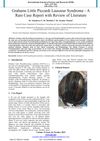 October 2023 in “International Journal of Science and Research (IJSR)”
 Early diagnosis of GLPLS is crucial to prevent complications, but scarring alopecia is irreversible.
 11 citations
,
January 2020 in “Skin appendage disorders”
11 citations
,
January 2020 in “Skin appendage disorders” Low-level laser therapy safely and effectively improves hair growth and coverage for male and female pattern hair loss.
3 citations
,
March 2024 in “Journal of the American Academy of Dermatology” Low-dose naltrexone helps improve symptoms and stabilize frontal fibrosing alopecia and lichen planopilaris.
20 citations
,
February 2010 in “Journal of Investigative Dermatology” Slug (Snai2) helps regulate hair growth timing in mice.
IVL-DrugFluidic® can mass-produce high-quality, long-acting injectable drug microspheres, improving patient compliance and reducing side effects.