 1 citations
,
August 2016 in “Journal of Buffalo Science”
1 citations
,
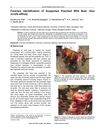
August 2016 in “Journal of Buffalo Science” The animal was likely a wild boar.
4 citations
,
July 2025 in “Annals of the New York Academy of Sciences” Combining skeletal and molecular anthropology improves identifying human remains.
 7 citations
,
January 1990 in “Eisei kagaku”
7 citations
,
January 1990 in “Eisei kagaku” Chemical analysis of hair products on human hair can help identify specific brands and link suspects to victims.
August 2024 in “Clinical & experimental pathology” Forensic DNA phenotyping can now predict more physical traits and ancestry from DNA, but further improvements are needed.
17 citations
,
February 2022 in “Microscopy Research and Technique” Scanning electron microscopy and elemental analysis can help identify animal species by their hair patterns and elements.
 April 2025 in “INTERANTIONAL JOURNAL OF SCIENTIFIC RESEARCH IN ENGINEERING AND MANAGEMENT”
 Hair histology helps identify animal species in forensic investigations.
 May 2023 in “GSC biological and pharmaceutical sciences”
 Forensic DNA phenotyping is becoming useful for predicting physical traits in criminal investigations but is limited by ethical concerns and incomplete genetic understanding.
12 citations
,
January 2010 in “The anthropologist/Anthropologist” Human hair is valuable for identifying people and detecting drug use.
30 citations
,
May 2020 in “Forensic Science International Genetics” The method improved hair analysis for better forensic identification.
14 citations
,
September 2017 in “Proteomics. Clinical applications” Hair protein analysis could improve medical testing and understanding of hair characteristics.
8 citations
,
May 2025 in “Biomolecules” Forensic genetics can now predict physical traits and lifestyle habits, with future advancements expected from new technologies.
4 citations
,
June 1990 in “PubMed” Hair protein differences help identify species and individuals in forensic science.
December 2025 in “Journal of Forensic Sciences” Bleaching hair doesn't affect the accuracy of dye identification using SERS.
 January 2023 in “Türkiye klinikleri adli tıp ve adli bilimler dergisi”
 DNA markers can help predict male pattern baldness, useful in criminal and missing person cases.
 1 citations
,
January 2020 in “Elsevier eBooks”
1 citations
,
January 2020 in “Elsevier eBooks” Forensic medicine is crucial for justice and needs continuous innovation and technology integration.
May 2023 in “Zenodo (CERN European Organization for Nuclear Research)” Forensic DNA phenotyping can predict physical traits from DNA but faces challenges in knowledge and ethics.
 2 citations
,
January 2013
2 citations
,
January 2013 Hair can help solve crimes by revealing personal and chemical information.
 10 citations
,
May 2020 in “Journal of proteome research”
10 citations
,
May 2020 in “Journal of proteome research” Explosions don't stop hair proteins from being used to identify people.
8 citations
,
October 2011 in “Anthropologischer Anzeiger” Pubic hair is thicker than axillary and scalp hair, useful for forensic identification.
 December 2024 in “Turkish Journal of Forensic Medicine”
 Next-Generation Sequencing improves forensic analysis by providing detailed genetic information quickly.
1 citations
,
April 2009 in “Wiley Encyclopedia of Forensic Science” Microscopic hair analysis helps identify species and sometimes individuals in forensic science.
 1 citations
,
June 1938 in “New England journal of medicine/The New England journal of medicine”
1 citations
,
June 1938 in “New England journal of medicine/The New England journal of medicine” Hair analysis can offer clues about a person, but individual differences limit making precise identifications.
 June 2025 in “Rapid Communications in Mass Spectrometry”
 The new method improves protein extraction and analysis in hair, aiding biomedical and forensic work.
1 citations
,
August 1985 in “Proceedings annual meeting Electron Microscopy Society of America” SEM/EDX can analyze hair elements but struggles with trace elements, limiting its forensic use.
The research found that people's hair proteins vary, especially by ethnicity and body part, which could help identify individuals in forensic science.
14 citations
,
September 2019 in “Forensic Science International Genetics” Hair keratin proteins can be reliably identified in hair as short as 0.12 cm, with 0.5 to 2 cm being the best length for analysis.
November 2001 in “PubMed” Perming, combing, and stretching damage hair by reducing keratin.
Keratin peptide signatures in hair may help identify gender and ethnicity.
Keratin peptide signatures in hair may help identify gender and ethnicity.
December 2025 in “Rapid Communications in Mass Spectrometry” Pepsin digestion improves accuracy in analyzing proteins in human hair.