36 citations
,
November 2005 in “Forensic Science International” BioPlex-11 improves DNA profiling from telogen hair roots in forensic work.
January 2010 in “Elsevier eBooks” Hair color is important in many fields and is measured for various purposes.
 7 citations
,
February 2021 in “Legal Medicine”
7 citations
,
February 2021 in “Legal Medicine” Hair analysis showed very high metformin levels in two fatal overdose cases, suggesting it's useful in forensics but sweat may affect results.
18 citations
,
April 2018 in “Biotechniques/BioTechniques” A new method was developed to extract and analyze proteins from very short human hairs.
 60 citations
,
December 2005 in “Biomedical Papers”
60 citations
,
December 2005 in “Biomedical Papers” Hair analysis can detect drug use but requires careful interpretation due to its complexity.
94 citations
,
April 2018 in “Nature Genetics” New genetic locations explain much of hair color variation in Europeans.
1 citations
,
January 2019 in “Studia Biologica” Extracted keratin from wool and hair can be used in medicine and bioengineering.
June 2025 in “Albus Scientia” MC1R gene variations affect skin, hair color, UV sensitivity, and melanoma risk.
January 2016 in “Belarusian State Pedagogical University repository (Belarusian State Pedagogical University)” A 6-group geometric classification of human scalp hair is more reliable and objective for testing than an 8-group system.
Human hair color is determined by melanin types and genetic factors.
69 citations
,
April 2005 in “Forensic Science International” Degraded hair shafts resist contamination and can be easily cleaned.
research Hair
1 citations
,
April 2023 in “Elsevier eBooks” Hair analysis can detect drug use but is costly and interpretation is complex.
March 2026 in “Journal of the mechanical behavior of biomedical materials/Journal of mechanical behavior of biomedical materials” Bleaching and UV exposure significantly damage hair.
89 citations
,
April 2023 in “Forensic Science International Genetics” Forensic DNA Phenotyping can now better predict appearance, ancestry, and age from DNA, but more research is needed for precise police use.
 9 citations
,
February 2018 in “Forensic Science International”
9 citations
,
February 2018 in “Forensic Science International” The study could not confirm if Victor Vinnetou was Mbuyisa Makhubu and suggested more evidence, like DNA tests, is needed.
 5 citations
,
September 2016 in “Security science and technology”
5 citations
,
September 2016 in “Security science and technology” DNA can predict physical traits like eye and hair color accurately, especially in Europeans, but predicting other traits and in diverse populations needs more research.
4 citations
,
March 2024 in “Forensic Sciences Research” Forensic DNA phenotyping faces challenges like inconsistent terms and limited genetic knowledge.
 April 2026 in “Science & Justice”
 Hair analysis can confirm drug use but can't accurately measure how much was taken.
 March 2026 in “Egyptian Journal of Forensic Sciences”
 Unified regulations and ethical guidelines are needed for fair use of forensic DNA phenotyping.
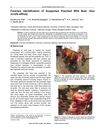 1 citations
,
August 2016 in “Journal of Buffalo Science”
1 citations
,
August 2016 in “Journal of Buffalo Science” The animal was likely a wild boar.
4 citations
,
July 2025 in “Annals of the New York Academy of Sciences” Combining skeletal and molecular anthropology improves identifying human remains.
November 2025 in “Wiley Interdisciplinary Reviews Forensic Science” Hair testing is a useful method for detecting past substance use and recent advancements improve its accuracy and reliability.
October 2020 in “Indian Journal of Forensic Medicine & Toxicology” Most people in Raichur have loop fingerprint patterns.
30 citations
,
May 2020 in “Forensic Science International Genetics” The method improved hair analysis for better forensic identification.
January 2025 in “Science World Journal” Male and female scalp hair differ in size, density, length, curliness, pigmentation, and cuticle preservation.
19 citations
,
August 2022 in “Forensic Science International Genetics” The model accurately predicts age from saliva and buccal cells for forensic use.
 6 citations
,
November 2022 in “Forensic Science Medicine and Pathology”
6 citations
,
November 2022 in “Forensic Science Medicine and Pathology” Genetic markers can help predict ear shapes for forensic use.
3 citations
,
February 2024 in “Forensic Sciences Research” Mitochondrial DNA from nails and hair can be effectively analyzed for forensic use.
2 citations
,
October 2018 in “Journal of Mind and Medical Sciences” A new method effectively measures nicotine and cotinine in blood and urine for forensic analysis.
 7 citations
,
January 1990 in “Eisei kagaku”
7 citations
,
January 1990 in “Eisei kagaku” Chemical analysis of hair products on human hair can help identify specific brands and link suspects to victims.