 8 citations
,
January 2003 in “Plastic and Reconstructive Surgery”
8 citations
,
January 2003 in “Plastic and Reconstructive Surgery” Hair transplants using follicular unit grafting can significantly improve appearance for men with advanced hair loss.
 8 citations
,
January 1998 in “Journal of Cutaneous Medicine and Surgery”
8 citations
,
January 1998 in “Journal of Cutaneous Medicine and Surgery” Hair transplantation is effective for baldness, with new methods improving results, but staying updated is crucial for patient outcomes.
 8 citations
,
January 2003 in “Plastic and Reconstructive Surgery”
8 citations
,
January 2003 in “Plastic and Reconstructive Surgery” Hair transplants using follicular unit grafting and a strategic design can give great results even for men with severe hair loss.
 5 citations
,
August 2013 in “Facial plastic surgery clinics of North America”
5 citations
,
August 2013 in “Facial plastic surgery clinics of North America” Use a frontal forelock pattern to manage advanced hair loss.
 3 citations
,
July 1997 in “Current problems in dermatology”
3 citations
,
July 1997 in “Current problems in dermatology” Hair restoration surgery has evolved over time, with a focus on natural-looking results and managing patient expectations, while also considering potential complications and the lifelong progression of male pattern baldness.
 1 citations
,
September 1997 in “PubMed”
1 citations
,
September 1997 in “PubMed” The uniform density approach in hair restoration is less noticeable in situations like wind or exercise.
 September 1997 in “Dermatologic Surgery”
 The article concludes that uniform density hair restoration is generally preferred for its natural look, but the best approach depends on the individual's characteristics and preferences.
 3 citations
,
February 1996 in “Dermatologic Surgery”
3 citations
,
February 1996 in “Dermatologic Surgery” Walter P. Unger suggests using advanced hair transplant techniques for broader coverage, as they provide natural results and use donor tissue efficiently, while also recommending personalized planning due to the unpredictable progression of baldness.
 8 citations
,
January 2007 in “International Society of Hair Restoration Surgery”
8 citations
,
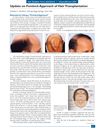
January 2007 in “International Society of Hair Restoration Surgery” The forelock approach in hair transplants improves natural appearance by focusing hair density in one area.
 53 citations
,
May 2010 in “Dermatologic Surgery”
53 citations
,
May 2010 in “Dermatologic Surgery” Hair transplantation may not work for Frontal Fibrosing Alopecia as transplanted hair was lost when the disease came back.
 November 2009 in “Cambridge University Press eBooks”
 The document's conclusion cannot be provided because the content is not accessible.
 8 citations
,
April 2001 in “Dermatologic Surgery”
8 citations
,
April 2001 in “Dermatologic Surgery” Michael L. Beehner proposed a standardized way to describe balding areas on the scalp to help hair restoration experts communicate better.
 3 citations
,
December 2004 in “Aesthetic Surgery Journal”
3 citations
,
December 2004 in “Aesthetic Surgery Journal” Hair restoration, especially at the hairline and frontal hair volume, can improve facial balance and attractiveness, with follicular unit transplantation being a successful method.
 1 citations
,
June 2001 in “International Journal of Cosmetic Surgery and Aesthetic Dermatology”
1 citations
,
June 2001 in “International Journal of Cosmetic Surgery and Aesthetic Dermatology” The Anchor Flap is an effective, quick treatment for severe baldness but requires skilled surgeons and careful patient selection.
 April 2001 in “Dermatologic Surgery”
 Michael L. Beehner proposed a standardized naming system for balding scalp areas to help hair restoration surgery.
 3 citations
,
March 1998 in “Aesthetic Surgery Journal”
3 citations
,
March 1998 in “Aesthetic Surgery Journal” Experts suggest various surgical methods for hair restoration, including scalp reduction, transplantation using minigrafts, and establishing a permanent frontal hairline with follicular units. The drug finasteride may also be used alongside these procedures.
 June 2026 in “Journal of Cutaneous and Aesthetic Surgery”
 Recipient site scalp necrosis in hair transplantation is linked to microvascular injury and regional vascular vulnerability, especially in the frontal and mid-scalp areas.
 5 citations
,
September 1998 in “Atlas of the oral and maxillofacial surgery clinics of North America”
5 citations
,
September 1998 in “Atlas of the oral and maxillofacial surgery clinics of North America” Hair transplantation and micrografting, used for baldness, involve moving hair follicles from hair-rich to bald areas, requiring careful procedure and post-care for success.
 25 citations
,
November 2008 in “Facial Plastic Surgery”
25 citations
,
November 2008 in “Facial Plastic Surgery” Dr. Michael Beehner recommends a personalized, careful approach to hairline design in hair replacement surgery for a natural look.
 January 2014 in “Revista Brasileira de Cirurgia Plástica”
 A new method using gentian violet and a protective spray can improve symmetry and reduce surgery time in hair restoration, but it's only effective for total hair loss, not diffuse hair loss or follow-up treatments.
 July 2008 in “Expert Review of Dermatology”
 Proper planning for hair transplants is crucial for natural results, with careful patient selection and strategic graft placement being key factors.
 4 citations
,
January 2007 in “Indian Journal of Dermatology”
4 citations
,
January 2007 in “Indian Journal of Dermatology” Body hair can be used as an extra source of donor hair in hair restoration surgery for people with severe hair loss.
 5 citations
,
September 2000 in “Dermatologic Surgery”
5 citations
,
September 2000 in “Dermatologic Surgery” Lower hairlines using the rule of thirds can be used in hair transplants due to improved techniques.
 15 citations
,
January 1999 in “Archives of Facial Plastic Surgery”
15 citations
,
January 1999 in “Archives of Facial Plastic Surgery” Advancements in hair transplantation have resulted in more natural-looking hair and increased patient satisfaction.
 2 citations
,
April 1999 in “Dermatologic Clinics”
2 citations
,
April 1999 in “Dermatologic Clinics” The paper concludes that creating a natural-looking hairline in hair restoration is important for facial aesthetics and involves careful planning and realistic expectations.
 33 citations
,
January 1991 in “The Journal of Dermatologic Surgery and Oncology”
33 citations
,
January 1991 in “The Journal of Dermatologic Surgery and Oncology” Incisional slit grafting for hair transplantation gives natural-looking results and has a high success rate.
 3 citations
,
February 1997 in “Annals of Plastic Surgery”
3 citations
,
February 1997 in “Annals of Plastic Surgery” The document concludes that successful hair restoration surgery should consider facial proportions and balance, and requires surgical skill, artistic judgment, and realistic goals for a natural look.
 2 citations
,
June 2000 in “Journal of Oral and Maxillofacial Surgery”
2 citations
,
June 2000 in “Journal of Oral and Maxillofacial Surgery” Hair transplantation techniques have improved over time, leading to natural-looking results and high graft survival rates, making it a popular treatment for hair loss.
 January 2016 in “Georg Thieme Verlag eBooks”
 Hair transplantation in East Asians needs special techniques to ensure natural results and prevent complications due to their unique hair and scalp characteristics.
 August 1998 in “Dermatologic Surgery”
 Dr. George A. Farber recommends using follicular unit transplantation for hair restoration because it gives a more natural look and has fewer problems compared to the older miniflap technique.