 March 2025 in “Wound Repair and Regeneration”
 The hydrogel scaffold improved skin flap healing and reduced inflammation.
4 citations
,
November 2020 in “Acta Dermato Venereologica” Tofacitinib effectively improved severe skin symptoms in a patient with Hypohidrotic Ectodermal Dysplasia.
 October 2024 in “Journal of the Endocrine Society”
 Certain genetic variants impair enzyme activity, contributing to non-classic congenital adrenal hyperplasia.
 1 citations
,
September 2023 in “Clinical, cosmetic and investigational dermatology”
1 citations
,
September 2023 in “Clinical, cosmetic and investigational dermatology” Certain genetic variants linked to immune response increase the risk of alopecia areata in Taiwanese people.
 April 2023 in “Journal of Investigative Dermatology”
 Both laser treatments improved acne scars similarly, but the Nd:YAG laser was safer and less painful, while the Er:YAG laser left patients slightly more satisfied.
 April 2017 in “Journal of Investigative Dermatology”
 SIG-1451 could be a promising new treatment for atopic dermatitis.
 2 citations
,
September 2022
2 citations
,
September 2022 The PER3 rs772027021 SNP may cause mild skin pigmentation changes in a new subtype of dyschromatosis universalis hereditaria.
3 citations
,
January 2025 in “Animal Genetics” Variants on chromosome 10 affect hair thickness in Dazu black goats.
8 citations
,
April 2017 in “Journal of The Royal Society Interface” Giant axonal neuropathy changes the structure of keratin in human hair.
 1 citations
,
November 2008 in “Acta crystallographica”
1 citations
,
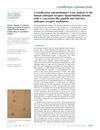
November 2008 in “Acta crystallographica” Scientists successfully created and analyzed the structure of a part of the human androgen receptor with specific modulators and a peptide to understand how it binds differently in various tissues.
September 2015 in “Photodiagnosis and Photodynamic Therapy”  August 2016 in “Journal of Investigative Dermatology”
  24 citations
,
July 2017 in “Structure”
24 citations
,
July 2017 in “Structure” FGF9 controls which receptors it binds to through a process where two FGF9 molecules join, and changes in FGF9 can lead to incorrect receptor activation.
Finding functions for unknown GPCRs is hard but key for making new drugs.
 6 citations
,
September 2023 in “Experimental physiology”
6 citations
,
September 2023 in “Experimental physiology” A special receptor in sensory nerve endings helps control how they respond to stretching.
A genetic mutation in the CDH3 gene causes hair loss and vision problems in a young Saudi girl.
September 2012 in “DOAJ (DOAJ: Directory of Open Access Journals)” D-004 shows moderate antidepressant effects but is less effective than Sertraline and Imipramine.
9 citations
,
October 2017 in “Frontiers in plant science” The peach gene CTG134 helps control the interaction between auxin and ethylene, which could lead to new agricultural chemicals.
 January 2023 in “Indian dermatology online journal”
 A child with ectodermal dysplasia-syndactyly syndrome has a new mutation in the NECTIN4 gene.
 97 citations
,
March 2002 in “Molecular and cellular biology”
97 citations
,
March 2002 in “Molecular and cellular biology” Mutant CDP/Cux protein causes hair defects and reduced male fertility in mice.
22 citations
,
April 2010 in “Journal of Cellular Biochemistry” Certain mutations in the hairless protein disrupt its ability to regulate the hair cycle.
September 2017 in “Journal of Investigative Dermatology” RCS-01 is safe and may help rejuvenate aging skin.
9 citations
,
June 2017 in “American journal of ophthalmology. Case reports” A new mutation in the CDH3 gene causes hair loss and vision problems in a young girl.
88 citations
,
August 2014 in “PLOS genetics” Syndecan-1 is essential for maintaining skin fat and preventing cold stress.
 12 citations
,
January 2016 in “Journal of Orofacial Orthopedics / Fortschritte der Kieferorthopädie”
12 citations
,
January 2016 in “Journal of Orofacial Orthopedics / Fortschritte der Kieferorthopädie” Researchers found a new mutation in the EDA gene that likely causes missing teeth and mild skin symptoms in one family.
4 citations
,
July 2019 in “Experimental Dermatology” 2-deoxy D-glucose does not help with hair regrowth in alopecia areata.

SNP rs2479106 in the DENND1A gene may increase PCOS risk in Saudi Arabian females.
January 2012 in “Zhongguo nongye Kexue” The technology can create transgenic cashmere goats with improved wool quality.
18 citations
,
January 2018 in “BMC dermatology” A new mutation in the PLEC gene causes a rare condition with skin blistering, muscle weakness, and hair loss.
July 2026 in “Journal of the American Academy of Dermatology” The lotion helps manage mild to moderate hair loss.