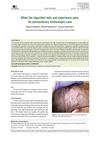
 January 2026 in “Forum Dermatologicum”
 Thorough hair examination is crucial for accurate diagnosis and treatment.
 April 2017 in “IOSR journal of dental and medical sciences”
 Netherton Syndrome is a non-treatable genetic disorder in children causing skin, hair, and allergy issues.
January 2025 in “International Journal of Trichology” Increased hair growth after a cast is temporary and harmless.
87 citations
,
August 1974 in “Journal of Investigative Dermatology”  30 citations
,
January 2021 in “Journal of Clinical Immunology”
30 citations
,
January 2021 in “Journal of Clinical Immunology” FOXN1 mutations can cause varying immune and physical issues, with severity influenced by gene activity and possibly other factors.
2 citations
,
June 2001 in “Medical Electron Microscopy” Trichilemmal cysts may form from hair follicle outer root sheath growth.
12 citations
,
January 2013 in “Indian dermatology online journal” Dermatopathia pigmentosa reticularis causes skin discoloration, hair loss, and nail problems.
4 citations
,
November 2018 in “Postgraduate Medical Journal” Trichoscopy is a useful, quick, and non-invasive way to diagnose tinea capitis.
 December 2022 in “Curēus”
 Genetic testing confirmed a young girl has Atrichia with Papular Lesions due to mutations in the hairless gene.
September 2025 in “Journal of the American Academy of Dermatology” 15 citations
,
October 1999 in “PubMed” Understanding genes and mutations can lead to new treatments for hair loss disorders.
 5 citations
,
May 2018 in “PloS one”
5 citations
,
May 2018 in “PloS one” Both classical and L-type atypical BSE from cattle can infect goats with different incubation times, and tests can distinguish between the two strains.
January 2003 in “Linchuang pifuke zazhi” A benign skin tumor was removed from a man's leg, and it didn't come back after 9 months.
 October 2022 in “Miscellaneous”
 A rare, non-cancerous ovarian tumor was successfully treated with surgery, improving the patient's symptoms.
 8 citations
,
May 2022 in “Orphanet Journal of Rare Diseases”
8 citations
,
May 2022 in “Orphanet Journal of Rare Diseases” The UD-PrOZA program successfully diagnosed 18% of adult patients with rare diseases, often using genetic testing.
23 citations
,
July 2003 in “Journal of Investigative Dermatology” Genetic testing for hairless gene mutations is crucial to correctly diagnose and treat atrichia with papular lesions.
2 citations
,
January 2017 in “International Journal of Trichology” Trichoscopy can reveal specific hair and scalp changes in linear morphea.
3 citations
,
May 2024 in “BMC Medical Genomics” A new ARID1B gene variation causes Coffin-Siris syndrome 1 and early high myopia in a Chinese family.
 5 citations
,
May 2011 in “European Journal of Medical Genetics”
5 citations
,
May 2011 in “European Journal of Medical Genetics” A genetic duplication on chromosome 5 was linked to a woman's unique combination of medical conditions.
 3 citations
,
September 2024 in “Frontiers in Bioscience-Scholar”
3 citations
,
September 2024 in “Frontiers in Bioscience-Scholar” Pantaneiro sheep have more genetic diversity than Texel sheep, with potential for future research in Brazilian farming.
 October 2024 in “Journal of the Endocrine Society”
 A rare genetic mutation causes resistance to vitamin D, leading to severe rickets and requiring high doses of calcium and vitamin D for treatment.
 July 2025 in “Clinical Dermatology Review”
 A rare family case of multiple benign hair follicle tumors was identified, highlighting the need to distinguish them from similar conditions.
19 citations
,
July 1997 in “British Journal of Dermatology” LHTric-1 is a specific antibody useful for studying hair and nail formation.
January 2026 in “Animal Genetics” A genetic variant in the GJB6 gene likely caused the Labrador's paw pad condition.
 November 2022 in “Journal of the Endocrine Society”
 A woman's masculine features were caused by a rare ovarian tumor that produced male hormones.
5 citations
,
May 2017 in “Journal of dermatological science” The combined treatment effectively managed severe skin issues in Olmsted syndrome.
 1 citations
,
June 2021 in “bioRxiv (Cold Spring Harbor Laboratory)”
1 citations
,
June 2021 in “bioRxiv (Cold Spring Harbor Laboratory)” GTL1 is needed to control root hair growth and prevent problems when there are too many nutrients.
7 citations
,
April 2019 in “Animal biotechnology” The POMP gene is active in various goat tissues and affects hair growth, with certain treatments influencing its expression.
210 citations
,
February 2008 in “Nature genetics” Mutations in the P2RY5 gene cause autosomal recessive woolly hair.
27 citations
,
June 2020 in “Genes” Lykoi cats' unique sparse hair is linked to specific genetic variants in the Hairless gene.