77 citations
,
April 1968 in “Development” Excess vitamin A can cause hair follicles to change into gland-like structures.
16 citations
,
November 1994 in “Developmental Biology” Retinoic acid causes gland formation instead of hair in mouse skin by altering epidermal and dermal interactions.
10 citations
,
August 1998 in “Journal of Investigative Dermatology”  February 2023 in “Mağallaẗ Tikrīt li-l-ʻulūm al-ṣirfaẗ/Tikrit journal of pure science”
 Horse skin has a layered epidermis, a dermis with hair follicles, sweat and sebaceous glands, and is supplied by small arteries.
 71 citations
,
February 2006 in “Clinics in Dermatology”
71 citations
,
February 2006 in “Clinics in Dermatology” Pregnancy causes skin changes like darkening, hair thickening, nail changes, and increased risk of skin growths, most of which usually resolve after birth.
132 citations
,
April 2005 in “Gastroenterology” A gluten-free diet significantly improves skin and health issues in people with dermatitis herpetiformis, a skin condition linked to celiac disease.
 265 citations
,
July 2012 in “Cell”
265 citations
,
July 2012 in “Cell” The study found that sweat glands contain different types of stem cells that help with healing and maintaining healthy skin.
 7 citations
,
December 2011 in “Elsevier eBooks”
7 citations
,
December 2011 in “Elsevier eBooks” The document concludes that early diagnosis and treatment are crucial for managing skin diseases in ferrets.
83 citations
,
May 2011 in “European Journal of Dermatology” Corneodesmosin is crucial for skin and hair health, and its dysfunction can cause skin and hair disorders.
 17 citations
,
June 2012 in “Journal of experimental zoology. Part B, Molecular and developmental evolution”
17 citations
,
June 2012 in “Journal of experimental zoology. Part B, Molecular and developmental evolution” Hair in mammals likely evolved from glandular structures, not scales.
 January 2026 in “Archive ouverte UNIGE (University of Geneva)”
 Skin-sparing techniques in gynecomastia surgery lead to good chest results and high patient satisfaction with less scarring.
 208 citations
,
July 2001 in “Journal of The American Academy of Dermatology”
208 citations
,
July 2001 in “Journal of The American Academy of Dermatology” Pregnancy can cause various skin changes and diseases, with PUPPP being the most common skin condition specific to pregnancy.
18 citations
,
October 1978 in “The journal of investigative dermatology/Journal of investigative dermatology” Excess vitamin A causes lasting gland changes in mouse hair follicles.
November 2025 in “Journal of Investigative Dermatology” Mesenchymal stiffness affects sweat gland cell development.
October 1940 in “Clinical and Experimental Optometry” Vitamin A deficiency can cause eye problems and other health issues.
18 citations
,
April 2002 in “Journal of cutaneous pathology” Tiny infundibular cysts are the main lesions in chloracne, not comedones.
 10 citations
,
July 2022 in “Dermatology and Therapy”
10 citations
,
July 2022 in “Dermatology and Therapy” Melasma's causes include genetics, sun exposure, hormones, and oxidative stress, and understanding these can help create better treatments.
 5 citations
,
January 2014 in “Journal of Cutaneous and Aesthetic Surgery”
5 citations
,
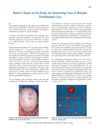
January 2014 in “Journal of Cutaneous and Aesthetic Surgery” A woman had 13 non-cancerous cysts on her scalp successfully removed in one surgery.
 1 citations
,
April 2017 in “Journal of Investigative Dermatology”
1 citations
,
April 2017 in “Journal of Investigative Dermatology” D-OCT shows increased blood vessel growth in response to tissue damage in Frontal Fibrosing Alopecia and is useful for diagnosis and monitoring.
 March 2026 in “Dermatopathology”
 A rare skin tumor with extra hair growth was found and safely removed from a 27-year-old woman.
 48 citations
,
May 1991 in “The journal of investigative dermatology/Journal of investigative dermatology”
48 citations
,
May 1991 in “The journal of investigative dermatology/Journal of investigative dermatology” Trichohyalin is also found in the outer layers of normal human skin.
 2 citations
,
April 2010 in “The Open Dermatology Journal”
2 citations
,
April 2010 in “The Open Dermatology Journal” Corneodesmosin is essential for skin and hair health, and its dysfunction can lead to skin and hair disorders.
61 citations
,
January 2011 in “PloS one” Notch signaling is essential for healthy skin and hair follicle maintenance.
March 2024 in “Veterinary sciences” Geriatric Julia Creek dunnarts often suffer from reproductive and skin diseases, impacting conservation efforts.
 141 citations
,
January 1984 in “Journal of The American Academy of Dermatology”
141 citations
,
January 1984 in “Journal of The American Academy of Dermatology” Pregnancy can cause skin darkening, varicose veins, more sweating, hair growth, hair loss after birth, nail changes, and gum inflammation.
 118 citations
,
January 2016 in “Current Topics in Developmental Biology”
118 citations
,
January 2016 in “Current Topics in Developmental Biology” The document concludes that while significant progress has been made in understanding skin biology and stem cells, more research is needed to fully understand their interactions with their environment.
 47 citations
,
May 2002 in “Journal of Cutaneous Medicine and Surgery”
47 citations
,
May 2002 in “Journal of Cutaneous Medicine and Surgery” Pregnancy can cause normal skin changes that usually go away after childbirth and don't need treatment.
 35 citations
,
December 2014 in “Clinical Obstetrics and Gynecology”
35 citations
,
December 2014 in “Clinical Obstetrics and Gynecology” Most skin changes during pregnancy go away after giving birth.
April 2024 in “UNESP Institutional Repository (São Paulo State University)” Alpaca skin has glands, hair follicles, and different collagen types.
 September 1999 in “The Journal of The British Menopause Society”
 The document concludes that skin aging in women can be caused by UV exposure and hormonal changes, and treatments like hormone replacement therapy and various skin therapies can help.