91 citations
,
December 2019 in “The EMBO Journal” NEDD4 and NEDD4L help control intestinal stem cells and prevent tumors by breaking down the LGR5 receptor.
April 2023 in “Journal of Investigative Dermatology” RNase L suppresses regeneration in mammals.
32 citations
,
August 1982 in “Journal of the American Academy of Dermatology” GLPLS and LPP are variants of lichen planus.
1 citations
,
August 2021 in “Journal of Investigative Dermatology” ASLAN004 was safe and well-tolerated, supporting further development for treating certain diseases.
14 citations
,
August 2015 in “Endocrinology” The antibody 005-C04 blocks prolactin receptors, causing reversible infertility, impaired lactation, and hair regrowth in female mice.
Lhx2 helps retinal cells respond to signals for eye development.
 April 2016 in “The journal of investigative dermatology/Journal of investigative dermatology”
 RPGRIP1L helps skin cells stick together by blocking PKCβII, which can prevent skin blistering like in pemphigus.
 57 citations
,
May 2014 in “Molecular Phylogenetics and Evolution”
57 citations
,
May 2014 in “Molecular Phylogenetics and Evolution” The research found how GPCR Class A Rhodopsin receptors are related and suggested possible substances they interact with.
 September 2017 in “The journal of investigative dermatology/Journal of investigative dermatology”
 Scarred skin in lichen planopilaris loses immune cells due to a decrease in a specific protein in skin cells.
 October 2023 in “International Journal of Science and Research (IJSR)”
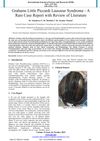
 Early diagnosis of GLPLS is crucial to prevent complications, but scarring alopecia is irreversible.
 February 2024 in “Experimental Dermatology”
 IGFBP-rP1 could be a new treatment for a common type of hair loss.
 7 citations
,
March 2011 in “Hormone and Metabolic Research”
7 citations
,
March 2011 in “Hormone and Metabolic Research” Certain gene variations might help protect against insulin resistance and glucose intolerance in people with Polycystic Ovary Syndrome.
 39 citations
,
March 2008 in “Journal of biological chemistry/The Journal of biological chemistry”
39 citations
,
March 2008 in “Journal of biological chemistry/The Journal of biological chemistry” GLI2 increases follistatin production in human skin cells.
7 citations
,
May 2022 in “Cancers” UC.145 may be a new biomarker for predicting gastric cancer.
February 2026 in “Endokrynologia Polska” Early diagnosis and treatment are crucial for managing Berardinelli–Seip syndrome.
September 2020 in “Research Square (Research Square)” Enhanced stem cells from the placenta can reduce fat buildup in eye tissue for Graves' disease.
43 citations
,
January 1999 in “Endocrinology” Cortisol increases a specific protein in bone cells, which may help explain its negative effects on bone.
 April 2019 in “Journal of Investigative Dermatology”
 DPP4-positive fibroblasts play a major role in producing proteins that lead to skin fibrosis.
December 2019 in “Reproduction Fertility and Development” A new method helps grow skin stem cells better, which could improve skin grafts for burn victims.
September 2025 in “Development” Nelfb is crucial for forming skin fat tissue by regulating genes needed for fat cell development.
 May 2017 in “bioRxiv (Cold Spring Harbor Laboratory)”
 The peach gene pCTG134 helps control the interaction between auxin and ethylene hormones during fruit ripening.
36 citations
,
March 2014 in “Annals of the Rheumatic Diseases” Activating liver X receptors can reduce fibrosis by stopping certain immune cells from releasing harmful proteins.
July 2025 in “International Journal of Dermatology” 1 citations
,
April 2016 in “Journal of lipid research” Lipin-1 is important for skin cell differentiation and skin barrier function.
July 2005 in “TSpace (University of Toronto)” Ghrelin and its receptors likely aren't risk factors for PCOS.
 24 citations
,
November 2019 in “Experimental Dermatology”
24 citations
,
November 2019 in “Experimental Dermatology” PPAR-γ is important for healthy hair and its problems, and more research on PPAR-γ treatments is needed.
November 2020 in “Acta Medica Bulgarica/Acta medica Bulgarica” The document concludes that treatment improved skin lesions but not scalp hair loss in two patients with Graham-Little-Piccardi-Lassueur syndrome.
227 citations
,
February 1989 in “The Journal of Comparative Neurology” CGRP-IR axons may help maintain and renew tissues.
 August 2023 in “The journal of investigative dermatology/Journal of investigative dermatology”
 Ixekizumab may be an effective first treatment for a rare skin condition causing hair loss.
23 citations
,
December 2008 in “Current medicinal chemistry” Stimulating sensory neurons can increase IGF-I production, which may help treat various diseases and improve tissue health.