1 citations
,
April 2024 in “Journal of Cutaneous Pathology” Recurrent NICF is a rare skin condition with unclear causes, involving follicle inflammation and crystal deposits.
107 citations
,
June 1997 in “PubMed” EGFR is essential for normal hair development and follicle differentiation.
 16 citations
,
March 2016 in “The journal of investigative dermatology/Journal of investigative dermatology”
16 citations
,
March 2016 in “The journal of investigative dermatology/Journal of investigative dermatology” The Notch signaling pathway helps in mouse hair development through a noncanonical mechanism that does not rely on RBPj or transcription.
September 2023 in “Zenodo (CERN European Organization for Nuclear Research)”  October 2024 in “Journal of the Endocrine Society”
 Certain genetic variants impair enzyme activity, contributing to non-classic congenital adrenal hyperplasia.
September 2025 in “Journal of the American Academy of Dermatology” January 2025 in “Regenerative Biomaterials” A dissolving microneedle patch with collagen XVII effectively promotes hair regrowth in androgenic alopecia.
5 citations
,
April 2020 in “Journal of Mind and Medical Sciences” The new device improves surgical accuracy by using a special dye and camera to see inside tissues.
 April 2016 in “Journal of Investigative Dermatology”
 Double-stranded RNA activates a pathway that causes a skin protein to be expressed in the wrong place.
 April 2017 in “The journal of investigative dermatology/Journal of investigative dermatology”
 CD101 is highly effective in treating dermatophytosis in guinea pigs.
11 citations
,
January 2014 in “Dermatology” Certain SPINK5 gene mutations are common in Israeli families with Comèl-Netherton syndrome.
5 citations
,
January 2011 in “Archives de Pédiatrie” A severe form of Netherton syndrome caused by a specific gene mutation led to neonatal deaths in a family.
 4 citations
,
March 2012 in “Annals of oncology”
4 citations
,
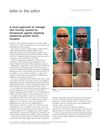
March 2012 in “Annals of oncology” New treatment with green tea polyphenols and nicotinamide improves skin problems from cancer therapy.
 November 2005 in “Reactions Weekly”
 A man treated with gefitinib for lung cancer grew new hair on his bald scalp.
 July 2022 in “The journal of investigative dermatology/Journal of investigative dermatology”
 A patient with a PLEC mutation has epidermolysis bullosa, muscular dystrophy, and myasthenia gravis, which improved with steroid treatment.
 3 citations
,
June 1993 in “Hair transplant forum international”
3 citations
,
June 1993 in “Hair transplant forum international” The document's conclusion cannot be provided because the content is not available to parse.
 April 2018 in “Journal of Investigative Dermatology”
 High amphiregulin in the skin is a bad sign for acute graft-versus-host disease.
8 citations
,
May 2024 in “Regenerative Therapy” Bioactive glass 1393 speeds up wound healing by helping new blood vessels form.
 April 2019 in “Journal of Investigative Dermatology”
 Researchers fixed gene mutations causing a skin disease in stem cells, which then improved skin grafts in mice.
41 citations
,
October 2001 in “Experimental Dermatology” The nude gene is important for skin and hair development.
 April 2018 in “Journal of Investigative Dermatology”
 The research found that blocking a gene called NEMO can potentially prevent harmful effects of aging at the cellular level.
CCC1 is essential for ion balance and proper plant cell function.
 22 citations
,
October 2019 in “International Journal of Nanomedicine”
22 citations
,
October 2019 in “International Journal of Nanomedicine” The nanoparticles improved hair growth and enlarged hair bulbs.
 February 2024 in “Molecules/Molecules online/Molecules annual”
 NMN could potentially treat hair loss by reducing oxidative stress and improving cell health.
103 citations
,
February 1972 in “Proceedings of the National Academy of Sciences” A unique enzyme in guinea pig hair follicles helps form protein cross-links in hair.
1 citations
,
January 2011 in “ScholarlyCommons (University of Pennsylvania)” Notch signaling is crucial for specifying niche cells in Drosophila testis.
 2 citations
,
July 2011 in “AFRICAN JOURNAL OF BIOTECHNOLOGY”
2 citations
,
July 2011 in “AFRICAN JOURNAL OF BIOTECHNOLOGY” Seven genetic variations in sheep's DSG4 gene are linked and affect wool traits.
 June 2023 in “International Journal of Research in Dermatology”
 Certain gene variations are linked to severe acne in Egyptian patients and could guide treatment choices.
 4 citations
,
May 2019 in “Zeitschrift für Naturforschung C”
4 citations
,
May 2019 in “Zeitschrift für Naturforschung C” Ishige sinicola extract helps bone-building cells grow and mature, which could aid in treating osteoporosis.
14 citations
,
September 1999 in “Mammalian genome” The scraggly mutation causes hair loss and skin defects in mice.