 18 citations
,
February 2014 in “PubMed”
18 citations
,
February 2014 in “PubMed” Androgenetic alopecia is a common hair loss condition caused by testosterone effects on hair follicles, leading to thinner, shorter, and less pigmented hair, diagnosed using scalp dermoscopy and treated with topical minoxidil, antiandrogen agents, and 5-alpha reductase inhibitors.
 12 citations
,
August 2013 in “Facial Plastic Surgery Clinics of North America”
12 citations
,
August 2013 in “Facial Plastic Surgery Clinics of North America” Choose hair restoration surgery candidates carefully and plan treatments for a natural look and future hair loss.
 2 citations
,
May 2023 in “JAAD Case Reports”
2 citations
,
May 2023 in “JAAD Case Reports” The document concludes that early and accurate diagnosis of hair loss on the top of the scalp in Black men is important to distinguish CCCA from other types of hair loss.
2 citations
,
June 2021 in “Sultan Qaboos University medical journal” Familial frontal fibrosing alopecia is rare, mostly affects women, and often occurs between sisters or mother-daughter pairs.
 1 citations
,
July 2016 in “Prescriber”
1 citations
,
July 2016 in “Prescriber” Minoxidil and spironolactone slow hair loss in women.
 January 2026 in “Zenodo (CERN European Organization for Nuclear Research)”
 Effective hair restoration requires long-term planning, scalp health, and a combination of treatments for sustainable results.
 November 2023 in “International Journal of Dermatology”
 Trichoscopy helps tell apart other hair loss conditions from common hair loss.
 15 citations
,
September 2018 in “Medicine”
15 citations
,
September 2018 in “Medicine” Childhood ptosis can vary from a minor cosmetic issue to a serious condition and may signal other health problems.
 January 2020 in “Clinical dermatology open access journal”
 Changing certain hairstyles can prevent worsening hair loss in Mexican women.
 155 citations
,
September 2008 in “British journal of dermatology/British journal of dermatology, Supplement”
155 citations
,
September 2008 in “British journal of dermatology/British journal of dermatology, Supplement” FFA is more common in postmenopausal women, can affect younger women, and may stabilize over time.
January 1976 in “Revista de Estudios Agrosociales” Frontal fibrosing alopecia and vitiligo might be linked by similar immune issues.
 57 citations
,
January 2003 in “Clinical and experimental dermatology”
57 citations
,
January 2003 in “Clinical and experimental dermatology” Postmenopausal frontal fibrosing alopecia is a type of hair loss in postmenopausal women that may stop on its own but has no effective treatment.
 November 2023 in “The journal of investigative dermatology/Journal of investigative dermatology”
 Early treatment and multidisciplinary care are key to managing Frontal Fibrosing Alopecia and preventing further hair loss.
 November 2018 in “Skin appendage disorders”
 The document concludes that a woman has both Frontal Fibrosing Alopecia and Lichen Simplex Chronicus, a previously unreported combination of conditions.
Early diagnosis and treatment of frontal fibrosing alopecia are crucial to prevent permanent hair loss.
 53 citations
,
May 2010 in “Dermatologic Surgery”
53 citations
,
May 2010 in “Dermatologic Surgery” Hair transplantation may not work for Frontal Fibrosing Alopecia as transplanted hair was lost when the disease came back.
 32 citations
,
June 2000 in “Dermatologic Surgery”
32 citations
,
June 2000 in “Dermatologic Surgery” Different factors help diagnose and treat hair loss accurately.
13 citations
,
August 2013 in “International Journal of Dermatology” Frontal fibrosing alopecia can affect African men and may be underdiagnosed.
12 citations
,
January 2016 in “Skin Appendage Disorders” Hydroxychloroquine is ineffective for treating frontal fibrosing alopecia with lupus erythematosus.
 9 citations
,
November 1993 in “Journal of The American Academy of Dermatology”
9 citations
,
November 1993 in “Journal of The American Academy of Dermatology” Some men can have female pattern baldness without hormonal abnormalities or signs of feminization.
 8 citations
,
January 2003 in “Plastic and Reconstructive Surgery”
8 citations
,
January 2003 in “Plastic and Reconstructive Surgery” Hair transplants using follicular unit grafting and a strategic design can give great results even for men with severe hair loss.
 3 citations
,
August 2002 in “Current Opinion in Otolaryngology & Head and Neck Surgery”
3 citations
,
August 2002 in “Current Opinion in Otolaryngology & Head and Neck Surgery” Hair transplantation, especially follicular unit micrografting, was the top treatment for male pattern baldness, with a focus on natural results and ongoing improvements in both surgical and medical management.
 3 citations
,
March 1998 in “Aesthetic Surgery Journal”
3 citations
,
March 1998 in “Aesthetic Surgery Journal” Experts suggest various surgical methods for hair restoration, including scalp reduction, transplantation using minigrafts, and establishing a permanent frontal hairline with follicular units. The drug finasteride may also be used alongside these procedures.
 1 citations
,
May 1999 in “Journal of The European Academy of Dermatology and Venereology”
1 citations
,
May 1999 in “Journal of The European Academy of Dermatology and Venereology” Treat hair loss with medicine, continue indefinitely.
 January 2023 in “Operative Techniques in Otolaryngology-Head and Neck Surgery”
 Hair transplants help transgender patients look more like their gender identity, with different procedures for trans women and men.
 July 2021 in “Journal Für Ästhetische Chirurgie”
 Effective hair loss treatments require medical diagnosis and realistic expectations, with hair transplants offering improved, natural-looking results.
 November 2018 in “Springer eBooks”
 Finasteride and minoxidil are effective, low-risk treatments for male hair loss, and patient education on these therapies is important.
 December 2024 in “Brazilian Journal of Health Review”
 Early diagnosis of alopecia frontal fibrosante is crucial, but treatment remains controversial and varies.
 March 2023 in “Journal of clinical review & case reports”
 Frontal Fibrosing Alopecia mainly affects postmenopausal Mexican women, requiring early detection to prevent permanent hair loss.
 January 2016 in “Journal of The American Academy of Dermatology”
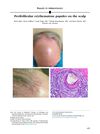
 The woman has a type of scarring hair loss with red bumps around hair follicles.