 15 citations
,
April 2007 in “Journal of child neurology”
15 citations
,
April 2007 in “Journal of child neurology” An 11-month-old boy with Menkes disease had severe brain shrinkage and abnormal blood vessels, and didn't respond well to treatment.
13 citations
,
February 2002 in “Archives of dermatology” A 32-year-old woman's hair loss was linked to skin nodules and severe headaches.
13 citations
,
October 2000 in “International Journal of Dermatology” A 6-year-old boy in India was diagnosed with Bloom's syndrome, showing growth and developmental issues, and skin problems worsened by sunlight.
 12 citations
,
January 2005 in “Pediatric Dermatology”
12 citations
,
January 2005 in “Pediatric Dermatology” Fox Fordyce disease might be more common in prepubertal girls than thought and can be managed with treatment.
 9 citations
,
July 2010 in “British Journal of Dermatology”
9 citations
,
July 2010 in “British Journal of Dermatology” The document suggests a rare skin condition might be caused by a genetic phenomenon.
 9 citations
,
January 2005 in “Pediatric Dermatology”
9 citations
,
January 2005 in “Pediatric Dermatology” Fox Fordyce disease can occur in prepubertal girls and may be underdiagnosed.
7 citations
,
January 2008 in “Indian Journal of Dermatology” Pigmentary mosaicism causes skin color changes and can affect multiple body systems, but has no cure.
 6 citations
,
November 2013 in “International Journal of Radiation Biology”
6 citations
,
November 2013 in “International Journal of Radiation Biology” Gamma-rays exposure during the resting phase of hair growth can damage hair regeneration and color in mice.
 5 citations
,
November 2015 in “International Journal of Radiation Biology”
5 citations
,
November 2015 in “International Journal of Radiation Biology” Gamma-ray exposure can cause long-lasting damage to hair follicles, affecting hair structure and color.
4 citations
,
May 2012 in “BMJ Case Reports” A Nigerian baby with neonatal lupus got better with treatment by 6 months.
3 citations
,
November 2018 in “Journal of osteopathic medicine” A rare scalp condition causing hair loss improved with a specific cream.
 3 citations
,
June 2017 in “International Journal of Radiation Biology”
3 citations
,
June 2017 in “International Journal of Radiation Biology” Gamma rays did not change hair follicle density but increased white and hypopigmented hairs in mice.
 2 citations
,
September 2022
2 citations
,
September 2022 The PER3 rs772027021 SNP may cause mild skin pigmentation changes in a new subtype of dyschromatosis universalis hereditaria.
1 citations
,
September 2017 in “BMJ” The man has a disease causing skin patches, thickened nerves, and mild muscle weakness.
 1 citations
,
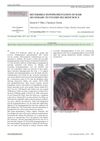
January 2013 in “Nasza Dermatologia Online”
1 citations
,
January 2013 in “Nasza Dermatologia Online” Vitamin B12 deficiency can cause reversible hair color loss in children.
 March 2021 in “CRC Press eBooks”
 The document concludes that different patterns of hair thickness and scalp changes can help diagnose types of non-scarring hair loss.
January 2025 in “NATIONAL BOARD OF EXAMINATIONS JOURNAL OF MEDICAL SCIENCES” Dermoscopy is useful for accurately diagnosing syphilitic alopecia.
 September 2023 in “Cells tissues organs”
 Mice skin matures by day 200, leading to aging signs like curved hair follicles and white hairs due to changes in skin stem cells.
 June 2023 in “Pediatric investigation”
 A boy's scalp infection, usually found on the body, was effectively treated with antifungal cream.
 January 2023 in “Figshare”
 Mouse skin and hair aging starts at 200 days, with changes in hair follicles and more white hairs as signs of aging.
January 2022 in “SSRN Electronic Journal” Mouse hair follicles age, causing more white hairs due to fewer pigment stem cells.
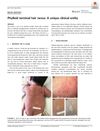 August 2018 in “Pediatric Dermatology”
 A baby had a unique skin condition with a pale patch and surrounding dark hairs, not linked to other health issues.
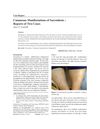 March 2017 in “BIRDEM Medical Journal”
 Sarcoidosis can cause various skin issues, making diagnosis difficult.
August 2016 in “Journal of the American Academy of Dermatology” The infant likely has Hay-Wells syndrome and needs genetic testing and heart screening.
November 2013 in “Institutional Repositories DataBase (IRDB)” Gamma-ray exposure during hair rest phase harms hair growth and color in mice.
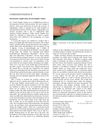 May 2002 in “British Journal of Dermatology”
 A pregnant woman's skin condition improved after giving birth, possibly due to high estrogen levels during pregnancy.
 May 2004 in “Pediatric Dermatology”
 Atopic dermatitis may have genetic causes and can be treated with pharmacologic methods, glycerin creams, and controlling Staphylococcus aureus colonization.
4 citations
,
November 2020 in “Case reports in dermatology” A rare skin condition causes red, dark, bumpy facial lesions.
 120 citations
,
July 2005 in “Dermatologic surgery”
120 citations
,
July 2005 in “Dermatologic surgery” Niacinamide improves aging skin and is safe for use in cosmetics.
96 citations
,
February 2002 in “Journal of the American Academy of Dermatology” Pseudofolliculitis barbae is a chronic skin condition affecting mainly African American and Hispanic individuals, caused by shaving tightly curled hair, and managed by prevention and treatment but not curable.