22 citations
,
March 2019 in “The Journal of Cell Biology” The Wave complex controls skin growth by suppressing certain signals.
29 citations
,
January 2013 in “The journal of investigative dermatology/Journal of investigative dermatology” P-cadherin is crucial for hair follicle pigmentation but not skin pigmentation.
6 citations
,
May 2000 in “Pediatric Dermatology” KID syndrome should be reclassified as an ectodermal dysplasia.
5 citations
,
September 2011 in “Biochimica et Biophysica Acta (BBA) - Molecular Basis of Disease” Hairless protein helps control hair growth by regulating vitamin D receptor activity.
22 citations
,
May 2011 in “Molecular Biology of the Cell” Integrin-linked kinase is crucial for normal skin healing.
 202 citations
,
August 2017 in “Nature cell biology”
202 citations
,
August 2017 in “Nature cell biology” Lactate production is important for activating hair growth stem cells.
1 citations
,
April 2010 in “Digital WPI” CLK1 is needed for skin cells to become epidermal cells but not sebocytes.
8 citations
,
June 2020 in “The journal of investigative dermatology/Journal of investigative dermatology” A boy's skin fragility and sparse hair were caused by a genetic mutation affecting skin cell adhesion.

A genetic mutation in the EDA gene causes hypohidrotic ectodermal dysplasia in cats.
 6 citations
,
January 2014 in “Clinical hemorheology and microcirculation”
6 citations
,
January 2014 in “Clinical hemorheology and microcirculation” Hereditary elliptocytosis causes elongated red blood cells and can lead to mild or no symptoms.
 1 citations
,
March 2023 in “Frontiers in Cardiovascular Medicine”
1 citations
,
March 2023 in “Frontiers in Cardiovascular Medicine” A specific gene variant is linked to heart disease, increased heart muscle, curly hair, and thick skin on palms and soles.
 April 2023 in “The journal of investigative dermatology/Journal of investigative dermatology”
 Elf5 is important for skin stem cell growth and could help treat skin and hair problems.
Mutations in specific genes cause different types of ectodermal dysplasias.
 June 2020 in “The journal of investigative dermatology/Journal of investigative dermatology”
 The enzymes Tet1, Tet2, and Tet3 are important for the development of hair follicles and determining hair shape by controlling hair keratin genes.
September 2012 in “Annals of saudi medicine/Annals of Saudi medicine” The twins' condition is unique and doesn't match any known syndromes.
 14 citations
,
July 2010 in “Experimental Dermatology”
14 citations
,
July 2010 in “Experimental Dermatology” A new mutation in the HR gene causes hair loss in a specific family.
January 2026 in “Journal of Radiation Research” 53BP1 focus analysis in hair cells can help estimate radiation doses.
 18 citations
,
August 2018 in “The FASEB journal”
18 citations
,
August 2018 in “The FASEB journal” Rabbits lacking the Hoxc13 gene show similar hair and skin issues to humans with ECTD-9, making them good for research on this condition.

Dacomitinib can cause nail and skin issues, but these can be managed without stopping the drug.
 September 2021 in “Research Square (Research Square)”
 Not having enough or having too much of the protein Grainyhead-like 3 leads to various developmental problems.
15 citations
,
June 2011 in “Journal of Investigative Dermatology” Overexpressing 14-3-3σ in mice skin reduces cell growth and hair density.
1 citations
,
August 2016 in “Journal of Investigative Dermatology” Vδ1+ T-cells in the skin contribute to hair loss in alopecia areata and could be targeted for treatment.
 9 citations
,
July 2018 in “Current Pharmaceutical Design”
9 citations
,
July 2018 in “Current Pharmaceutical Design” HO-1 helps skin health and healing but can worsen melanoma; it's a potential treatment target for skin diseases.
4 citations
,
April 2024 in “The Journal of Cell Biology” Caspase-1 helps hair stem cells move to heal wounded or inflamed skin.
 52 citations
,
March 2010 in “British Journal of Dermatology”
52 citations
,
March 2010 in “British Journal of Dermatology” Alopecia areata shows a unique type 1 interferon signature, suggesting potential treatment by targeting this pathway.
 12 citations
,
November 1987 in “Pediatric dermatology”
12 citations
,
November 1987 in “Pediatric dermatology” Four children had unmanageable pale blond hair due to uncombable-hair syndrome.
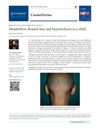 January 2026 in “Cosmoderma”
 A 9-year-old girl has a rare hair disorder causing beaded, sparse hair.
6 citations
,
March 2017 in “Journal of the European Academy of Dermatology and Venereology” Identical twins with a rare KRT 86 gene mutation both have the hair disorder monilethrix.
January 2014 in “China Animal Husbandry & Veterinary Medicine” EGF, IGF-I, and IGF-IR genes are crucial for mink skin and hair growth.
6 citations
,
June 2016 in “Journal of cellular biochemistry” The Hr protein binds to DNA, interacts with p53, and affects cell cycle genes.