 56 citations
,
March 2015 in “Cell death and differentiation”
56 citations
,
March 2015 in “Cell death and differentiation” Older skin has higher cancer risk due to inflammation and stem cell issues.
 9 citations
,
May 2012 in “PLOS ONE”
9 citations
,
May 2012 in “PLOS ONE” ILK is essential for skin development, pigmentation, and healing.
9 citations
,
February 2001 in “Journal of Dermatological Science” p21waf1/cip1 and p27kip1 help in hair follicle differentiation in rats.
 4 citations
,
January 2010 in “Acta dermato-venereologica”
4 citations
,
January 2010 in “Acta dermato-venereologica” Low androgen levels can still cause female pattern hair loss.
 64 citations
,
January 2010 in “The FASEB Journal”
64 citations
,
January 2010 in “The FASEB Journal” Prolactin affects the production of different keratins in human hair, which could lead to new treatments for skin and hair disorders.
 37 citations
,
November 1995 in “Journal of Investigative Dermatology”
37 citations
,
November 1995 in “Journal of Investigative Dermatology” Topical finasteride and flutamide reduce gland size and enzyme activity, with flutamide being more potent, potentially treating acne, seborrhea, hirsutism, and androgenic alopecia.
 35 citations
,
February 2019 in “Cell Communication and Signaling”
35 citations
,
February 2019 in “Cell Communication and Signaling” BMP6 and Wnt10b control whether hair follicles are resting or growing.
 24 citations
,
February 2006 in “Chinese Medical Journal”
24 citations
,
February 2006 in “Chinese Medical Journal” Cultured dermal papilla cells can regenerate hair follicles and sustain hair growth.
 23 citations
,
January 2007 in “Archives of Andrology”
23 citations
,
January 2007 in “Archives of Andrology” Finasteride may negatively affect male fertility.
 20 citations
,
January 2008 in “Journal of Korean Medical Science”
20 citations
,
January 2008 in “Journal of Korean Medical Science” NGAL may help maintain skin balance and is linked to skin disorders and cancers.
 20 citations
,
August 2005 in “Journal of Cutaneous Pathology”
20 citations
,
August 2005 in “Journal of Cutaneous Pathology” The protein ARA70/ELE1 is involved in male pattern baldness, and lower levels of its short form may lead to hair thinning.
 May 2024 in “Scientific reports”
 Twist2 is essential for scarless skin healing and hair growth in mouse fetuses.
 March 1998 in “Journal of dermatological science”
 Protease Nexin-1 is found in human hair growth cells and is affected by male hormones.
 62 citations
,
January 2000 in “Developmental dynamics”
62 citations
,
January 2000 in “Developmental dynamics” Notch-related genes play a key role in the development and cycling of hair follicles.
 1 citations
,
July 2013 in “Hair transplant forum international”
1 citations
,
July 2013 in “Hair transplant forum international” Advancements in hair follicle culture have led to better understanding and potential treatments for hair loss.
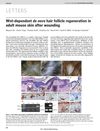 829 citations
,
May 2007 in “Nature”
829 citations
,
May 2007 in “Nature” Hair follicles can regrow in wounded adult mouse skin using a process like embryo development.
 286 citations
,
April 2009 in “The journal of neuroscience/The Journal of neuroscience”
286 citations
,
April 2009 in “The journal of neuroscience/The Journal of neuroscience” TRPA1 is crucial for mechanical sensitivity in skin sensory neurons.
 139 citations
,
December 1998 in “The journal of investigative dermatology/Journal of investigative dermatology”
139 citations
,
December 1998 in “The journal of investigative dermatology/Journal of investigative dermatology” K6hf is a unique protein found only in a specific layer of hair follicles.
 88 citations
,
May 2005 in “Journal of Dermatological Science”
88 citations
,
May 2005 in “Journal of Dermatological Science” Versican, a protein, is less present in thinning hair follicles and this decrease might contribute to common hair loss in men.
 87 citations
,
March 2014 in “Biochimica et Biophysica Acta (BBA) - Molecular and Cell Biology of Lipids”
87 citations
,
March 2014 in “Biochimica et Biophysica Acta (BBA) - Molecular and Cell Biology of Lipids” Cholesterol sulfate buildup due to a genetic mutation disrupts the skin barrier, leading to the scaling skin seen in X-linked ichthyosis.
 67 citations
,
May 2010 in “Journal of The American Academy of Dermatology”
67 citations
,
May 2010 in “Journal of The American Academy of Dermatology” Some chemotherapy can cause permanent hair loss.
 62 citations
,
January 2004 in “The journal of investigative dermatology/Journal of investigative dermatology”
62 citations
,
January 2004 in “The journal of investigative dermatology/Journal of investigative dermatology” A second domain of high sulfur KAP genes on chromosome 21q23 is crucial for hair structure.
 60 citations
,
August 2008 in “Human molecular genetics online/Human molecular genetics”
60 citations
,
August 2008 in “Human molecular genetics online/Human molecular genetics” A position effect on the TRPS1 gene causes excessive hair growth in humans and mice.
 48 citations
,
January 2012 in “The journal of investigative dermatology/Journal of investigative dermatology”
48 citations
,
January 2012 in “The journal of investigative dermatology/Journal of investigative dermatology” Chemokine signaling is important for hair development.
 34 citations
,
December 2000 in “The journal of investigative dermatology/Journal of investigative dermatology”
34 citations
,
December 2000 in “The journal of investigative dermatology/Journal of investigative dermatology” Rat vibrissa follicles are useful for studying hair growth cycles, especially the transition from pro-anagen to anagen.
 32 citations
,
February 1998 in “The journal of investigative dermatology/Journal of investigative dermatology”
32 citations
,
February 1998 in “The journal of investigative dermatology/Journal of investigative dermatology” Two specific hair keratin genes are active during hair growth and decline as hair transitions to rest.
 30 citations
,
April 2017 in “European Journal of Cell Biology”
30 citations
,
April 2017 in “European Journal of Cell Biology” CIP/KIP proteins help stop cell division and support hair growth.
 27 citations
,
May 2015 in “Neuropharmacology”
27 citations
,
May 2015 in “Neuropharmacology” Dutasteride protects dopamine neurons in Parkinson's mice, but Finasteride doesn't.
 25 citations
,
May 1994 in “Journal of Investigative Dermatology”
25 citations
,
May 1994 in “Journal of Investigative Dermatology” Researchers found a new gene, hacl-1, that is active in mouse hair follicles during hair growth and may be important for hair biology.
 20 citations
,
February 2013 in “Nutrition”
20 citations
,
February 2013 in “Nutrition” Selenium-enriched green tea might be a safe prebiotic for gut health.