 March 2014 in “Hair transplant forum international”
 Unable to provide a summary as the document content is not provided.
20 citations
,
January 2017 in “Experimental Dermatology” Igf1r helps regulate hair growth cycles.
 11 citations
,
June 1999 in “Seminars in Cutaneous Medicine and Surgery”
11 citations
,
June 1999 in “Seminars in Cutaneous Medicine and Surgery” The best hair transplant method depends on the desired look; faster techniques may not give better results or save money.
 2 citations
,
January 2014 in “Sen i Gakkaishi”
2 citations
,
January 2014 in “Sen i Gakkaishi” The new hair straightening method keeps hair straight permanently by using specific creams and heat.
June 2023 in “Zenodo (CERN European Organization for Nuclear Research)” 63 citations
,
February 2003 in “Australasian Journal of Dermatology” Global photography and phototrichogram techniques are the best current methods for measuring hair growth.
 19 citations
,
July 1993 in “The journal of investigative dermatology/Journal of investigative dermatology”
19 citations
,
July 1993 in “The journal of investigative dermatology/Journal of investigative dermatology” Dermal-epidermal interactions are crucial for hair growth and maintenance.
 2 citations
,
January 1985 in “Facial Plastic Surgery”
2 citations
,
January 1985 in “Facial Plastic Surgery” The paper concludes that for natural-looking hair restoration, it's important to create an irregular hairline, use appropriately sized and angled grafts, and ensure a snug fit between grafts and recipient sites.
January 2012 in “한국미용학회지” Applying conditioner in the middle of a perm process reduces hair damage the most.
January 1990 in “Advances in forensic haemogenetics” Human hair protein patterns are inherited genetically.
2 citations
,
October 2021 in “bioRxiv (Cold Spring Harbor Laboratory)” Lemur hair color and density vary by environment, supporting theories on primate hair evolution.
 8 citations
,
January 2007 in “International Society of Hair Restoration Surgery”
8 citations
,
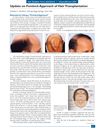
January 2007 in “International Society of Hair Restoration Surgery” The forelock approach in hair transplants improves natural appearance by focusing hair density in one area.
29 citations
,
July 2003 in “Experimental Dermatology” The upper hair follicle is stable, while the lower part allows movement during hair growth.
October 2015 in “Cosmetic Dermatology” Hair is complex, varies in type, and plays a big role in attractiveness and culture.
11 citations
,
May 2016 in “PubMed” New imaging and testing methods can effectively assess hair shape changes and damage.
 8 citations
,
October 2020 in “Infant behavior & development”
8 citations
,
October 2020 in “Infant behavior & development” Collecting hair for cortisol analysis is possible in low-income mother-toddler pairs.
17 citations
,
September 2005 in “International Journal of Dermatology” African hair is more fragile due to its unique shape and internal structure.

Future techniques will greatly improve hair restoration.
October 2018 in “Oncology Times” Hair is important for aging and cancer treatment, affecting emotions, culture, and health.
October 2022 in “Hair Transplantation” Successful hair transplants need enough donor hair and careful planning.
20 citations
,
July 2005 in “Experimental dermatology” The fuzzy gene is crucial for controlling hair growth cycles.
 March 2026 in “Zenodo (CERN European Organization for Nuclear Research)”
 Restoring communication in hair follicle networks may treat hair loss and improve sexual dysfunction.
15 citations
,
May 2013 in “International Journal of Cosmetic Science” Different ethnic hair types have unique nanoscopic and molecular features despite having the same basic keratin structure.
November 2022 in “Journal of Investigative Dermatology” A new tool helps study hair follicle cells to develop better treatments for hair disorders.
 20 citations
,
September 1978 in “International Journal of Dermatology”
20 citations
,
September 1978 in “International Journal of Dermatology” Hair growth is influenced by factors like genetics and nutrition, and more research is needed to understand hair loss and growth mechanisms.
 14 citations
,
January 2012 in “Proteins”
14 citations
,
January 2012 in “Proteins” Electrostatic interactions mainly stabilize the binding of peptides to hair keratin.
7 citations
,
July 2025 in “The Journal of Physiology” C-tactile nerves are sensitive to hair movement.
3 citations
,
March 2009 in “Hirosaki University Repository for Academic Resources (Hirosaki University)” Hirosaki hairless rats have sparse, twisted hair due to missing hair keratin genes.