 4 citations
,
January 2014 in “International Journal of Trichology”
4 citations
,
January 2014 in “International Journal of Trichology” A 12-year-old boy with a rare genetic condition has progressive hair loss with no effective treatment.
11 citations
,
February 2011 in “The Journal of Dermatology” Mutations in the hairless gene cause a rare form of permanent hair loss.
March 2020 in “Research Square (Research Square)” Different long non-coding RNAs in yaks change during hair growth cycles and are involved in key growth pathways.
19 citations
,
November 2017 in “General and comparative endocrinology” BMP2 and BMPR-IA may stop hair growth while Noggin may encourage it in yak skin.
December 2025 in “ILDS-DEV”  8 citations
,
June 2022 in “Scientific Reports”
8 citations
,
June 2022 in “Scientific Reports” LGR5 is a common marker of hair follicle stem cells in different animals and is important for hair growth and regeneration.
21 citations
,
April 2000 in “Journal of Cutaneous Pathology” The hamartoma is an abnormal hair growth with limited development in the upper hair follicle.
4 citations
,
August 2022 in “Cells” lncRNA2919 slows down rabbit hair growth by stopping cell growth and causing cell death.
20 citations
,
August 2003 in “Clinical and Experimental Dermatology” A new genetic mutation in the hairless gene causes a rare hair loss disorder.
 2 citations
,
November 2024 in “PeerJ”
2 citations
,
November 2024 in “PeerJ” Long non-coding RNAs play a role in hair growth stages of Hetian sheep, affecting wool quality.
30 citations
,
May 1980 in “Journal of the American Academy of Dermatology” Alopecia areata can cause spotty white areas on nails.
 210 citations
,
July 1993 in “The journal of investigative dermatology/Journal of investigative dermatology”
210 citations
,
July 1993 in “The journal of investigative dermatology/Journal of investigative dermatology” Hair color production in mice is closely linked to the hair growth phase and may also influence hair growth itself.
 13 citations
,
September 2018 in “Scientific Reports”
13 citations
,
September 2018 in “Scientific Reports” The research found that a complex gene network, controlled by microRNAs, is important for hair growth in cashmere goats.
 November 2023 in “Frontiers in veterinary science”
 The study provides insights into hair growth mechanisms in yaks.
2 citations
,
January 2010 Tianzhu white yak hair varies in structure and density between fuzz and coarse hair.
December 1978 in “Indian Journal of Otolaryngology and Head & Neck Surgery” 50 citations
,
March 2018 in “BMC Genomics” Non-coding RNAs help control hair growth cycles in cashmere goats, suggesting ways to improve cashmere production.
 January 1980 in “Journal of the Japan Veterinary Medical Association”
 Iodine deficiency in sows likely caused hair loss in newborn piglets.
1 citations
,
May 2025 in “BMC Genomics” lncRNAs may help control cashmere goat hair growth by responding to light changes.
July 2025 in “Frontiers in Medicine” Mutations in the LIPH gene cause woolly hair in a child.
January 2004 in “Giornale di Metafisica: revista bimestrale di filosofia” Increased Wnt signaling causes hair graying by depleting melanocyte stem cells in aged mice.
 3 citations
,
February 2014 in “Asian Pacific journal of tropical medicine”
3 citations
,
February 2014 in “Asian Pacific journal of tropical medicine” Wnt5a may slow down hair growth in mice.
 January 2026 in “International Journal of Dermatology Research”
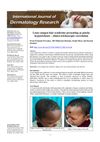
 Early recognition of loose anagen hair syndrome is important to prevent misdiagnosis and unnecessary treatments.
1 citations
,
April 2023 in “Animals” Wnt and BMP pathways stimulate hair growth in Min pigs, with Wnt being more effective.
 7 citations
,
November 2014 in “Histochemistry and Cell Biology”
7 citations
,
November 2014 in “Histochemistry and Cell Biology” The we/we wal/wal mice have defects in hair growth and skin layer formation, causing hair loss, useful for understanding alopecia.
20 citations
,
December 2010 in “Journal of Morphology” Lizard claws have hair-like keratins similar to those in mammals.
 6 citations
,
June 1981 in “PubMed”
6 citations
,
June 1981 in “PubMed” Whisker hair in young people might predict severe future hair loss.
 109 citations
,
October 2007 in “Journal of pineal research”
109 citations
,
October 2007 in “Journal of pineal research” Melatonin helps regulate hair growth and protects the hair follicle from stress.
3 citations
,
January 2016 in “Dermatology online journal” Some people with lichen planus pigmentosus might later develop frontal fibrosing alopecia.
 19 citations
,
October 1985 in “British Journal of Dermatology”
19 citations
,
October 1985 in “British Journal of Dermatology” The document concludes that unruly hair can be congenital or acquired, often lacks specific treatments, and can be managed with oils and short hairstyles.