21 citations
,
April 2000 in “Journal of Cutaneous Pathology” The hamartoma is an abnormal hair growth with limited development in the upper hair follicle.
 13 citations
,
November 1959 in “Annals of the New York Academy of Sciences”
13 citations
,
November 1959 in “Annals of the New York Academy of Sciences” Human hair follicles can grow back.
8 citations
,
July 2004 in “Journal of morphology” Marsupial hair structure and keratin distribution are similar to placental mammals.
3 citations
,
December 1967 in “Australasian Journal of Dermatology” Becker's Melanosis and Hypertrichosis mainly affects young males, causing brown skin patches and extra hair on one side of the upper body.
March 2023 in “Journal of Student Research” Humans likely became hairless to better regulate body temperature.
1 citations
,
April 2008 in “Pigment Cell & Melanoma Research” Foxn1 is essential for hair pigmentation by directing pigment transfer to hair cells.
20 citations
,
February 2012 in “Archives of dermatology” Leg hair transplants can create a natural-looking hairline and show successful growth over several years.
2 citations
,
September 1998 in “Der Hautarzt” A gene mutation causes a rare hereditary hair loss, offering potential for new treatments.
Hairlessness in mammals is due to complex genetic changes in both genes and regulatory regions.
 May 2024 in “Frontiers in medicine”
 A genetic mutation in the LIPH gene causes tightly curled hair that stops growing in some Japanese individuals.
 January 2023 in “Figshare”
 Mouse skin and hair aging starts at 200 days, with changes in hair follicles and more white hairs as signs of aging.
January 2012 in “The Journal of Practical Medicine” Chinese Han individuals have fewer hair follicles and hairs than Caucasians and Africans.
 63 citations
,
October 2011 in “Archives of Dermatology”
63 citations
,
October 2011 in “Archives of Dermatology” Isolated long hairs at the original hairline can help diagnose Frontal Fibrosing Alopecia.
41 citations
,
January 2001 in “Journal of Investigative Dermatology”  6 citations
,
April 2010 in “Journal of Dermatological Science”
6 citations
,
April 2010 in “Journal of Dermatological Science” Laminin-511 may help promote hair growth, while laminin-332 does not affect hair loss.
1 citations
,
January 2013 in “Indian journal of dermatology, venereology, and leprology” A girl inherited excessive body hair from her mother and grandmother.
2 citations
,
January 2010 Tianzhu white yak hair varies in structure and density between fuzz and coarse hair.
February 2026 in “Veterinary Dermatology” Coat-type differences in Pomeranians affect Alopecia X diagnosis and treatment.
18 citations
,
January 1992 in “Dermatology” A 4-year-old girl has a rare condition causing hairlessness and skin bumps, but normal teeth and sweating.
 2 citations
,
January 2000 in “Journal of Toxicologic Pathology”
2 citations
,
January 2000 in “Journal of Toxicologic Pathology” A single recessive gene causes sparse hair in certain Japanese White rabbits.
 12 citations
,
August 1984 in “Genetics Research”
12 citations
,
August 1984 in “Genetics Research” The N gene affects the protein makeup of mouse hair.
 1 citations
,
September 2016 in “Dermatologic Surgery”
1 citations
,
September 2016 in “Dermatologic Surgery” New hair loss subtype found, mimics common baldness.

Caucasian and Mediterranean hair is denser and varies in color and texture compared to African and Asian hair.
 August 2010 in “Journal of The American Academy of Dermatology”
 The document explains the diagnosis and characteristics of woolly hair nevus and alopecia neoplastica.
5 citations
,
January 2001 in “Journal of dermatological science” The G(S) alpha subunit gene may help start hair follicle growth in newborn mice.
56 citations
,
January 1970 in “Cell and Tissue Research” 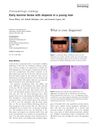 3 citations
,
April 2016 in “International Journal of Dermatology”
3 citations
,
April 2016 in “International Journal of Dermatology” A young man was diagnosed with trichoepitheliomas, causing thick skin and hair loss.
20 citations
,
December 2010 in “Journal of Morphology” Lizard claws have hair-like keratins similar to those in mammals.
33 citations
,
September 1987 in “American Journal of Medical Genetics” Uncombable hair is inherited dominantly with complete penetrance.
 November 2022 in “Nihon Nyuusankin Gakkaishi/Nihon Nyūsankin Gakkaishi”
 The lotion with N793 strain significantly increased hair density and reduced hair loss safely.