 3 citations
,
June 2022 in “Dermatology and therapy”
3 citations
,
June 2022 in “Dermatology and therapy” A new botanical treatment improved hair growth and symptoms in lichen planopilaris patients.
19 citations
,
January 2020 in “Journal of Biophotonics” A PEG-400/oleic acid mixture best improves drug delivery monitoring through hair follicles.
35 citations
,
February 2003 in “Biochimica et Biophysica Acta (BBA) - General Subjects” Lead can help reveal and organize lipids in human hair.
August 2020 in “OPAL (Open@LaTrobe) (La Trobe University)” May 2023 in “Pharmaceuticals” Three specific mutations in the LIPH gene can cause hair loss by damaging the protein's structure and function.
1 citations
,
July 2023 in “International Journal of Pharmaceutical Sciences and Drug Research” The HPTLC method is effective and accurate for measuring linoleic and oleanolic acid in Eclipta alba.
 2 citations
,
March 2016 in “The Journal of Dermatology”
2 citations
,
March 2016 in “The Journal of Dermatology” The Facial Psoriasis Log-based Area and Severity Index is a more effective way to measure improvements in facial psoriasis than the traditional method.
July 2021 in “Authorea (Authorea)” Graham-Little Piccardi Lassueur Syndrome is a rare skin condition with specific hair loss and skin symptoms.
December 2024 in “Biochemical and Biophysical Research Communications” LMWP-PDGFA shows promise for improving hair health and treating hair loss with fewer side effects.
 16 citations
,
December 2017 in “Journal of The American Academy of Dermatology”
16 citations
,
December 2017 in “Journal of The American Academy of Dermatology” Low-level laser therapy may reduce symptoms and increase hair thickness in lichen planopilaris patients.
 March 2026 in “Folia Histochemica et Cytobiologica”
 LTBP1 is a key regulator in diseases and a potential target for new treatments.
January 2025 in “Indian Journal of Dermatopathology and Diagnostic Dermatology” Dermoscopy helps diagnose rare GLPLS in males.
4 citations
,
May 2024 in “Rapid Communications in Mass Spectrometry” Girard's reagent P improves detection of spironolactone and its metabolites.
 April 2017 in “Journal of Investigative Dermatology”
 The study found a link between the severity of Lichen Planopilaris seen by doctors and the details seen under a microscope, and created a new way to measure this severity.
 2 citations
,
January 2016 in “Scientifica”
2 citations
,
January 2016 in “Scientifica” Researchers created a reliable method to measure dexpanthenol and resorcinol in hair products.
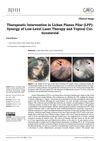 January 2024 in “Brazilian Journal of Hair Health”
 Combining low-level laser therapy with topical corticosteroids effectively improved Lichen Planopilaris symptoms.
 1 citations
,
March 2015 in “Oriental Journal of Chemistry/Oriental journal of chemistry”
1 citations
,
March 2015 in “Oriental Journal of Chemistry/Oriental journal of chemistry” A new method accurately measures minoxidil and aminexil in drugs.
 April 2012 in “KSBB Journal”
 Minoxidil analogs can be improved for hair growth inhibition by modifying specific parts of their structure.
 33 citations
,
October 2013 in “Journal of The American Academy of Dermatology”
33 citations
,
October 2013 in “Journal of The American Academy of Dermatology” Pioglitazone usually doesn't effectively treat or cure lichen planopilaris.
 4 citations
,
January 1994 in “Yakugaku zasshi”
4 citations
,
January 1994 in “Yakugaku zasshi” EPC-K is stable except at very acidic pH or when exposed to sunlight, and it can decompose in low ethanol concentrations.
3 citations
,
July 2022 in “Indian Journal of Dermatology” ALEP is a drug-triggered skin reaction with pustules that clears up in a week after stopping the drug.
 June 2022 in “Journal of the Liaquat University of Medical and Health Sciences”
 People with lichen planus are more likely to have abnormal blood fats than healthy people.
110 citations
,
January 2014 in “Journal of Controlled Release” Phospholipid-coated nanoparticles penetrate hair follicles better than others, especially in pig ears.
January 2004 in “Drug Development and Industrial Pharmacy” GI197111X is best dissolved in Capmul MCM for trials.
8 citations
,
January 2019 in “Journal of cosmetic dermatology” Modified phenol peels effectively reduced stubborn skin pigmentation in patients with Lichen Planus Pigmentosus.
24 citations
,
July 2015 in “Molecular Medicine Reports” Lysophosphatidic acid boosts stem cell growth and movement by creating reactive oxygen species.
May 2005 in “Molecular Carcinogenesis” mrp/plf-mRNA can indicate tumor-promoting effects in skin.
 1 citations
,
June 2023 in “ScienceRise Pharmaceutical Science”
1 citations
,
June 2023 in “ScienceRise Pharmaceutical Science” A semi-automated system can effectively help choose emulsion ingredients, simplifying the creation of medicinal and cosmetic products.