
Trichoscopy is a valuable tool for accurately diagnosing scalp conditions without invasive procedures.

Histopathological confirmation is crucial for accurately diagnosing challenging alopecia areata cases.
 February 2025 in “Cureus”
 Hair transplants can rarely cause scalp inflammation leading to hair loss, needing early detection and treatment.
 January 2025 in “International Journal of Pharmacognosy and Life Science”
 Herbal treatments like Aloe vera, Bhringraj, Neem, Tea tree oil, Amla, and Hibiscus are promising for safer, effective hair care.
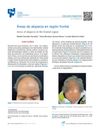 January 2025 in “Revista del Centro Dermatológico Pascua”
 Early diagnosis and treatment can help manage fibrosing alopecia in older women.
 January 2025 in “Universidad de Córdoba Insitutional Repository (Universidad de Córdoba)”
 An imbalanced scalp microbiome may worsen alopecia areata severity and inflammation, but treatment can partially restore balance.
Early and accurate identification of primary scarring alopecias is crucial to prevent permanent hair loss.
 July 2024 in “Plastic and Aesthetic Research”
 Careful planning and accurate diagnosis are crucial for successful hair restoration surgery.
 May 2024 in “International Journal For Multidisciplinary Research”
 The herbal hair cream helps protect and improve hair health.
 May 2024 in “International Seven Journal of Multidisciplinary”
 More research is needed to better understand and treat Fibrosing Frontal Alopecia.

Photobiomodulation effectively improves skin and hair conditions with minimal side effects.

Genetic testing can help diagnose skin conditions but needs more research for full effectiveness.

New treatments for skin conditions show promise, especially Coacillium® for hair growth in young people with alopecia areata.
 February 2024 in “PloS one”
 Tofacitinib and adalimumab are promising treatments for cicatricial alopecia with few side effects.
 October 2023 in “European medical journal. Dermatology”
 Hair loss greatly affects quality of life, and dermatologists are crucial for proper diagnosis and treatment.
 October 2023 in “bioRxiv (Cold Spring Harbor Laboratory)”
 A protein called EGFR protects hair follicle stem cells, and when it's disrupted, hair follicles can be damaged, but blocking certain pathways can restore hair growth.
 October 2023 in “International Journal of Science and Research (IJSR)”
 Early diagnosis of GLPLS is crucial to prevent complications, but scarring alopecia is irreversible.
 September 2023 in “Frontiers in medicine”
 The mTOR signaling pathway is crucial for hair health and targeting it may lead to new hair loss treatments.
 September 2023 in “Clinical, cosmetic and investigational dermatology”
 A new surgical method using special sutures significantly reduced wound size and prevented disease return in patients with a scarring scalp condition.
 November 2022 in “Research Square (Research Square)”
 Using facial sunscreen and moisturizer may increase the risk of frontal fibrosing alopecia.
 March 2022 in “Más dermatología”
 Chronic lupus and frontal fibrosing alopecia can occur together, but their connection is unclear.
 February 2022 in “International Journal of Complementary & Alternative Medicine”
 Good hair and scalp health indicate good overall health.
 May 2021 in “Dermatopathology”
 The review emphasizes the need to recognize skin conditions that affect hair follicles and sweat glands to avoid misdiagnosis.
 March 2021 in “Actas Dermo-Sifiliográficas”
 The microbiome may be linked to hair loss and could be a target for new treatments.
 November 2019 in “Harper's Textbook of Pediatric Dermatology”
 The document is a detailed medical reference on skin and genetic disorders.
 November 2019 in “Journal of Aesthetic Nursing”
 The article concludes that a thorough diagnosis and treatment plan, including medications, non-invasive methods, or surgery, is important for managing hair loss, with a combination of minoxidil and finasteride being particularly effective.

The document is a detailed guide on skin conditions and treatments for dermatologists.

The document concludes that diagnosing female hair loss requires careful examination, with treatments varying by condition and psychological support often necessary.
 June 2019 in “Pediatric Dermatology”
 Alopecia in patients with epidermolysis bullosa varies in severity and is often caused by skin blistering or trauma.
 April 2019 in “Journal of Investigative Dermatology”
 Testosterone affects androgen receptors and lipid storage in cells, while DHEA does not convert to testosterone or affect these receptors in the same way.