
EfficientNet improves accuracy in diagnosing hair loss stages.
 101 citations
,
January 2016 in “Journal of Cutaneous and Aesthetic Surgery”
101 citations
,
January 2016 in “Journal of Cutaneous and Aesthetic Surgery” Different types of hair loss need specific treatments, and while many classification systems exist, each has its flaws; more research is needed to refine these systems and treatments.
 1 citations
,
January 2017 in “Springer eBooks”
1 citations
,
January 2017 in “Springer eBooks” The document explains how hair loss patterns in men and women, known as Androgenetic alopecia, are classified using the Hamilton-Norwood system for men and the Ludwig grade system for women.
March 2026 in “Frontiers in Medicine” A hybrid model using traditional methods, trichoscopy, and AI improves hair loss assessment.
 January 2016 in “Springer eBooks”
 The document explains how hair loss in men and women, known as Androgenetic alopecia, is categorized using the Hamilton-Norwood system for men and the Ludwig grade system for women.
 4 citations
,
February 1995 in “Journal of Clinical Dermatology”
4 citations
,
February 1995 in “Journal of Clinical Dermatology” More men than women have hair loss, it's often inherited, and it's linked with higher testosterone levels. There's been a rise in female hair loss patients.
 1 citations
,
January 2009 in “Journal of Clinical Dermatology”
1 citations
,
January 2009 in “Journal of Clinical Dermatology” More men have Androgenic Alopecia than women, it's often inherited, and stress can contribute to it.

More men have androgenic alopecia than women, with stress linked to the condition in both genders.
 January 2009 in “대한피부과학회지”
 The conclusion is that more women in their forties are getting AGA and stress is linked to AGA in both men and women.
January 2008 in “대한피부과학회지” Androgenetic alopecia is more common in men, often linked to genetics and hormones.
January 2008 in “대한피부과학회지” Androgenetic alopecia is more common in men, linked to genetics and androgen levels, but routine pelvic ultrasound isn't recommended.
 5 citations
,
September 2011 in “Pediatric Dermatology”
5 citations
,
September 2011 in “Pediatric Dermatology” Two young siblings experienced hair loss without hormone issues or other skin problems.
 1 citations
,
March 2014 in “PubMed”
1 citations
,
March 2014 in “PubMed” Androgenic alopecia (AA) in Indian women is rarely reported, with varying severity and patterns, and hair pull tests and trichograms help understand it better.
 1 citations
,
May 2013 in “PubMed”
1 citations
,
May 2013 in “PubMed” The document concludes that female pattern baldness involves hair thinning, is classified differently than in men, and is assessed using the Ludwig classification. It also explains the hair growth cycle stages.
 June 2023 in “Journal of General Procedural Dermatology and Venereology Indonesia”
 Older, overweight women with children and a family history of hair loss are more likely to experience female pattern hair loss.
 January 2018 in “Georg Thieme Verlag eBooks”
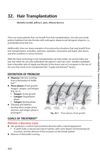
 Hair transplantation is a surgical procedure to move hair to bald areas, requires good donor hair, and results show in about a year.
 January 2007 in “Revista del Centro Dermatológico Pascua”
 Hair loss in women, often not related to male hormones, increases with age and can cause significant emotional distress.
 September 2004 in “PubMed”
 Androgenetic alopecia, or hair loss, is influenced by hormones and genetics, and can be treated with medications like minoxidil, finasteride, or hormone therapy, with effectiveness evaluated after 6 months.
 9 citations
,
October 1988 in “Clinics in Dermatology”
9 citations
,
October 1988 in “Clinics in Dermatology” Hair loss is caused by genetics and hormones, diagnosed through examination and biopsy, and treated with medications or surgery.
2 citations
,
May 2002 in “PubMed” Micro-graft hair transplantation is an effective, simple, and painless method for permanent hair restoration in men and women.
 January 2025 in “International Journal of Scientific Research”
 12.5% of women with PCOS experience moderate hair loss, highlighting the need for early detection and management.

Female hair loss is often hereditary and can be treated with medication, hair transplants, and lasers.
 666 citations
,
September 1977 in “British Journal of Dermatology”
666 citations
,
September 1977 in “British Journal of Dermatology” Common baldness, also known as Androgenetic Alopecia, is caused by a combination of genetic factors and hormones called androgens.
 107 citations
,
August 2014 in “Dermatologic Surgery”
107 citations
,
August 2014 in “Dermatologic Surgery” PRP injections improve hair thickness for baldness.
March 2023 in “Pakistan Journal of Medical and Health Sciences” Low vitamin D levels are linked to higher rates of hair loss in women.
 1 citations
,
January 2020 in “British Journal of Dermatology”
1 citations
,
January 2020 in “British Journal of Dermatology” The British Association of Dermatologists celebrated 100 years by looking back at important research, including work on hair loss, skin condition impact, psoriasis treatment, and skin cancer rates.
 8 citations
,
January 2013 in “International Journal of Trichology”
8 citations
,
January 2013 in “International Journal of Trichology” The BASP classification is effective for diagnosing pattern hair loss in Indian men and women.
 125 citations
,
May 2007 in “Journal of The American Academy of Dermatology”
125 citations
,
May 2007 in “Journal of The American Academy of Dermatology” The BASP classification is a detailed and accurate way to categorize hair loss in both men and women.
 16 citations
,
October 2012 in “The Journal of Dermatology”
16 citations
,
October 2012 in “The Journal of Dermatology” The BASP classification is more reliable than the Norwood-Hamilton for classifying hair loss in men and women.
 2 citations
,
June 2019 in “International Journal of Dermatology”
2 citations
,
June 2019 in “International Journal of Dermatology” The modified hair loss classification is more detailed but less user-friendly.