 May 2011 in “Archives of Plastic Surgery”
 Korean men in their 20s and 30s most commonly have an inverted U-shaped hairline.
 31 citations
,
March 2011 in “Dermatologic Surgery”
31 citations
,
March 2011 in “Dermatologic Surgery” The new hairline classification and correction methods can improve the appearance of Asian women with wide or M-shaped foreheads.
 1 citations
,
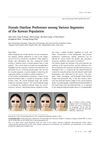
January 2014 in “Annals of Dermatology”
1 citations
,
January 2014 in “Annals of Dermatology” Korean people prefer M-shaped hairlines and lower foreheads, with no major differences across various demographics.
 July 2026 in “Innovations in Pharmaceutical Sciences & Care”
 Combining mesotherapy injections with minoxidil improved hair growth and appearance.
2 citations
,
December 2022 in “Archives of Dermatological Research” The study created a new system to classify Asian men's hairlines to help with hair loss treatment and cosmetic procedures.
Hairless mammals evolved quickly in both gene and non-gene areas related to skin and hair.
 125 citations
,
May 2007 in “Journal of The American Academy of Dermatology”
125 citations
,
May 2007 in “Journal of The American Academy of Dermatology” The BASP classification is a detailed and accurate way to categorize hair loss in both men and women.
 5 citations
,
June 2016 in “Dermatologic Surgery”
5 citations
,
June 2016 in “Dermatologic Surgery” Hair restoration for East Asians should consider their unique characteristics like head shape, hair thickness, and hair density, and use modified procedures and treatments to minimize scarring and maintain hair density.
 3 citations
,
April 2011 in “Dermatologic Surgery”
3 citations
,
April 2011 in “Dermatologic Surgery” Different women have various natural hairline shapes, and understanding this is important for designing hair transplants.
 2 citations
,
January 2014 in “Archives of Aesthetic Plastic Surgery”
2 citations
,
January 2014 in “Archives of Aesthetic Plastic Surgery” The procedure effectively created natural-looking hairlines and improved facial balance in female patients.
January 2026 in “JPRAS Open” Sleeping position can influence hairline recession in men with certain hair loss patterns.
 2 citations
,
January 1985 in “Facial Plastic Surgery”
2 citations
,
January 1985 in “Facial Plastic Surgery” The paper concludes that for natural-looking hair restoration, it's important to create an irregular hairline, use appropriately sized and angled grafts, and ensure a snug fit between grafts and recipient sites.
 November 2002 in “Dermatologic Surgery”
 Scalp reduction gives the most natural result for significant crown baldness, despite potential complications, and a systematic approach to surgical hair restoration results in few complications and high graft survival.
 July 2007 in “Faculty Opinions – Post-Publication Peer Review of the Biomedical Literature”
 The BASP classification is a detailed system for categorizing hair loss in both men and women, but it may be complex for beginners and not fully suitable for grading female hair loss.
 March 2021 in “Indian Journal of Dermatology”
 A man unhappy with his old hair restoration got a new, natural-looking hairline using a combination of follicular unit extraction and punch graft reduction.
 February 2023 in “EAS Journal of Medicine and Surgery”
 Most Idoma people have a curved hairline due to genetics.
 8 citations
,
April 2018 in “Facial Plastic Surgery”
8 citations
,
April 2018 in “Facial Plastic Surgery” Men and women have different hairline restoration needs, with natural design being more complex for women, and hairline changes being important for transgender individuals' transitions.
 April 2025 in “Scholars International Journal of Anatomy and Physiology”
 Straight-lined hairlines are most common among Etche people.
 July 1998 in “Dermatologic Surgery”
 Various techniques and tools for hair restoration were presented in 1998, including a mathematical model for donor area, use of lasers in surgery, methods for controlling grafted hair direction, and ways to increase graft yield. Satisfaction rates were around 39%, and studies showed trauma and dehydration can damage hair follicles.
 7 citations
,
October 2018 in “Journal of Craniofacial Surgery”
7 citations
,
October 2018 in “Journal of Craniofacial Surgery” About 21.3% of young, healthy Chinese men experience hair loss. Hairlines are mostly linear or have a central protrusion. Hair is densest on the top and back of the head, and hair follicles usually have 1 or 2 hairs. This information can help in designing hair restoration procedures.
 21 citations
,
January 2000 in “Aesthetic Plastic Surgery”
21 citations
,
January 2000 in “Aesthetic Plastic Surgery” Researchers created a new system to classify male baldness, finding six types and a common hairline shape, to improve hair loss treatments.
 January 2012 in “Jaypee Brothers Medical Publishers (P) Ltd. eBooks”
 Various surgical methods for hair restoration, like scalp reconstruction and tissue expansion, have been developed, but follicular unit transplant remains the most common procedure for correcting pattern baldness.
 1 citations
,
April 2017 in “Journal of Investigative Dermatology”
1 citations
,
April 2017 in “Journal of Investigative Dermatology” D-OCT shows increased blood vessel growth in response to tissue damage in Frontal Fibrosing Alopecia and is useful for diagnosis and monitoring.
13 citations
,
July 2023 in “Plastic & Reconstructive Surgery Global Open” Women have smaller foreheads and different hairline shapes than men.
 2 citations
,
May 2010 in “Hair transplant forum international”
2 citations
,
May 2010 in “Hair transplant forum international” Different hair restoration techniques like follicular unit extraction, scalp reduction, and body hair transplantation can improve results for patients unhappy with their initial surgery, but they also have potential risks.
 9 citations
,
June 2001 in “International Journal of Cosmetic Surgery and Aesthetic Dermatology”
9 citations
,
June 2001 in “International Journal of Cosmetic Surgery and Aesthetic Dermatology” A single session hair transplant can create a natural hairline using a detailed technique with specific zones and careful planning.
 September 2017 in “Springer eBooks”
 Older East and Southeast Asian men need less hair density for hair restoration satisfaction, and natural hairline features should guide surgery plans.
 11 citations
,
January 2015 in “Annals of Dermatology”
11 citations
,
January 2015 in “Annals of Dermatology” Using a hair removal laser can make hairs finer for better hairline correction in hair transplants, with most patients happy and few side effects.
 7 citations
,
April 2015 in “Plastic and Aesthetic Nursing”
7 citations
,
April 2015 in “Plastic and Aesthetic Nursing” Hair transplantation can effectively restore a natural-looking hairline when properly planned and executed.
 2 citations
,
November 2018 in “Journal of Cosmetic Dermatology”
2 citations
,
November 2018 in “Journal of Cosmetic Dermatology” The conclusion is that surgeons should carefully create a natural-looking occipital hairline in hair transplants to avoid detection.