 9 citations
,
November 2021 in “Frontiers in Cell and Developmental Biology”
9 citations
,
November 2021 in “Frontiers in Cell and Developmental Biology” PBX1 helps reduce aging and cell death in hair follicle stem cells by decreasing DNA damage, not by improving DNA repair.
 9 citations
,
November 2019 in “Scientific reports”
9 citations
,
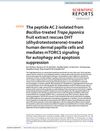
November 2019 in “Scientific reports” The AC 2 peptide from Trapa japonica fruit helps protect hair cells and may treat hair loss.
 3 citations
,
May 2017 in “Heliyon”
3 citations
,
May 2017 in “Heliyon” Wound healing can help prevent hair loss from chemotherapy in young rats by increasing interleukin-1β signaling.
1 citations
,
October 2021 in “bioRxiv (Cold Spring Harbor Laboratory)” Heat shock proteins help basal cell carcinoma grow by responding to inflammation signals.
March 2026 in “Chemical Engineering Journal” The hydrogel helps heal diabetic wounds by combining antibacterial, antioxidant, and immune-boosting effects.
January 2026 in “SSRN Electronic Journal” January 2026 in “SSRN Electronic Journal” January 2026 in “SSRN Electronic Journal” February 2024 in “bioRxiv (Cold Spring Harbor Laboratory)” Increased energy use in Pik3r1-related insulin resistance isn't due to Ucp1 thermogenesis.
 April 2023 in “The journal of investigative dermatology/Journal of investigative dermatology”
 Removing UBE2N from skin cells causes inflammation and immune response, which can be lessened with specific inhibitors.
 July 2022 in “The journal of investigative dermatology/Journal of investigative dermatology”
 A patient with a PLEC mutation has epidermolysis bullosa, muscular dystrophy, and myasthenia gravis, which improved with steroid treatment.

The document suggests that drugs for prostate issues might cause lasting sexual, mental, and physical health problems due to blood vessel damage in the penis.
Not having the gene PLAAT3 leads to fat loss, high insulin resistance, and abnormal fat levels in the blood due to a disruption in fat cell development and function.
July 2020 in “DOAJ (DOAJ: Directory of Open Access Journals)” Excessive sun protection might contribute to frontal fibrosing alopecia.
 60 citations
,
May 2014 in “British Journal of Dermatology”
60 citations
,
May 2014 in “British Journal of Dermatology” Caffeine affects hair growth and health differently in men and women.
18 citations
,
December 2016 in “European journal of pharmacology” A new compound slows cancer cell growth and causes cell death by blocking cell cycle progression and increasing cell-damaging molecules.
 11 citations
,
May 2016 in “Naunyn-Schmiedeberg's Archives of Pharmacology”
11 citations
,
May 2016 in “Naunyn-Schmiedeberg's Archives of Pharmacology” A substance called 15-deoxy prostaglandin J2 can cause hair follicle cells to die, which might explain how prostaglandin D2 can lead to hair loss.
1 citations
,
April 2013 in “The FASEB Journal” 3α‐OH‐DHP is essential for reducing nerve activity related to blood pressure control during pregnancy.
 November 2023 in “The journal of investigative dermatology/Journal of investigative dermatology”
 Blocking TYK2 might be a new way to treat hair loss from alopecia areata.
 June 2020 in “bioRxiv (Cold Spring Harbor Laboratory)”
 17α-estradiol extends lifespan and improves metabolism in male mice through the estrogen receptor α.
 421 citations
,
April 2012 in “The New England Journal of Medicine”
421 citations
,
April 2012 in “The New England Journal of Medicine” Alopecia Areata is an autoimmune condition causing hair loss with no cure and treatments that often don't work well.
 391 citations
,
January 2010 in “Journal of The American Academy of Dermatology”
391 citations
,
January 2010 in “Journal of The American Academy of Dermatology” Half of people with Alopecia Areata may see hair regrowth within a year without treatment, but recovery is unpredictable.
 290 citations
,
December 2017 in “Journal of The American Academy of Dermatology”
290 citations
,
December 2017 in “Journal of The American Academy of Dermatology” Alopecia areata is an autoimmune condition causing hair loss, influenced by genetics, stress, and diet, and may be prevented by a high soy oil diet.
289 citations
,
May 2003 in “Journal of Investigative Dermatology” Human skin can produce steroids from cholesterol.
250 citations
,
November 2003 in “The Journal of Cell Biology” BMP receptor IA is essential for proper hair cell differentiation in mice.
 150 citations
,
October 2010 in “The American Journal of Pathology”
150 citations
,
October 2010 in “The American Journal of Pathology” The document concludes that more research is needed to better understand and treat primary cicatricial alopecias, and suggests a possible reclassification based on molecular pathways.
132 citations
,
April 2005 in “Gastroenterology” A gluten-free diet significantly improves skin and health issues in people with dermatitis herpetiformis, a skin condition linked to celiac disease.
 127 citations
,
January 2013 in “PLOS ONE”
127 citations
,
January 2013 in “PLOS ONE” Probiotic bacteria improved skin and hair health in aged mice.
114 citations
,
July 2003 in “PubMed” Lack of KSR1 stops certain skin tumors in mice.
 99 citations
,
July 2012 in “PLoS Genetics”
99 citations
,
July 2012 in “PLoS Genetics” A mutation in the KRT75 gene causes frizzle feathers in chickens.