July 2023 in “Panacea Journal of Medical Sciences” Chemotherapy often causes skin, hair, and nail problems in cancer patients.
15 citations
,
January 2023 in “Journal of Translational Autoimmunity” Melatonin may help treat skin conditions.
 April 2017 in “Journal of Investigative Dermatology”
 Chemotherapy and radiation therapy cause skin and hair damage by altering gene expression and signaling pathways.
 222 citations
,
January 2005 in “Endocrine journal”
222 citations
,
January 2005 in “Endocrine journal” Melatonin is important for skin health and protection, and can be made by the skin or applied to it.
 60 citations
,
June 1997 in “Journal of The American Academy of Dermatology”
60 citations
,
June 1997 in “Journal of The American Academy of Dermatology” Apoptosis is crucial for healthy skin and treating skin diseases.
 August 2016 in “Journal of Dermatology”
 A chemical called 5-Bromo-2′-deoxyuridine caused rapid hair loss in mice by killing certain skin cells through a specific cell death pathway.
 63 citations
,
December 1988 in “International Journal of Dermatology”
63 citations
,
December 1988 in “International Journal of Dermatology” Vitiligo causes white skin patches and is linked to autoimmune issues.
1 citations
,
May 2024 in “Pediatric Blood & Cancer” Trametinib can effectively treat severe kaposiform lymphangiomatosis when other treatments fail.
Loss of the p53 gene alone causes tumors, and losing both p53 and Rb genes speeds up aggressive skin cancer.
11 citations
,
October 2020 in “PLoS ONE” Cooling can protect hair follicles from chemotherapy damage by reducing drug uptake.
 60 citations
,
January 2004 in “The journal of investigative dermatology/Journal of investigative dermatology”
60 citations
,
January 2004 in “The journal of investigative dermatology/Journal of investigative dermatology” Applying a specific inhibitor lightens skin and hair color.
3 citations
,
January 2023 in “Journal of Cutaneous and Aesthetic Surgery” Intradermal PRP significantly improved melasma in dark skin, with lasting results and no relapse after 3 months.
Loss of the p53 gene alone causes tumors, and losing both p53 and Rb genes speeds up aggressive skin cancer.
54 citations
,
February 2002 in “Carcinogenesis” Increasing SSAT makes skin more prone to cancer.
18 citations
,
February 2001 in “Der Hautarzt” A woman with myotonic dystrophy had multiple skin tumors on her scalp, suggesting a genetic link.
November 2022 in “Indian Journal of Dermatology/Indian journal of dermatology” Valproic acid can cause dark lines on nails.
 11 citations
,
March 2014 in “Journal of Investigative Dermatology”
11 citations
,
March 2014 in “Journal of Investigative Dermatology” Genetic mutation and carcinogen treatment are both needed for skin cancer to develop in these specific mice.
 September 2023 in “SKIN The Journal of Cutaneous Medicine”
 Talquetamab may cause hair loss and skin issues.
 April 2023 in “Journal of Investigative Dermatology”
 An automated method accurately assesses melanoma risk using 3D body images to analyze skin traits.
January 2011 in “Archivio Istituzionale della Ricerca (Universita Degli Studi Di Milano)” New molecules can prevent cell death in hair follicles.
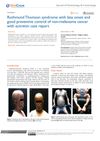 August 2024 in “Journal of Dermatology & Cosmetology”
 Acitretin effectively prevented skin cancer in a patient with late-onset Rothmund-Thomson syndrome.
15 citations
,
July 2004 in “AIDS” Indinavir therapy can cause reversible skin, hair, and nail darkening.
July 2024 in “Journal of Investigative Dermatology” INTASYL is a promising, adaptable RNAi technology for treating skin cancers.
 30 citations
,
December 2001 in “Experimental dermatology”
30 citations
,
December 2001 in “Experimental dermatology” Gonadal hormones significantly affect the severity of alopecia areata in mice.
November 2022 in “Indian Journal of Dermatology” Azole antifungals can cause skin reactions like EAC, requiring careful management.
 April 2019 in “Journal of Investigative Dermatology”
 The created skin model with melanoblasts improves the study of skin color and offers an alternative to animal testing.
 14 citations
,
April 2017 in “American Journal of Transplantation”
14 citations
,
April 2017 in “American Journal of Transplantation” Skin problems from transplant drugs are common and need careful management in organ transplant patients.
 January 2019 in “Przegląd Dermatologiczny”
 Chemotherapy with docetaxel can cause painful nail and skin side effects that may lead to stopping treatment.
10 citations
,
June 2009 in “Acta Biochimica Polonica” Old C57BL/6 mice with unsynchronized hair cycles show less melanin in their spleens.
July 2024 in “Journal of Investigative Dermatology” Topical melatonin may reduce skin aging by inhibiting certain cellular pathways.