Hair prostheses are important for people with significant hair loss.
 18 citations
,
March 2022 in “Drug design, development and therapy”
18 citations
,
March 2022 in “Drug design, development and therapy” Platelet-rich plasma (PRP) may help with various hair loss types, but more research is needed to find the best use method.
September 2021 in “Medicina Estética Revista Científica de la Sociedad Española de Medicina Estética (SEME)” The treatment improved hair growth and thickness in most patients with minimal side effects.
 14 citations
,
May 2018 in “Journal of the American Academy of Dermatology”
14 citations
,
May 2018 in “Journal of the American Academy of Dermatology” Platelet-rich plasma might be a new way to treat lichen planopilaris.
 January 2022 in “Journal of Cosmetic Dermatology”
 Placebo effects vary in hair loss trials, with split-scalp trials showing higher hair density after 6 months compared to whole-head trials.
 June 2024 in “Journal of Cosmetic Dermatology”
 PRP shows promise for hair growth, but more research and standardized protocols are needed.
 January 2024 in “International Journal of Advanced Research”
 Topical 6% salicylic acid effectively reduced skin plaques in a patient with wooly hair and palmoplantar keratoderma.
December 2023 in “Biblioteca Digital - Universidad Icesi” Chebe offers natural hair care products to prevent hair loss in Afro-Colombian women.
 19 citations
,
May 2016 in “Clinical, cosmetic and investigational dermatology”
19 citations
,
May 2016 in “Clinical, cosmetic and investigational dermatology” FGF-2&D/P nanoparticles can help treat hair loss.
8 citations
,
June 2024 in “Pharmaceutics” PEA-ENL improves skin delivery and reduces inflammation without side effects.
10 citations
,
January 1925 in “Archives of Dermatology” Trichostasis spinulosa is a rare skin condition with hair-filled plugs in hair follicles.
 1 citations
,
May 2025 in “Natural Products and Bioprospecting”
1 citations
,
May 2025 in “Natural Products and Bioprospecting” PEVIII is a promising treatment for Pseudomonas aeruginosa keratitis.
 September 2016 in “Journal of the Society of Cosmetic Scientists of Korea”
 Pine resin and abietic acid were found to promote hair growth in mice.
 June 2023 in “Journal of cosmetic dermatology”
 Both DPCP alone and with PRP are effective and safe for treating severe alopecia areata.
October 2025 in “Skin Health and Disease” Photothermal conditioning of PRP shows promise for improving hair growth but needs more research for confirmation.
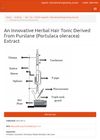
Portulaca-based hair tonics are promising eco-friendly and effective cosmetic alternatives.
 4 citations
,
August 2022 in “The Scientific World Journal”
4 citations
,
August 2022 in “The Scientific World Journal” Merremia peltata leaf extract, particularly the bufotalinin compound, shows potential for treating hair loss.
 January 2025 in “Turkiye Klinikleri Journal of Ophthalmology”
 Pilomatrixoma is a rare, harmless tumor near the eyebrow in kids, best treated with surgery.
 7 citations
,
December 2016 in “Journal of The Taiwan Institute of Chemical Engineers”
7 citations
,
December 2016 in “Journal of The Taiwan Institute of Chemical Engineers” Pig blood plasma can be used to promote human hair growth and is a good alternative to the commonly used serum additive.
 66 citations
,
June 2015 in “Aesthetic Plastic Surgery”
66 citations
,
June 2015 in “Aesthetic Plastic Surgery” Platelet preparations generally show positive effects on wound healing and facial rejuvenation, but more thorough research is needed to confirm their effectiveness.
June 2026 in “The Journal of Cosmetic Medicine” Scalp micropigmentation effectively creates the look of fuller hair but requires skilled application and touch-ups.
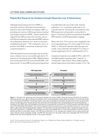 5 citations
,
April 2017 in “Dermatologic Surgery”
5 citations
,
April 2017 in “Dermatologic Surgery” PRP treatment satisfies 58% of female hair loss patients, with most noticing fuller, thicker hair and less shedding.
1 citations
,
September 2025 in “Plastic and Aesthetic Nursing”  33 citations
,
February 2019 in “Journal of Tissue Engineering and Regenerative Medicine”
33 citations
,
February 2019 in “Journal of Tissue Engineering and Regenerative Medicine” Platelet-Rich Plasma (PRP) shows promise for treating various skin conditions, but more research is needed to standardize its use.
1 citations
,
May 1983 in “Acta dermato-venereologica” The hairpiece matted due to weathered hair after shampooing.
An 11-year-old female Pinscher with Pemphigus Foliaceus was successfully diagnosed and treated.
 208 citations
,
December 2003 in “Journal of Investigative Dermatology”
208 citations
,
December 2003 in “Journal of Investigative Dermatology” Certain cells from hair follicles can create new hair and contribute to hair growth when implanted in mice.
June 2021 in “Aesthetic Surgery Journal” PRP improves hair growth in AGA, but higher concentrations aren't significantly better than lower ones.
 October 2023 in “Peer review”
 PRP is a safe and effective treatment for hair loss.
 16 citations
,
March 2020 in “Facial Plastic Surgery Clinics of North America”
16 citations
,
March 2020 in “Facial Plastic Surgery Clinics of North America” Platelet-Rich Plasma (PRP), a substance from a patient's own blood, can stimulate hair regrowth in people with Androgenetic Alopecia (AGA) who haven't had success with other treatments, but more research is needed to optimize its use.