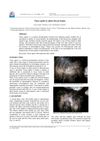
An adult Libyan woman was successfully treated for a rare scalp infection usually seen in children.
 April 2012 in “Journal of the American Academy of Dermatology”
 Dermoscopy can help diagnose tinea capitis in children by looking for comma hairs, black dots, and broken hairs with white bands.
 143 citations
,
October 2008 in “Journal of The American Academy of Dermatology”
143 citations
,
October 2008 in “Journal of The American Academy of Dermatology” Comma hairs are a specific sign of tinea capitis when viewed with videodermatoscopy.
 44 citations
,
March 1991 in “International Journal of Dermatology”
44 citations
,
March 1991 in “International Journal of Dermatology” Prompt treatment of inflammatory tinea capitis (kerion) is crucial to prevent scarring and hair loss.
 38 citations
,
July 2010 in “Clinical, cosmetic and investigational dermatology”
38 citations
,
July 2010 in “Clinical, cosmetic and investigational dermatology” To treat tinea capitis in children, oral antifungal medication is necessary, with newer drugs offering shorter treatment times than the traditional griseofulvin.
 36 citations
,
October 2016 in “Medical mycology”
36 citations
,
October 2016 in “Medical mycology” PCR-ELISA is better for identifying the fungus causing scalp infections in Ugandan children than traditional methods.
 35 citations
,
January 1996 in “Dermatologic clinics”
35 citations
,
January 1996 in “Dermatologic clinics” Tinea capitis is a common scalp infection causing hair loss, mostly in young children.
 33 citations
,
December 2013 in “Journal of cutaneous pathology”
33 citations
,
December 2013 in “Journal of cutaneous pathology” A fungal infection can look like a different scalp condition in teens, leading to wrong treatment until proper tests are done.
 29 citations
,
April 2013 in “Mycoses”
29 citations
,
April 2013 in “Mycoses” A young man was initially misdiagnosed with a scalp condition but was found to have a fungal infection, which improved with antifungal treatment.
 15 citations
,
August 2015 in “Scanning”
15 citations
,
August 2015 in “Scanning” Corkscrew and cigarette-ash-shaped hairs in tinea capitis are caused by internal hair degradation and external resistance.
 11 citations
,
May 2010 in “Annals of the Academy of Medicine Singapore”
11 citations
,
May 2010 in “Annals of the Academy of Medicine Singapore” Tinea capitis can cause scalp issues in children and should be considered in similar cases; treatment with griseofulvin and selenium sulfide is effective.
 3 citations
,
April 2021 in “Berkala ilmu kedokteran/Journal of the medical sciences”
3 citations
,
April 2021 in “Berkala ilmu kedokteran/Journal of the medical sciences” A fungus called Epidermophyton floccosum can cause scalp infections.
 January 2026 in “Pediatria Polska”
 Early diagnosis and treatment of tinea capitis in children is crucial to prevent permanent hair loss and scarring.
 October 2022 in “Gadua Journal of Pure and Allied Science”
 Terbinafine is the most effective treatment for tinea capitis, a scalp infection often confused with other conditions.
 October 2022 in “The Journal of Family Practice”
 Tinea capitis is a scalp fungal infection in children that can cause hair loss, scaling, and other symptoms.
 March 2022 in “Berkala Ilmu Kesehatan Kulit dan Kelamin/Berkala ilmu kesehatan kulit dan kelamin (Periodical of dermatology and venerology)”
 Touching cats can increase the risk of getting a fungal scalp infection, especially in boys and kids over 5.
 April 2019 in “Journal of Medical Science And clinical Research”
 The grey patch variant of tinea capitis is most common, mainly spread through family and animals.
 June 2017 in “Çocuk Enfeksiyon Dergisi/Journal of Pediatric Infection”
 Tinea capitis can rarely cause urticarial skin reactions in children.
 43 citations
,
August 2013 in “Pediatric Dermatology”
43 citations
,
August 2013 in “Pediatric Dermatology” Trichoscopy is good for diagnosing and monitoring hair and scalp problems in children but needs more research for certain conditions.
 16 citations
,
January 2013 in “Indian Journal of Dermatology, Venereology and Leprology”
16 citations
,
January 2013 in “Indian Journal of Dermatology, Venereology and Leprology” New treatments and early diagnosis methods for permanent hair loss due to scar tissue are important for managing its psychological effects.
 November 2015 in “European Journal of Inflammation”
 Cicatricial alopecia, a permanent hair loss condition, is mainly caused by damage to specific hair follicle stem cells and abnormal immune responses, with gene regulator PPAR-y and lipid metabolism disorders playing significant roles.
 23 citations
,
July 1982 in “International Journal of Dermatology”
23 citations
,
July 1982 in “International Journal of Dermatology” The review concludes that accurate diagnosis of different types of hair loss requires proper biopsy techniques and understanding the hair growth cycle and underlying causes.
 May 2024 in “International Journal of Science and Research Archive”
 Herbal hair oil made from herbs and coconut oil helps reduce dandruff and hair fall.
 February 2026 in “International Journal of Homoeopathic Sciences”
 Homeopathy may help reduce hair pulling and improve hair regrowth in trichotillomania.

Coconut oil can damage hair by clogging pores, causing frizz, and disrupting moisture balance.
 June 2023 in “Dermatology and therapy”
 Doctors in the Middle East need better treatments and more knowledge about new therapies for hair loss condition Alopecia Areata.
 3 citations
,
January 2019 in “Skin Research and Technology”
3 citations
,
January 2019 in “Skin Research and Technology” Frequent use of hair straighteners can cause hair loss similar to scarring alopecia in young Turkish women.
 September 2025 in “International Journal of Ayurveda and Pharma Research”
 Anutaila Nasya is more effective in reducing hair fall than Keshamitra Yoga alone.
 January 2016 in “Elsevier eBooks”
 Trichoscopy is a key method for dermatologists to quickly and effectively diagnose hair and scalp conditions.
22 citations
,
October 2007 in “JDDG Journal der Deutschen Dermatologischen Gesellschaft” Combining isotretinoin and dapsone effectively treated a challenging scalp condition.