 January 2025 in “International Journal of Pharmaceutical Research and Applications”
 The hair gel with Mussaenda frondosa leaf extract effectively removes dandruff and improves hair and scalp health.
 August 2024 in “RCMOS - Revista Científica Multidisciplinar O Saber”
 Barbershops should prioritize safe, responsible scalp care and refer clients to dermatologists when needed.
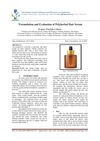 June 2024 in “International Journal of Pharmaceutical Research and Applications”
 Polyherbal hair serum can hydrate the scalp and promote hair growth safely.
 February 2024 in “International journal of biology, pharmacy and allied sciences”
 The polyherbal hair oil effectively treats various hair problems and promotes hair health.
Hair proteins in preschool children and their mothers could indicate developmental changes and health status.
 January 2024 in “International Journal of Homoeopathic Sciences”
 Homeopathic treatment may help manage alopecia areata.
 September 2023 in “British Journal of Dermatology”
 Hair regrowth from severe alopecia areata treatment with baricitinib can vary, with faster results in those with shorter hair loss duration.

Higher disease activity in systemic lupus erythematosus is strongly linked to more internal organ damage.
 January 2023 in “International Journal for Research in Applied Science and Engineering Technology”
 Herbs like Tea Tree Oil and Aloe Vera could be safer, more conditioning antidandruff alternatives to synthetic products.
January 2023 in “Springer eBooks”  July 2021 in “Indian journal of dermatopathology and diagnostic dermatology”
 Trichoscopy is a reliable method for diagnosing hair and scalp disorders quickly and non-invasively.
 July 2019 in “Journal der Deutschen Dermatologischen Gesellschaft”
 A mother and daughter have a rare genetic hair loss disorder with no effective treatment.
 July 2018 in “Elsevier eBooks”
 The most common cause of hair loss in children is tinea capitis, followed by alopecia areata and telogen effluvium.
 April 2018 in “Journal of Investigative Dermatology”
 Macrophages are more involved in Lichen planopilaris than in Frontal fibrosing alopecia.
 September 2017 in “Journal of Investigative Dermatology”
 Certain miRNAs might be involved in a hair loss condition called frontal fibrosing alopecia and could possibly help in its diagnosis.
 April 2017 in “Journal of Investigative Dermatology”
 Deep phenotyping helps distinguish between xeroderma pigmentosum and trichothiodystrophy, aiding in diagnosis and treatment.
 April 2016 in “Journal of Investigative Dermatology”
 Tumor cell adhesion is linked to higher risk of SLN metastasis and melanoma recurrence, and a model including these factors predicts these outcomes better than one with just clinical data.
 January 2014 in “Journal of Investigative Dermatology”
 Proteins like aPKC and PDGF-AA, substances like adenosine and ATP, and adipose-derived stem cells all play important roles in hair growth and health, and could potentially be used to treat hair loss and skin conditions.
 September 2013 in “Hair transplant forum international”
 Dr. Robert S. Haber concluded that hair transplant surgeons must master scalp biopsy techniques to quickly diagnose and treat hair loss conditions.

Accurate diagnosis of cicatricial alopecias requires thorough scalp examination and multiple biopsy techniques.
 January 2011 in “Medicina interna de México”
 The document concludes that treating the underlying causes of telogen effluvium usually results in hair regrowth.
 September 2007 in “Dermatologic Surgery”
 3% hydrogen peroxide does not reduce hair graft survival compared to saline.
 October 2003 in “Journal of Investigative Dermatology Symposium Proceedings”
 Mice treatments didn't grow hair, a patient treatment may affect immune response, and people with hair loss often feel anxious or depressed.
 September 2003 in “Journal of the Royal Society of Medicine”
 The document concludes that while some advocate for a patient voucher system, it may be unequal and current healthcare reforms should be given a chance, and it also recommends various medical books for their comprehensive coverage and advice on specific health issues.
 August 2003 in “International Journal of Cosmetic Surgery and Aesthetic Dermatology”
 The document recommends the reviewed medical books for professionals in cosmetic surgery, dermatology, and genetics.
 June 2025 in “ARSHI Veterinary Letters”
 The cat's skin condition improved and hair regrew after antifungal treatment.
 September 2023 in “Jurnal Ilmu Kesehatan Hewan”
 The dog improved significantly after treatment for skin mites and fungi.
 January 2023 in “Pesquisa Veterinária Brasileira”
 A KRT71 mutation in Hereford cattle in Uruguay causes thin, curly hair and scaly skin.
 October 2022 in “Veterinária notícias/Veterinária Notícias”
 A 5-year-old Akita with a rare skin condition improved significantly after treatment.
December 2022 in “Frontiers in Microbiology” The scalp microbiome is more diverse and may be more important in hair loss than the gut microbiome.