 25 citations
,
January 2001 in “Facial Plastic Surgery”
25 citations
,
January 2001 in “Facial Plastic Surgery” Both tissue expansion and serial excision are effective for scar revision in the head and neck area.
 1 citations
,
August 2018 in “Journal of The American Academy of Dermatology”
1 citations
,
August 2018 in “Journal of The American Academy of Dermatology” Patients with melanoma who saw dermatologists and were from higher-income areas were more likely to have follow-up visits, which was linked to lower mortality.
2 citations
,
November 2014 in “International Scholarly Research Notices” The terpenoid fraction may cause thicker scars by delaying wound healing.
 November 2022 in “Archives of Plastic Surgery”
 Hair transplant technique can be used to treat thin scars after skull surgery.
 8 citations
,
March 1994 in “The American Journal of Cosmetic Surgery”
8 citations
,
March 1994 in “The American Journal of Cosmetic Surgery” The Total Excision Techniques improve hair transplant results by increasing grafts by at least 50% and reducing scarring.
 1 citations
,
July 2021 in “Aesthetic Plastic Surgery”
1 citations
,
July 2021 in “Aesthetic Plastic Surgery” The new triangular flag-shaped design for incisions in hair transplant surgery provides better hair alignment and cosmetic appearance without extra scarring, especially for patients with specific hair directions.
 July 2026 in “Preprints.org”
 Combining fat grafting, hair transplantation, and scalp micropigmentation effectively restores appearance and improves life for burn survivors.
January 2025 in “Dermatologic Therapy” Combining punch excision with superficial X-ray effectively improves keloid scars safely.
October 2022 in “Hair Transplantation” Improving donor scar appearance in hair transplants involves careful technique and addressing factors like tension, scalp elasticity, and patient habits.
 10 citations
,
January 2018 in “Elsevier eBooks”
10 citations
,
January 2018 in “Elsevier eBooks” Burn scars heal abnormally and more research is needed to find better treatments.
 9 citations
,
March 2020 in “Dermatologic Surgery”
9 citations
,
March 2020 in “Dermatologic Surgery” Both Follicular Unit Transplantation (FUT) and Follicular Unit Excision (FUE) are effective hair transplant methods; the best choice depends on the patient's needs and the surgeon's preference.
 2 citations
,
January 2022 in “Hair transplant forum international”
2 citations
,
January 2022 in “Hair transplant forum international” The FUE-LE technique combines two hair transplant methods to harvest more hair with minimal visible scarring, especially for patients with advanced hair loss.
 January 2024 in “Journal of cosmetic dermatology”
 Long-hair follicular unit excision improves hairline restoration results and patient satisfaction.
October 2022 in “Hair Transplantation” FUE is popular due to no linear scar, but choice depends on personal preference and specific factors.
 June 2023 in “Clinical Case Reports”
 Complete surgical removal and regular check-ups are essential for treating a rare skin cancer, and hair transplant can help fix scars from cancer surgery.
 April 2023 in “Authorea (Authorea)”
 Hair transplantation can improve scars after removing a rare skin cancer.
 6 citations
,
July 2017 in “Clinics in Plastic Surgery”
6 citations
,
July 2017 in “Clinics in Plastic Surgery” The document concludes that individualized reconstruction plans are essential for improving function and appearance after head and neck burns.
January 2004 in “Linchuang pifuke zazhi” A man lost hair permanently from a salon burn, and surgery was needed to fix the scar.
 February 2025 in “Dermatologic Surgery”
 Hair follicle transplantation can help treat wounds, sweating, odor, and skin conditions beyond just restoring hair.
 January 2022 in “Consultant”
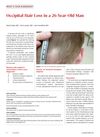
 The man's occipital hair loss was due to temporal triangular alopecia, not alopecia areata.
April 2025 in “ALEXMED ePosters” Combining nanofat with FUE improves scar appearance and function better than FUE alone.
 December 2023 in “Facial Plastic Surgery”
 Follicular unit excision (FUE) is a popular hair transplant method that avoids a linear scar but has potential challenges and side effects if not done properly.
 12 citations
,
April 2014 in “Facial Plastic Surgery Clinics of North America”
12 citations
,
April 2014 in “Facial Plastic Surgery Clinics of North America” Direct excision techniques can rejuvenate the neck but may not enhance the jawline and could cause neck-face disharmony if done incorrectly.
 4 citations
,
January 2009 in “Indian Journal of Plastic Surgery”
4 citations
,
January 2009 in “Indian Journal of Plastic Surgery” Surgery for scar-related hair loss on the scalp and eyebrow was successful in 75% of patients.
81 citations
,
January 2003 in “Journal of cosmetic and laser therapy” New techniques have improved acne scar treatment, but multiple tailored sessions are often needed.
1 citations
,
October 2022 in “Hair Transplantation” Surgical correction of cicatricial alopecia requires careful planning, with excision preferred over hair transplantation, and surgery should be delayed for stable conditions.
 December 2022 in “Indian Journal of Plastic Surgery”
 Hair transplant improved a facial scar and patient satisfaction.
 September 2021 in “PubMed”
 Hair transplantation is effective for treating scar-related hair loss on the head and neck.
 July 2021 in “World journal of plastic surgery”
 Hair transplantation is effective for treating scar-related hair loss on the head and neck.
 January 2023 in “Burns & Trauma”
 The study concluded that the new wound model can be used to evaluate skin regeneration and nerve growth.