 11 citations
,
January 2014 in “Indian journal of dermatology, venereology, and leprology”
11 citations
,
January 2014 in “Indian journal of dermatology, venereology, and leprology” Trichosporon inkin and Trichosporon mucoides can cause white piedra on scalp hair.
 24 citations
,
November 1978 in “Biochemistry”
24 citations
,
November 1978 in “Biochemistry” α-type filaments in guinea pig hair follicles have unique structural features.
36 citations
,
January 1994 in “Cell and Tissue Research” 1 citations
,
January 2007 in “中国科学通报:英文版” Women's hair has more sulfur, and black hair has more calcium than white hair.
 191 citations
,
November 1959 in “Annals of the New York Academy of Sciences”
191 citations
,
November 1959 in “Annals of the New York Academy of Sciences” Hair and wool have complex microscopic structures with microfibrils and varying cystine content.
9 citations
,
July 2014 in “PubMed” Different S100 proteins have specific roles in various parts of the hair follicle.
 February 2024 in “ACS applied bio materials”
 Keratin microspheres might help hair grow.
28 citations
,
October 1985 in “The Journal of Cell Biology” Researchers isolated and identified structural components of human hair follicles, providing a model for studying hair formation.
Spiny mice have resilient, large mitochondria that help them regenerate tissue.
 239 citations
,
December 2013 in “Scientific Reports”
239 citations
,
December 2013 in “Scientific Reports” A new method quickly creates controllable cell clusters for tissue engineering and drug testing.
July 2025 in “Journal of Investigative Dermatology” 7 citations
,
January 1973 in “Calcified Tissue International” Hair follicle tissue can induce mineral formation, likely due to a potent nucleator.
1 citations
,
January 2004 in “Adelaide Research & Scholarship (AR&S) (University of Adelaide)” SPARC likely aids in tissue remodeling during the hair cycle, not in starting new hair growth phases.
35 citations
,
January 2000 in “Journal of comparative neurology” Rat vibrissae have sensory terminals with specific structures that help detect hair movements.
4 citations
,
January 2006 in “International Journal of Cosmetic Science” The method shows how hair lipids form specific patterns and their roles in hair structure.
22 citations
,
September 2001 in “Journal of Investigative Dermatology” S100A8 and S100A9 proteins help form hair shafts during growth.
9 citations
,
February 2016 in “Anatomical Science International” Hair proteins change location and structure as hair cells mature.
26 citations
,
December 1979 in “Journal of Cutaneous Pathology” Seborrheic keratoses may partly come from hair follicle cells.
 418 citations
,
September 2012 in “Nature”
418 citations
,
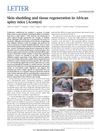
September 2012 in “Nature” African spiny mice can regenerate skin, hair, and cartilage, but not muscle, and their unique abilities could be useful for regenerative medicine.
56 citations
,
February 2012 in “Developmental biology” Sostdc1 controls the size and number of hair and mammary gland structures.
89 citations
,
May 2005 in “Stem Cells” Mouse skin has special cells in the epidermis that decrease with age and are linked to keratinocyte stem cells.
24 citations
,
June 2003 in “Journal of Structural Biology” Sheet formation is key to macrofibril structure differences in wool.
 37 citations
,
February 2019 in “Experimental Dermatology”
37 citations
,
February 2019 in “Experimental Dermatology” Spiny mice are better at regenerating hair after injury than laboratory mice and could help us understand how to improve human skin repair.
8 citations
,
May 2005 in “The American journal of dermatopathology/American journal of dermatopathology” The hair defect is due to abnormal inner root sheath keratinization.
 June 2020 in “Journal of Investigative Dermatology”
 The technique effectively shows how human skin and hair cells form into ball-like structures.
5 citations
,
July 1999 in “Journal of Anatomy” Methylene blue staining effectively reveals detailed nerve structures in rat snouts.
 15 citations
,
May 2003 in “The Laryngoscope”
15 citations
,
May 2003 in “The Laryngoscope” FGF-1 causes spiral ganglion neurites to branch more.
 316 citations
,
June 2004 in “The journal of investigative dermatology/Journal of investigative dermatology”
316 citations
,
June 2004 in “The journal of investigative dermatology/Journal of investigative dermatology” Microspheres about 1.5 micrometers in size can best penetrate hair follicles, potentially reaching important stem cells.
Encapsulating hair follicle cells in a special gel boosts their activity.
April 2018 in “Journal of Investigative Dermatology” African spiny mice can regenerate skin and hair after wounds due to specific tissue mechanics.