 December 2011 in “Journal of The American Academy of Dermatology”
 The book is a detailed and useful guide for doctors learning about hair transplantation.
 July 2011 in “Microscopy and microanalysis”
 Human hair's structure makes it tough and resistant to breaking.
Hair properties change under electromagnetic fields and are influenced by individual characteristics and the environment.
 June 2002 in “Seminars in Cutaneous Medicine and Surgery”
 Hair transplantation has improved to more natural-looking results and is complemented by effective non-surgical treatments, with ongoing research into hair follicle cloning.
 May 2015 in “Journal of The American Academy of Dermatology”
 A woman with Parry-Romberg syndrome developed new curly hair on one side of her scalp, a condition not previously linked to the syndrome.
49 citations
,
April 2007 in “Pediatric Dermatology” Biotin improved hair appearance in uncombable hair syndrome but didn't change hair structure.
 November 2005 in “Nature Reviews Molecular Cell Biology”
 The protein hairless is important for hair regrowth because it stops the protein wise from blocking the hair cycle.
 1 citations
,
December 1972 in “Journal of Colloid and Interface Science”
1 citations
,
December 1972 in “Journal of Colloid and Interface Science” Ethanol spreads well on hair at low humidity but less so at higher humidity due to water condensation.
78 citations
,
June 2003 in “Journal of the American Academy of Dermatology” Curly hair shape is determined by the hair bulb.
 16 citations
,
October 2003 in “Journal of applied polymer science”
16 citations
,
October 2003 in “Journal of applied polymer science” 2-iminothiorane hydrochloride improves hair waving permanence without damage.
Researchers developed a new model for more realistic computer graphics of hair by considering how light scatters on hair fibers.
32 citations
,
March 2016 in “American Journal of Physical Anthropology” African hair is curled, Asian hair is thick, European hair is lighter, and chemical methods help identify hair color differences.
The guide teaches wig-making and styling for theater and film.
May 2026 in “Journal of Investigative Dermatology”  June 2004 in “Dermatologic Surgery”
 Dr. Walter P. Unger suggests that copying a person's natural hair direction and angle during transplants leads to a more natural and fuller appearance.
1 citations
,
January 2019 in “Archives of Clinical and Medical Case Reports” Changing hair's surface and structure can help protect its natural oils from being washed away.
 5 citations
,
January 2010 in “The anatomical record”
5 citations
,
January 2010 in “The anatomical record” Most dogs have hair whorls on their chest and limbs, with shelter dogs and short-haired dogs having more chest whorls.
 July 2025 in “Journal of Cosmetic Dermatology”
 The model shows how heat damages hair, helping test hair care products.

The document concludes that the new model realistically simulates male baldness and could be useful for medical purposes and entertainment.
 January 2020 in “Clinical dermatology open access journal”
 Changing certain hairstyles can prevent worsening hair loss in Mexican women.
17 citations
,
June 1990 in “PubMed” Hair varies in size and features depending on body region.
January 2022 in “Clinical Cases in Dermatology” A 4-year-old boy has a rare type of hair loss in a line pattern on his scalp.
December 2000 in “Kirk-Othmer Encyclopedia of Chemical Technology” Hair care products are regulated, with shampoos, conditioners, dyes, and styling products designed for cleaning, enhancing, and maintaining hair.
3 citations
,
December 2021 in “Skin research and technology” Higher hair luminosity and shine mean higher perceived transparency.
 4 citations
,
August 2023 in “Nature Communications”
4 citations
,
August 2023 in “Nature Communications” Mouse zigzag hair bends form due to a 3-day cycle of changes in hair progenitors and their environment.
 24 citations
,
November 2015 in “Scientific reports”
24 citations
,
November 2015 in “Scientific reports” Human hair has a new region with ordered filaments and the cuticle contains β-keratin sheets.
Hairline design is crucial for lasting, natural-looking hair restoration in West Asians.
 1 citations
,
August 2011 in “Dermatology Reports”
1 citations
,
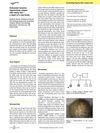
August 2011 in “Dermatology Reports” Two siblings were found to have a genetic condition causing progressive hair loss and woolly hair, which may often be misdiagnosed.
3 citations
,
January 2020 in “JAAD Case Reports” A girl had two rare hair conditions that helped understand their overlap.
 September 2024 in “Institutional Repositories DataBase (IRDB)”
 Young cancer survivors need better information on wigs and hair regrowth.