 4 citations
,
November 2015 in “Aesthetic Plastic Surgery”
4 citations
,
November 2015 in “Aesthetic Plastic Surgery” Using tissue expanders for scalp reconstruction in patients with extensive Aplasia Cutis Congenita is effective and has minimal complications.
 13 citations
,
November 2018 in “Annals of Plastic Surgery”
13 citations
,
November 2018 in “Annals of Plastic Surgery” Nonshaven follicular unit extraction is a good hair transplant option that doesn't require shaving and can transplant up to 3000 grafts daily.
March 2007 in “Journal of Plastic Reconstructive & Aesthetic Surgery” A new method was developed to create better skin models for healing and reconstruction.
 1 citations
,
November 2020 in “Dermatologic Surgery”
1 citations
,
November 2020 in “Dermatologic Surgery” Using combined hair restoration methods can effectively treat severe scalp wrinkling.
 10 citations
,
July 1981 in “Archives of Otolaryngology-head & Neck Surgery”
10 citations
,
July 1981 in “Archives of Otolaryngology-head & Neck Surgery” Short scalp flaps are easier but not good for severe baldness; Juri flaps are complex but better for density and coverage.
 August 1998 in “Dermatologic Surgery”
 Follicular unit hair transplantation is better than Miniflap Hair Restoration due to less scarring and more natural results.
 September 1997 in “Dermatologic Surgery”
 Hair restoration has greatly improved, allowing for natural-looking hairlines and better results.
41 citations
,
January 2006 in “Dermatology” Noncultured epidermal cell transplantation is effective for repigmenting stable vitiligo.
 October 2001 in “Dermatologic Surgery”
 Cutting and implanting hair follicles can create finer, more natural-looking hairlines, with about half of the implanted hairs growing back.
4 citations
,
October 2015 in “JAAD Case Reports” Surgical grafting may fix nail issues caused by valproic acid.
 49 citations
,
March 2014 in “Journal of Investigative Dermatology”
49 citations
,
March 2014 in “Journal of Investigative Dermatology” Using the drugs AMD3100 and Tacrolimus together greatly improves skin healing and hair growth after a deep skin cut by increasing stem cells in the wound.
January 2001 in “Chinese Journal of Aesthetic Medicine” Transplanting individual hair follicles can effectively restore natural-looking eyebrows.
12 citations
,
June 2012 in “Wound Repair and Regeneration” Regulating keratinocyte growth in engineered skin can improve wound healing.
May 2025 in “Arquivos Catarinenses de Medicina” Fat micrografting improves hair transplant success in burn-related hair loss.
 25 citations
,
March 2009 in “Dermatologic Surgery”
25 citations
,
March 2009 in “Dermatologic Surgery” Eyebrow transplantation can be successful for Asians with the right technique and care, but regular maintenance is necessary.
 2 citations
,
October 2010 in “Springer eBooks”
2 citations
,
October 2010 in “Springer eBooks” Using cheek skin and cartilage grafts for nose reconstruction after skin cancer surgery can maintain shape and function but may require multiple surgeries and hair removal in men.
3 citations
,
July 2010 in “Dermatologic surgery” The technique effectively makes Asian eyelashes look fuller and more natural.
January 2008 in “Hair transplant forum international”  September 2024 in “Journal of Cutaneous and Aesthetic Surgery”
 A young man with severe neck and beard burns was successfully treated, restoring neck movement and improving skin appearance.

Plucked hair follicles grow faster than conventional ones, making them a potentially better option for hair transplants.
 2 citations
,
September 2014 in “The American Journal of Cosmetic Surgery”
2 citations
,
September 2014 in “The American Journal of Cosmetic Surgery” Stem cells could potentially rebuild missing structures in wounds, improving facial skin replacement techniques.
42 citations
,
April 2016 in “Plastic and reconstructive surgery/PSEF CD journals” The hydrogel with fractionated PRP improves skin regeneration by enhancing wound healing and growth of skin structures.
 4 citations
,
January 2008 in “Facial Plastic Surgery”
4 citations
,
January 2008 in “Facial Plastic Surgery” Improve skin paddle appearance after head and neck reconstruction using tissue expansion, rearrangement, and flaps.
 1 citations
,
January 2008 in “Hair transplant forum international”
1 citations
,
January 2008 in “Hair transplant forum international” The document could not be processed to provide a conclusion.
 December 2025 in “Journal of Maxillofacial and Oral Surgery”
 Sapphire blades, double-forceps, and personalized procedures improve hair transplant success and satisfaction.
3 citations
,
April 2000 in “Plastic and Reconstructive Surgery”  July 2024 in “International Journal of Dermatology Venereology and Leprosy Sciences”
 Scalp tissue micrografts can effectively treat hair loss by increasing hair density and thickness.
December 2023 in “Medicine” Platelet-rich gel is a simpler, cheaper, and painless option for scalp defects, but tissue expansion offers better hair growth despite more pain.
 4 citations
,
October 2020 in “Journal of oral and maxillofacial surgery”
4 citations
,
October 2020 in “Journal of oral and maxillofacial surgery” Tisseel shows promise for bone graft stabilization but needs more clinical trials to confirm its effectiveness.
 8 citations
,
January 2007 in “International Society of Hair Restoration Surgery”
8 citations
,
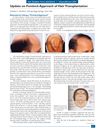
January 2007 in “International Society of Hair Restoration Surgery” The forelock approach in hair transplants improves natural appearance by focusing hair density in one area.