
Choose the best brow lift method based on patient needs and goals.
October 2023 in “Asian journal of pharmaceutical and clinical research” Standardized data is essential for diagnosing scalp and hair conditions in males.
 September 2023 in “Journal of the American Academy of Dermatology”
 Increased awareness and research are needed to prevent hair loss from cosmetic procedures.
 September 2023 in “Skin Research and Technology”
 The paper suggests a way to diagnose male hair loss and check treatment results using a dermoscope at four specific scalp points.
 September 2023 in “Hair transplant forum international”
 Temporary hair loss can happen after a facial rejuvenation procedure due to blood flow blockage caused by a certain filler.
July 2023 in “International journal of physiology” Hypertrichosis lanuginosa causes excessive fine hair growth, often linked to genetics or cancer, with limited treatment options.
June 2023 in “The Journal of Family Practice” The hair loss is likely due to a fade haircut.
 May 2023 in “Frontiers in chemistry”
 Zolpidem shows up in hair from the top back of the head after one dose and fades over time, suggesting it gets into hair through blood and sweat.
 January 2023 in “Al-Azhar International Medical Journal /Al-Azhar International Medical Journal”
 Trichoscopy is a quick, non-invasive way to measure hair density and thickness, helping diagnose hair loss.
 October 2022 in “Ophthalmic Plastic and Reconstructive Surgery”
 A child lost eyelashes on one eyelid after COVID-19, likely due to a temporary hair loss condition.
October 2022 in “Amplla Editora eBooks” COVID-19 can cause temporary hair loss in some people.
 July 2022 in “Research Square (Research Square)”
 Hair analysis can somewhat track past testosterone levels but is influenced by factors like hair washing, growth rate, sex, and hair color.
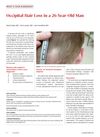 January 2022 in “Consultant”
 The man's occipital hair loss was due to temporal triangular alopecia, not alopecia areata.
November 2021 in “Медицинский алфавит” COVID-19 can cause temporary hair loss due to stress and inflammation.
Hair can naturally regain color, and stress might influence greying and its reversal.
 January 2021 in “Journal of Pakistan Association of Dermatology”
 COVID-19 recovery can lead to temporary hair loss called telogen effluvium.
January 2021 in “Hair therapy & transplantation” Telogen effluvium causes temporary hair loss, but new hair still grows.
 January 2020 in “Przegla̧d dermatologiczny”
 A 5-year-old boy was diagnosed with congenital triangular alopecia, a type of hair loss without skin changes, usually starting between ages 2-5, with no specific treatment.
 December 2019 in “Journal of pediatrics & neonatology”
 A 13-year-old boy had a rare, stable type of hair loss with little chance of regrowth, but treatment is available for looks.
 September 2019 in “Journal of The American Academy of Dermatology”
 Using a microfoam plaster on the forehead helps prevent eyelid swelling after hair transplant surgery.
 July 2018 in “Elsevier eBooks”
 The most common cause of hair loss in children is tinea capitis, followed by alopecia areata and telogen effluvium.
 January 2018 in “Springer eBooks”
 Congenital triangular alopecia is a harmless, non-spreading hair loss condition often seen in young children.
 April 2016 in “Journal of The American Academy of Dermatology”
 The study found that Temporal Triangular Alopecia often starts in early childhood, while Folliculitis Decalvans is characterized by tufted hairs and redness around hair follicles.
January 2016 in “프로그램북(구 초록집)” The revised BASP classification for hair loss is less accurate and harder to use but could still be a viable option.
 December 2014 in “PubMed”
 A scalp biopsy can help confirm hair loss types when other methods don't provide a clear diagnosis.

The document concludes that severe trauma can cause temporary hair loss, known as Telogen Effluvium, which usually resolves without treatment.
January 2013 in “프로그램북(구 초록집)” Hair perms or treatments seem safe to use up to 3 to 4 times during pregnancy.
 March 2012 in “Journal of The American Academy of Dermatology”
 Dermoscopy helps diagnose different hair loss conditions, and characteristics vary among ethnicities and individual cases.

The man has Temporal Triangular Alopecia, a stable, non-scarring hair loss condition best treated with hair transplantation.
 August 2011 in “Clinical and Experimental Dermatology”
 About 30% of women feel they lose too much hair, often starting before age 40, and most can't find a reason for it.