 November 2023 in “Indian Journal of Dermatology/Indian journal of dermatology”
 A well-equipped resident's bag enhances clinical skills, preparation, confidence, and learning for junior doctors.
April 2024 in “JURNAL ILMU KEFARMASIAN INDONESIA” The mud mask with 22.5% kaolin and pomegranate peel extract worked best.
September 2024 in “Journal of the American Academy of Dermatology” Generic topical and transdermal systems usually cause minimal irritation or sensitization.
 May 2026 in “Zenodo (CERN European Organization for Nuclear Research)”
 Hidradenitis suppurativa tunnels have different microenvironments, suggesting targeted treatments could be more effective.
 20 citations
,
February 1991 in “Archives of dermatology”
20 citations
,
February 1991 in “Archives of dermatology” High doses of tryptophan may cause eosinophilic fasciitis.
 5 citations
,
July 2017 in “Skin appendage disorders”
5 citations
,
July 2017 in “Skin appendage disorders” A man got a rare rash from the drug topiramate, which went away after he stopped taking it.
May 2022 in “The journal of immunology/The Journal of immunology” FOXN1 is crucial for thymus development and immune response in Xenopus laevis.
 August 2022 in “Archives of pediatric surgery”
 Hair-Thread Tourniquet Syndrome is a rare condition where hair or thread tightly wraps around a child's body part, requiring quick treatment to prevent damage.
 29 citations
,
November 2014 in “Experimental Dermatology”
29 citations
,
November 2014 in “Experimental Dermatology” Injecting alpha-melanocyte-stimulating hormone in mice improved skin healing and reduced scarring.
11 citations
,
January 1977 in “Archives of dermatological research” Mouse tail skin has different keratinization near hair follicles and scales.
 2 citations
,
December 2021 in “Aesthetic surgery journal”
2 citations
,
December 2021 in “Aesthetic surgery journal” The new silicone gel wound dressing may speed up early healing after hair transplant surgery compared to Bacitracin.
September 2012 in “British Small Animal Veterinary Association eBooks” January 2007 in “British Small Animal Veterinary Association eBooks” 
A neck lesion misdiagnosed as benign was later treated successfully with Mohs Micrographic Surgery.
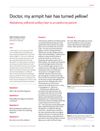
A 15-year-old boy's smelly, yellow armpit hair improved with clindamycin treatment.
 September 2025 in “Journal of Psychiatry Spectrum”
 Mirtazapine can cause male breast enlargement.
 15 citations
,
August 2015 in “Scanning”
15 citations
,
August 2015 in “Scanning” Corkscrew and cigarette-ash-shaped hairs in tinea capitis are caused by internal hair degradation and external resistance.

The digital system for measuring melasma shows promise but needs more development for better accuracy and automation.
 September 1997 in “Journal of the European Academy of Dermatology and Venereology”
 People with acne have more CD4+ immune cells in their skin than healthy people.
19 citations
,
April 2023 in “Antibiotics” Azelaic acid in a special gel is more effective against skin fungi than regular azelaic acid.
78 citations
,
May 2019 in “Frontiers in Cellular and Infection Microbiology” DPK-060 in poloxamer gel effectively treats skin infections, but nanocarriers don't enhance its efficacy.
July 2025 in “Journal of Investigative Dermatology” Acne involves increased lipid production and inflammation, affecting skin cell behavior and treatment resistance.
October 2025 in “The Sri Lanka Journal of Dermatology” SJS and TEN can cause long-term organ damage and psychological issues beyond skin and eye problems.
April 2018 in “Veterinary Pathology” Tigers had a skin condition causing hair loss and inflammation, but the cause is unknown and treatment didn't work.
8 citations
,
April 2016 in “Experimental dermatology” B6.Cg-Tyr c−2J Hr hr /J mice have a stronger delayed sunburn reaction and are good for UV research.
73 citations
,
November 2001 in “Journal of Investigative Dermatology Symposium Proceedings” Markers help differentiate between apocrine and eccrine sweat glands to identify sweat gland tumors.

Deleting Smad4 and PTEN genes in mice causes rapid, invasive forestomach cancer.
3 citations
,
July 2015 in “Biotechnic & histochemistry” Bim and Puma proteins are found in developing mouse hair follicles and are involved in more than just cell death.

Deleting Smad4 and PTEN genes in mice causes rapid, invasive stomach cancer.
23 citations
,
September 1997 in “Veterinary dermatology” Mupirocin ointment effectively treats feline acne.