 April 2016 in “Journal of Investigative Dermatology”
 Double-stranded RNA activates a pathway that causes a skin protein to be expressed in the wrong place.
 April 2016 in “Journal of Investigative Dermatology”
 Blocking Prostaglandin D₂ (PGD₂) could help treat hair loss.
 April 2016 in “Journal of Investigative Dermatology”
 Gypenosides from Gynostemma pentaphyllum were found to have anti-aging effects, increasing skin collagen and reducing wrinkles.
 April 2016 in “Journal of Investigative Dermatology”
 Lithocholic acid helps hair growth and regeneration in alopecia by activating vitamin D receptors.
 December 2015 in “Journal of Psoriasis and Psoriatic Arthritis”
 A patient experienced long-lasting hair loss after using acitretin for psoriasis.
 January 2012 in “Yearbook of Dermatology and Dermatologic Surgery”
 Some African American women experience central scalp hair loss, often linked to a history of fungal scalp infection.
 November 2011 in “Australasian Journal of Dermatology”
 Cellulite may be linked to low adiponectin, isotretinoin with UVB can treat psoriasis effectively, permanent alopecia post-chemotherapy resembles a unique hair loss, deodorants may cause fragrance allergies, desmoplastic melanoma is becoming more common, and intensive UVB treatment can give long-term psoriasis remission.
 February 2011 in “Annales de dermatologie et de vénéréologie”
 Tofacitinib shows promise for treating severe alopecia areata with good safety and effectiveness.
 September 2009 in “Dermato-endocrinology”
 Good nutrition and vitamins are important for healthy skin and can prevent diseases.
 March 2005 in “Journal of the American Academy of Dermatology”
 Bexarotene 1% topical gel helped some patients with alopecia areata regrow hair.
 September 1998 in “JEADV. Journal of the European Academy of Dermatology and Venereology/Journal of the European Academy of Dermatology and Venereology”
 Hair changes could indicate neurological diseases and help monitor treatment.
 September 1998 in “JEADV. Journal of the European Academy of Dermatology and Venereology/Journal of the European Academy of Dermatology and Venereology”
 The document concludes that individualized treatments for hair issues are effective, certain hair changes can indicate neurocutaneous diseases, specific lotions improve skin health, laser hair removal works but needs more study on long-term effects, men's cosmetics are diverse, peeling is effective but can have side effects, and facial pigmentation is often due to overactive skin cells.
 August 1996 in “Australasian Journal of Dermatology”
 The document concludes that "Photodamage" and "Photoimmunology" are valuable resources, while "Pediatric Dermatopathology" and "Hair and Scalp Disorders" have limitations.
 July 1989 in “British Journal of Dermatology”
 Long-term use of canthaxanthin may cause reversible changes in the eye, including crystal deposits and altered vision responses.
 March 1987 in “Journal of The American Academy of Dermatology”
 Oral spironolactone and isotretinoin are effective for treating acne.
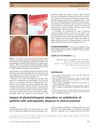 July 2014 in “Journal of Dermatology”
 Educating patients on phototrichogram increased satisfaction in androgenetic alopecia treatment.
 September 1997 in “Journal of The European Academy of Dermatology and Venereology”
 Hormonal differences affect male pattern baldness.
 2 citations
,
December 2020 in “American Journal of Dermatological Research and Reviews”
2 citations
,
December 2020 in “American Journal of Dermatological Research and Reviews” The combination therapy was effective and well-tolerated, especially in young patients.
March 2019 in “Reactions Weekly” December 2024 in “Medicina (Ribeirão Preto)” Adverse reactions to isotretinoin in acne treatment are common and mainly linked to treatment duration.
1 citations
,
June 2014 in “Journal of developmental biology” Retinoic acid helps change skin cells and is important for skin development and hair growth.
 September 2021 in “Revista Interdisciplinar em Saúde”
 Oral isotretinoína effectively stabilizes frontal fibrosing alopecia.
Isotretinoin effectively treats acne, often providing lasting relief.
24 citations
,
July 1994 in “Journal of Investigative Dermatology” May 2018 in “Dermatologic Surgery”  April 2017 in “Journal of Investigative Dermatology”
 Triptolide effectively and safely reduces actinic keratosis lesions in mice.
 7 citations
,
May 2022 in “International Journal of Environmental Research and Public Health”
7 citations
,
May 2022 in “International Journal of Environmental Research and Public Health” Isotretinoin therapy for acne can cause many reversible side effects, mainly mild skin conditions, and patient understanding of these effects can improve treatment adherence.
 1 citations
,
May 2024 in “Cureus”
1 citations
,
May 2024 in “Cureus” Combining oral isotretinoin and rifampicin effectively treats folliculitis decalvans.
Isotretinoin may cause temporary, reversible facial hair growth in some women.
Delonix polymeric nanoparticles with isotretinoin effectively treat acne by targeting hair follicles and reducing skin irritation.