53 citations
,
July 2002 in “Journal of Investigative Dermatology” The Dfl mutation in mice causes poor sebaceous gland function and complete hair loss.
June 2024 in “Annals of Medicine and Surgery” Surgeons should know about pilomatricoma for accurate diagnosis, even though it's rare.
August 2019 in “Anais Brasileiros de Dermatologia”  November 2024 in “Journal of Cosmetic Dermatology”
 MSC exosome therapy improved hair quality in patients with acquired trichorrhexis nodosa.
 3 citations
,
April 2012 in “Bioinformation”
3 citations
,
April 2012 in “Bioinformation” Two specific SNPs in the TRPS1 gene cause excessive hair growth by altering the protein's structure.
July 2022 in “British Journal of Dermatology”  19 citations
,
January 2014 in “International Journal of Medical Sciences”
19 citations
,
January 2014 in “International Journal of Medical Sciences” Abnormal activation of hair follicle stem cells and Wnt/β-catenin signaling contributes to sebaceous neoplasms.
 8 citations
,
June 2021 in “Acta dermato-venereologica”
8 citations
,
June 2021 in “Acta dermato-venereologica” Trichoscopy is a reliable method for diagnosing hair-pulling disorder.
February 2013 in “Journal of the American Academy of Dermatology” Uncombable hair syndrome causes dry, frizzy hair that can't be combed flat, seen in a young child.
13 citations
,
February 2012 in “International Journal of Dermatology” A new genetic mutation in the CDH3 gene causes hair loss and eye problems in young people.

Trichoriboside treatment helps maintain scalp hair by increasing cAMP levels in hair follicles of men with hair loss.
9 citations
,
April 1985 in “Archives of Dermatology” Recognizing the "bamboo hair defect" is crucial for diagnosing Netherton's syndrome.
14 citations
,
March 2000 in “Journal of Zoo and Wildlife Medicine” A new type of mite caused hair loss in a koala, which was treated successfully with ivermectin.
July 2025 in “Actas Dermo-Sifiliográficas” Trichodynia is a challenging scalp condition to treat, needing gentle care and more research for better solutions.
 10 citations
,
February 2016 in “Anais Brasileiros de Dermatologia”
10 citations
,
February 2016 in “Anais Brasileiros de Dermatologia” Topical minoxidil can cause excessive hair growth in children, so use it carefully.
7 citations
,
May 1988 in “International Journal of Dermatology” The patient's hair has unique structural differences with alternating bright and dark bands.
 1 citations
,
October 2023 in “Veterinary Dermatology”
1 citations
,
October 2023 in “Veterinary Dermatology” Transversal biopsy sections are better than longitudinal sections for diagnosing alopecia X.
 May 2025 in “Pediatric Dermatology”
 Topical and oral minoxidil are the best treatments for monilethrix.
 April 2016 in “Journal of The American Academy of Dermatology”
 The study found that Temporal Triangular Alopecia often starts in early childhood, while Folliculitis Decalvans is characterized by tufted hairs and redness around hair follicles.
September 2016 in “European Journal of Pediatric Dermatology/PD. European journal of pediatric dermatology” Ulerythema ophryogenes causes hair thinning and inflammation, with limited treatment options.
22 citations
,
February 2012 in “Journal of Investigative Dermatology” A specific gene mutation causes severe skin and nail issues and hair loss.
 1 citations
,
February 2013 in “Clinical pediatrics”
1 citations
,
February 2013 in “Clinical pediatrics” The baby’s hair loss was due to a rare genetic condition, not treatable by usual methods.
 April 2026 in “International Journal of Drug Delivery Technology”
 Histopathology is crucial for accurately diagnosing and predicting outcomes of skin adnexal tumors.
The chapter concludes that certain skin diseases in bovines cause symmetrical, non-painful lesions and temporary hair loss due to stress.
26 citations
,
February 1991 in “PubMed” Trichotillomania can be identified by a "Friar Tuck sign" and nail-biting.
 2 citations
,
August 2008 in “Journal of Liaquat University of Medical & Health Sciences”
2 citations
,
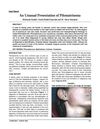
August 2008 in “Journal of Liaquat University of Medical & Health Sciences” A painless cheek lump was misdiagnosed but found to be a rare, benign skin lesion called pilomatrixoma, treatable by surgery.
 June 2023 in “QJM: An International Journal of Medicine”
 Diagnosing diffuse alopecia is challenging due to its varied appearance and underlying causes.
86 citations
,
June 1998 in “Journal of Investigative Dermatology” The hairless gene mutation causes baldness by disrupting hair follicle structure.
12 citations
,
May 2009 in “Ophthalmic plastic and reconstructive surgery” Multiple pilomatrixoma may indicate Turner syndrome.
March 1999 in “Annals of the Academy of Medicine Singapore” Trichotillomania is a chronic condition where people uncontrollably pull out their hair, often needing medication and therapy for treatment.