 15 citations
,
April 2017 in “Cell Stem Cell”
15 citations
,
April 2017 in “Cell Stem Cell” Some brain cancer cells avoid immune system detection, and certain treatments could target this to slow their growth; also, certain fat cell precursors help regenerate hair and skin after injury.
6 citations
,
March 2018 in “The American journal of dermatopathology/American journal of dermatopathology” BerEP4 and CD34 staining can help tell apart tricholemmoma from basal cell carcinoma.
 4 citations
,
May 2021 in “The American Journal of Surgical Pathology”
4 citations
,
May 2021 in “The American Journal of Surgical Pathology” Cutaneous Lymphadenoma is a unique skin tumor with specific protein markers and common gene mutations that may cause continuous cell growth.
February 2001 in “Chinese Journal of Dermatology” Epidermal growth factor (EGF) boosts the growth of hair follicle cells.
2 citations
,
November 2020 in “The American journal of dermatopathology/American journal of dermatopathology” Sweat duct differentiation in trichilemmal cysts is very rare and can be successfully removed with surgery.
January 2026 in “Biomaterials” October 2015 in “CRC Press eBooks” Trichoscopy is a useful tool for examining and monitoring hair and scalp conditions.
 4 citations
,
February 2020 in “Cell & tissue research/Cell and tissue research”
4 citations
,
February 2020 in “Cell & tissue research/Cell and tissue research” Hair follicle stem cells might help treat traumatic brain injury.
39 citations
,
February 1990 in “The journal of cell biology/The Journal of cell biology” Trichohyalin, a hair follicle protein, has a part with repeating patterns of 23 amino acids.
141 citations
,
May 2007 in “Cancer Research” CD34 is crucial for skin tumor development in mice.
 November 2022 in “The journal of investigative dermatology/Journal of investigative dermatology”
 Deleting the CD271 gene in mouse skin cells leads to disorganized skin and increased hair growth, suggesting CD271 is important for skin health.
April 2016 in “The journal of investigative dermatology/Journal of investigative dermatology” Neoplasms hide in hair follicles to avoid the immune system.
 August 1994 in “Journal of dermatological science”
 Mouse hair cells respond to male hormones by growing less, and this can be stopped by certain blockers.
April 2018 in “Journal of Investigative Dermatology” African spiny mice can regenerate skin and hair after wounds due to specific tissue mechanics.
 May 2014 in “Journal of Investigative Dermatology”
 Scientists developed tools to observe hair regeneration in real time and assess skin health, using glowing mice and light-controlled genes.
2 citations
,
January 1989 Researchers developed a method to grow skin-like tissue from hair cells.
27 citations
,
July 1993 in “The journal of investigative dermatology/Journal of investigative dermatology” 59 citations
,
November 2011 in “Development” Trps1 is essential for proper hair follicle development.
 June 2020 in “Journal of Investigative Dermatology”
 Scientists successfully grew mini hair follicles using human skin cells, which could help treat baldness.
 January 2012 in “Journal of Investigative Dermatology”
 Small molecule DMF improves psoriasis and multiple sclerosis, adult skin cells can be made to grow new hair, certain skin cells initiate hair growth, IL-17C controls gut health and can cause skin inflammation, and skin cells produce IL-17 that can lead to psoriasis.
January 2026 in “Materialia” Porcine ADM scaffold helps hair growth in mice.

Dermal stem cells help regenerate hair follicles and heal skin wounds.
87 citations
,
January 1999 in “British Journal of Dermatology” Trichoblastic fibroma and basal cell carcinoma are similar but different from trichoepithelioma.
 418 citations
,
September 2012 in “Nature”
418 citations
,
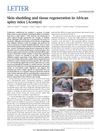
September 2012 in “Nature” African spiny mice can regenerate skin, hair, and cartilage, but not muscle, and their unique abilities could be useful for regenerative medicine.
303 citations
,
October 2000 in “Nature” RXRα is crucial for hair growth and skin cell function.
 207 citations
,
March 2012 in “Development”
207 citations
,
March 2012 in “Development” Skin needs dermal β-catenin activity for hair growth and skin cell multiplication.
 1 citations
,
January 2021
1 citations
,
January 2021 CD4+ skin cells may be precursors to basal cell carcinoma.
4 citations
,
September 2004 in “Experimental Dermatology” Mutations in certain skin proteins cause severe skin issues, while others have limited effects, highlighting the need to understand these proteins for better treatments.
8 citations
,
October 2024 in “Developmental Cell”  April 2023 in “The journal of investigative dermatology/Journal of investigative dermatology”
 EGFR deficiency causes significant changes in skin cells and hair follicles.