 August 2025 in “BMC Pregnancy and Childbirth”
 A new EDA gene variant causes X-linked hypohidrotic ectodermal dysplasia in a Chinese family.
 June 2023 in “Animal Bioscience”
 Vimentin and transthyretin proteins are linked to black coat color in sheep.
A KRT32 gene variant causes loose anagen hair syndrome.
A new mutation in the CYP11B1 gene was found in a woman with mild hyperandrogenemia, a rare cause of non-classic congenital adrenal hyperplasia.
January 2002 in “Agritrop (Cirad)” The hr gene is linked to hair loss in Valle del Belice sheep.
 195 citations
,
February 2005 in “Journal of biological chemistry/The Journal of biological chemistry”
195 citations
,
February 2005 in “Journal of biological chemistry/The Journal of biological chemistry” The ZIP7 gene helps control zinc levels in cells by moving zinc from the Golgi apparatus to the cytoplasm.
CCC1 is essential for ion balance and proper plant cell function.
September 2016 in “Journal of dermatological science” The conclusion is that the variation in hair thinness in patients is mostly due to the amount of underdeveloped hairs, and treatments that thicken fine hairs might work for those with mild to severe conditions.
2 citations
,
August 2020 in “CRC Press eBooks” Tabby mutations in mice affect hair follicle development and help study genetic mapping and certain medical conditions.
July 2024 in “Journal of Investigative Dermatology” CRISPR/Cas9 and prime editing can potentially fix skin disorder genes safely and effectively.
January 2025 in “Kuwait Journal of Science” KRT71 gene variants may influence camel hair shape but don't fully explain it.
 20 citations
,
July 2013 in “European Journal of Oral Sciences”
20 citations
,
July 2013 in “European Journal of Oral Sciences” A new PAX9 gene mutation causes missing teeth and hair problems, but not skin or nail issues.
 277 citations
,
July 2002 in “Molecular Endocrinology”
277 citations
,
July 2002 in “Molecular Endocrinology” Removing part of the vitamin D receptor stops vitamin D from working properly.
34 citations
,
January 2000 in “Journal of Andrology” CAG repeat polymorphism and prostate zone volume are not reliable markers of long-term androgen sensitivity.
 8 citations
,
December 2009 in “Journal of The European Academy of Dermatology and Venereology”
8 citations
,
December 2009 in “Journal of The European Academy of Dermatology and Venereology” Researchers found a new mutation in the FERMT1 gene in a Spanish family with Kindler syndrome.
2 citations
,
July 2022 in “Journal of the Endocrine Society” Some women with PCOS have rare genetic variants linked to the condition.
The KRT84 gene is linked to better wool quality in Gansu Alpine Fine-wool sheep.
39 citations
,
December 2012 in “The American Journal of Human Genetics” Mutations in the SNRPE gene cause hereditary hair loss.
 1 citations
,
September 2017
1 citations
,
September 2017 C-scores can help predict gain-of-function and loss-of-function mutations.
September 2022 in “Indian Journal of Paediatric Dermatology” Clouston syndrome is inherited in an autosomal dominant pattern and caused by a specific gene mutation, with no current treatment available.
210 citations
,
February 2008 in “Nature genetics” Mutations in the P2RY5 gene cause autosomal recessive woolly hair.
9 citations
,
June 1999 in “Journal of Investigative Dermatology” The HPV type 11 region activates hair-specific gene expression in mice.
 21 citations
,
October 2019 in “The journal of investigative dermatology/Journal of investigative dermatology”
21 citations
,
October 2019 in “The journal of investigative dermatology/Journal of investigative dermatology” A specific gene change plus an additional mutation in the same gene cause hereditary trichilemmal cysts.
 28 citations
,
February 2010 in “British journal of dermatology/British journal of dermatology, Supplement”
28 citations
,
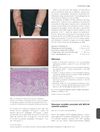
February 2010 in “British journal of dermatology/British journal of dermatology, Supplement” WNT10A mutations cause varied symptoms in patients with odonto-onycho-dermal dysplasia.
 1 citations
,
July 1997 in “The Lancet”
1 citations
,
July 1997 in “The Lancet” Scientists found a new protein, AMY117, common in Alzheimer's patients, which could be important for treatment and diagnosis.
January 2026 in “Preprints.org” Four new FGF5 gene variants cause long hair in dogs.
 115 citations
,
March 2019 in “Nature Communications”
115 citations
,
March 2019 in “Nature Communications” Frontal fibrosing alopecia is linked to four genetic areas, especially the HLA-B*07:02 allele.
48 citations
,
August 1998 in “Developmental Biology” Deleting part of a gene in mice causes wavy hair and high pup loss.
39 citations
,
January 2020 in “Frontiers in Genetics” PDGFC gene may help select goats with desirable curly wool traits.
21 citations
,
March 2003 in “Clinical and Experimental Dermatology” Mutations in the hHb6 gene cause the hair disorder monilethrix.