 July 2025 in “Journal of Dermatological Treatment”
 PRP improves hair growth in androgenic alopecia, especially when combined with minoxidil.

Exosome therapy successfully regrew and restored natural hair color in a man with stress-related hair loss.
 January 2025 in “International Journal of Trichology”
 Topical spironolactone and minoxidil both effectively treat female hair loss, but spironolactone has fewer side effects.
 January 2025 in “International Journal of Medical Arts”
 Topical sildenafil 1.0% may help increase hair count in female pattern hair loss.

Combining Nanofat with PRP is a safe and effective treatment for female pattern hair loss.
 September 2024 in “Egyptian Journal of Dermatology and Venerology”
 Low-energy fractional CO2 laser therapy significantly improves hair regrowth in women with female-pattern hair loss.
 June 2024 in “Benha Journal of Applied Sciences”
 β1 integrin may indicate and influence the severity of hair loss in androgenetic alopecia.
 June 2024 in “Journal of cosmetic dermatology”
 The document corrects errors in a table about hair loss in women.
 February 2024 in “International Journal of Molecular Sciences”
 Hair loss in Androgenetic Alopecia is caused by genetics, aging, and lifestyle, leading to hair follicle shrinkage and related health risks.
 January 2024 in “Photodiagnosis and Photodynamic Therapy”
 Using minoxidil with laser therapy is more effective for female hair loss than minoxidil alone.
 January 2024 in “Journal of Cosmetic Dermatology”
 Men's and women's pattern hair loss progress differently, with men showing more hair thinning and women having more widespread hair loss.
 January 2024 in “Lecture notes in networks and systems”
 "TRICHOASSIST" is a system that analyzes hair and scalp images to help diagnose scalp diseases.
 November 2023 in “Journal of Cosmetic Dermatology”
 The topical treatment with caffeine and Procapil 3% improved male pattern hair loss and was well tolerated after 12 weeks.
 September 2023 in “Cureus”
 Dr. SKS Hair Booster Serum effectively treats hair loss in women with PCOS.
 May 2023 in “JAAD international”
 Minoxidil-dutasteride tattooing can potentially help regrow hair, especially in men who already have some thin hair.
 January 2023 in “Research Square (Research Square)”
 Many patients experienced severe hair loss after COVID-19, especially older adults and women.
 January 2023 in “Journal of Cutaneous Pathology”
 The study found certain scalp biopsy features can help tell apart alopecia areata from pattern hair loss even when typical immune cells are not seen.
 December 2022 in “Cureus”
 Hormones significantly influence hair growth, with conditions like hirsutism and patterned hair loss linked to hormone levels; more research is needed for full understanding.
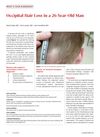 January 2022 in “Consultant”
 The man's occipital hair loss was due to temporal triangular alopecia, not alopecia areata.
 July 2021 in “Indian journal of dermatopathology and diagnostic dermatology”
 Trichoscopy is a reliable method for diagnosing hair and scalp disorders quickly and non-invasively.
 January 2021 in “International journal of dermatology, venereology and leprosy sciences”
 Most adult women experiencing hair loss are aged 21-40, with the most common type being female pattern hair loss. Trichoscopy is a useful tool for diagnosing different types of hair loss.
 December 2020 in “Vestnik dermatologii i venerologii”
 Iron supplements and physiotherapy together can better treat hair loss in women with iron deficiency.
Hair loss is caused by hormonal changes that shorten hair growth phases and shrink hair follicles.
January 2017 in “Nutrafoods - International Journal on Nutraceuticals, Functional Foods and Novel Foods” The supplement reduces hair loss and increases hair thickness in older women.
September 2016 in “Journal of dermatological science” The conclusion is that the variation in hair thinness in patients is mostly due to the amount of underdeveloped hairs, and treatments that thicken fine hairs might work for those with mild to severe conditions.
January 2016 in “Hair therapy & transplantation” Hair UpTM effectively and safely promotes hair regrowth, especially in minors.
 January 2015 in “Springer eBooks”
 The pull test and wash test are cheap, easy methods to diagnose hair loss.
March 2014 in “CRC Press eBooks” Human head hair can grow very long and is thicker than most body hair.
 August 2013 in “Pharmacy Today”
 Viviscal may modestly improve hair loss in women without adverse effects.
 January 2012 in “Journal of the Dermatology Nurses’ Association”
 The document explains hair growth, hair loss types, and other hair-related terms.