78 citations
,
June 2003 in “Journal of the American Academy of Dermatology” Curly hair shape is determined by the hair bulb.
September 2014 in “Daehan miyong hakoeji” Adding 2% glycerin or hyaluronic acid to permanent wave treatments reduces hair damage, with hyaluronic acid being more effective.

Use gentle products and nourishing masks to keep thin hair strong and voluminous.
2 citations
,
March 2010 in “European journal of dermatology/EJD. European journal of dermatology” A young Caucasian girl had both woolly hair and alopecia areata, which is rare.
 16 citations
,
October 2003 in “Journal of applied polymer science”
16 citations
,
October 2003 in “Journal of applied polymer science” 2-iminothiorane hydrochloride improves hair waving permanence without damage.

Grateloupia elliptica seaweed extract may promote hair growth by activating Wnt/β-catenin signaling and cell proliferation.

Curly hair may be caused by a muscle contraction, and muscle relaxants might help treat it.
January 2024 in “World Congress on Medical Physics and Biomedical Engineering, September 7 - 12, 2009, Munich, Germany” Polisorbate 20 is not suitable for curl creams due to instability.
117 citations
,
August 2005 in “Ultramicroscopy” Human hair's strength and flexibility vary by ethnicity, damage, and treatment.
7 citations
,
April 2000 in “Mammalian Genome” A new mutation in mice causes crooked whiskers and messy hair.
June 2016 in “한국디자인문화학회지” UVA damages all hair types, especially permanently waved and colored hair.
1 citations
,
October 2018 in “Ukraïnsʹkij žurnal dermatologìï, venerologìï, kosmetologìï” Wolvit® (biotin 5 mg) is effective and safe for treating hair loss and scalp conditions in women.
3 citations
,
March 2010 in “International Journal of Cosmetic Science” Functionalized silicones improve hair appearance, combing, and manageability.
17 citations
,
September 2005 in “International Journal of Dermatology” African hair is more fragile due to its unique shape and internal structure.
January 2025 in “Open University of Cape Town (University of Cape Town)” Lipids play a key role in determining hair curvature.
 6 citations
,
January 2000 in “Dermatology”
6 citations
,
January 2000 in “Dermatology” A girl's severely tangled hair couldn't be fixed and had to be cut due to a rare condition called plica neuropathica.
 October 2024 in “Skin Research and Technology”
 Extracorporeal shock waves significantly improve hair growth in women with female pattern hair loss.
35 citations
,
January 2000 in “Journal of comparative neurology” Rat vibrissae have sensory terminals with specific structures that help detect hair movements.
 August 2010 in “Journal of The American Academy of Dermatology”
 The document explains the diagnosis and characteristics of woolly hair nevus and alopecia neoplastica.
50 citations
,
March 2001 in “Clinics in dermatology” Human hair is complex and grows in cycles starting from embryonic life.
1 citations
,
June 2022 in “Tidsskrift for Den norske legeforening” A young boy's uncombable hair is due to a rare genetic condition that usually improves over time.
 September 2021 in “Mağallaẗ al-Muẖtar li-l-ʿulūm”
 Two sisters have rare hair disorders causing short, fragile, kinky hair.
1 citations
,
July 1935 in “Nature” Animal hair can curl tightly on its own, especially in foxes, due to changes in keratin.
 September 2017 in “Journal of Investigative Dermatology”
 Hair care products used for 4 weeks made hair smoother.
 42 citations
,
January 2009 in “Colloids and Surfaces B: Biointerfaces”
42 citations
,
January 2009 in “Colloids and Surfaces B: Biointerfaces” A certain surfactant sticks to human hair, making it change from water-repelling to water-attracting, which could help in hair conditioning.
 20 citations
,
April 2016 in “Journal of Cosmetic Dermatology”
20 citations
,
April 2016 in “Journal of Cosmetic Dermatology” Methyl vanillate spray increases hair count and hair mass in women with hair loss.
January 2016 in “Belarusian State Pedagogical University repository (Belarusian State Pedagogical University)” A 6-group geometric classification of human scalp hair is more reliable and objective for testing than an 8-group system.
 1 citations
,
January 2018 in “Acta dermato-venereologica”
1 citations
,
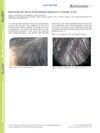
January 2018 in “Acta dermato-venereologica” A teenager's hair with alternating white and dark bands, known as Pili annulati, is a genetic condition that is usually harmless and often considered attractive.
November 2024 in “International Journal of Cosmetic Science” Hair absorbs moisture differently based on its structure and treatment, with changes occurring at 30% humidity.
 June 2004 in “Dermatologic Surgery”
 Dr. Walter P. Unger suggests that copying a person's natural hair direction and angle during transplants leads to a more natural and fuller appearance.