
An automated system can accurately classify hair disorders using image analysis.
December 2025 in “Aesthetic Surgery Journal” Exosomes are promising tools in aesthetic medicine for skin and hair regeneration.
November 2025 in “Journal of Investigative Dermatology” KLHL24-mutant stem cells help understand skin and heart disease.
November 2025 in “Frontiers in Pharmacology” Fermented rice bran extract helps delay skin aging by boosting collagen and elastin.
September 2025 in “Chinese Journal of Chromatography” A new method accurately detects illegal JAK inhibitors in hair loss cosmetics.
 July 2025 in “Journal of the European Academy of Dermatology and Venereology”
 A new treatment plan helps manage folliculitis decalvans effectively.
May 2025 in “International Journal of Trichology” Hair Heat Disease is caused by wet, oily hair and friction in hot, humid conditions.
 December 2024 in “Journal of Population Therapeutics and Clinical Pharmacology”
 Rosemary and kalonji seeds can improve hair health and treat hair conditions.
 July 2024 in “Frontiers in Microbiology”
 Data-driven methods can help understand microbiota's role in diseases and develop personalized treatments.
Stiffness gradients in alginate gels can guide cancer cell invasion and study cellular behaviors.
 June 2024 in “Nature Cell and Science”
 The Scalp Coverage Scoring method reliably measures hair density from images.
April 2024 in “Demiroglu Science University Florence Nightingale Journal of Medicine” Understanding the APCDD1 gene can lead to new hair loss treatments.
February 2024 in “Asian Journal of Pharmaceutical and Clinical Research” Expired platelet concentrates can be used effectively for wound healing, reducing waste.
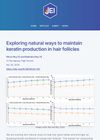
Coconut and castor oils may naturally boost hair growth by increasing keratin.
 December 2023 in “Annales Pharmaceutiques Françaises”
 The UV–Vis Spectrophotometry method effectively measures minoxidil in rat skin for alopecia treatment.
 August 2023 in “International Journal of Molecular Sciences”
 Human skin xenografting could improve our understanding of skin development, renewal, and healing.
June 2023 in “Zenodo (CERN European Organization for Nuclear Research)” Hutchinson-Gilford Progeria Syndrome causes rapid aging due to a gene mutation, with no cure yet, but research may lead to better treatments.
 June 2023 in “Historical records of Australian science/Historical Records of Australian Science”
 George Ernest Rogers was a notable scientist who made important discoveries about hair and wool proteins.
 May 2023 in “Jurnal farmasi sains dan praktis”
 The hair tonic with cinnamon oil and coconut oil was stable and caused very mild irritation.
 January 2023 in “MIMESIS”
 The study concluded that McDonald's Father's Day ad uses a burger bun to symbolize a father, with colors and text celebrating the occasion and representing the brand's identity.
 January 2023 in “Springer eBooks”
 New understanding of hair loss could lead to better treatments.
 August 2022 in “bioRxiv (Cold Spring Harbor Laboratory)”
 Mouse touch-sensitive nerve cells adjust their connections based on competition with other similar cells.
December 2021 in “Prosiding Seminar Nasional Kesehatan” Bandotan leaf extract effectively promotes hair growth.
 July 2021 in “Clinical Medicine”
 Sexually transmitted infections and HIV should be considered as possible causes of chronic diarrhea, especially in men who have sex with men.
August 2019 in “Journal of the American Academy of Dermatology” Depression and hair loss may influence each other.
 August 2018 in “Journal of Investigative Dermatology”
 A woman with dermatomyositis improved after treatment for neck panniculitis, suggesting similar treatment for related conditions.
April 2017 in “The journal of sexual medicine” 5-alpha-reductase inhibitors significantly affect the penile tissue of hypertensive rats.
Reviewers suggested the study on finding new drug uses through social media side-effects needs better methods and clearer limitations.
December 2015 in “OPAL (Open@LaTrobe) (La Trobe University)” Oleuropein increases IGF-1 levels in mouse skin.
 January 2015 in “Farmatsevtychnyĭ zhurnal”
 The tincture made from nettle, sage, and horse chestnut in a 5:3:2 ratio is effective for treating telogen effluvium.