 July 2022 in “Journal of Investigative Dermatology”
 Substance P may contribute to hair loss by increasing oxidative stress and mitochondrial activity in hair follicles.
 January 2023 in “International journal of pharmacognosy and clinical research”
 The polyherbal oil made from natural ingredients improves hair health and appearance.
 July 2022 in “Journal of Investigative Dermatology”
 Dkk4 is necessary for the initial development and arrangement of hair follicles.
 1 citations
,
March 2005 in “International Journal of Cosmetic Science”
1 citations
,
March 2005 in “International Journal of Cosmetic Science” Twisting hair weakens it, but strength can be recovered at low twist levels.
11 citations
,
November 2019 in “The FASEB Journal” A mutation in the MAP2 gene causes reduced hair follicle density, leading to hairlessness.
 May 2025 in “Science Advances”
 PIEZO1 helps keep hair follicle stem cells inactive, affecting hair growth.
2 citations
,
April 1970 in “Archives of Dermatology” Ichthyosis serpentina may be a variant linked to bamboo hair, with a possible genetic component.
 33 citations
,
August 1985 in “Archives of Dermatology”
33 citations
,
August 1985 in “Archives of Dermatology” Acquired Progressive Kinking of Hair is likely an early sign of male pattern baldness.
Wheat bran promotes hair growth by helping hair cells multiply.
27 citations
,
January 2000 in “Developmental Dynamics” Mutations in the Whn gene affect hair keratin gene expression differently.
ISX9 helps regrow hair by activating a specific cell signaling pathway.
June 2026 in “Journal of Applied Animal Welfare Science” Social hair plucking in rhesus macaques is linked to grooming, aggression, and health issues like hair loss, especially in females and lower-ranked individuals.
 63 citations
,
October 1972 in “British Journal of Dermatology”
63 citations
,
October 1972 in “British Journal of Dermatology” Women with thinning hair have thinner hair strands than women without hair loss.
 170 citations
,
July 2012 in “Journal of Investigative Dermatology”
170 citations
,
July 2012 in “Journal of Investigative Dermatology” Wnt ligands are crucial for hair growth and repair.
 39 citations
,
October 1967 in “British Journal of Dermatology”
39 citations
,
October 1967 in “British Journal of Dermatology” Hair loss in women often doesn't follow a pattern, isn't linked to age, may be genetic, and can be related to thyroid issues or other health factors.
July 2026 in “Journal of Investigative Dermatology” 
Social hair plucking in rhesus macaques is an abnormal behavior with both social and aggressive traits, affecting health.
 2 citations
,
August 2019 in “International Journal of Cosmetic Science”
2 citations
,
August 2019 in “International Journal of Cosmetic Science” Older age and certain lifestyles are linked to thinner, weaker hair, while how you see your hair relates to its thickness.
February 2006 in “Cambridge University Press eBooks” A 45-year-old woman experienced excessive hair shedding beyond the normal range.
53 citations
,
October 2003 in “Genetics” The mK6irs1/Krt2-6g gene likely causes wavy hair in mice.
December 2010 in “대한미용학회지” PMWE effectively stimulates hair growth and is safer than minoxidil.
254 citations
,
January 2007 in “Chemical Society Reviews” Hair is a complex protein fiber with unique properties useful for developing hair products.
2 citations
,
August 1993 in “Archives of Dermatology” A 39-year-old woman developed uncombable hair syndrome after taking oral contraceptives.
 1 citations
,
May 2019 in “Journal of The European Academy of Dermatology and Venereology”
1 citations
,
May 2019 in “Journal of The European Academy of Dermatology and Venereology” New method, hair distribution width (HDW), improves accuracy in diagnosing androgenetic alopecia (AGA).
91 citations
,
December 2006 in “Proceedings of the National Academy of Sciences” Hair patterns in mice are controlled by both a global system dependent on Fz6 and a local self-organizing system.
 15 citations
,
January 2018 in “Annals of Dermatology”
15 citations
,
January 2018 in “Annals of Dermatology” Wigs significantly improve the well-being of people with severe hair loss.

Hairlessness in mammals is caused by combined changes in genes and regulatory regions.
November 2019 in “Journal of Vertebrate Biology” QIA-64 software can measure straight wire lengths accurately but needs improvement for curved wires and width measurements.
March 2023 in “Journal of Student Research” Humans likely became hairless to better regulate body temperature.
 January 2026 in “Cosmoderma”
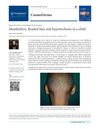
 A 9-year-old girl has a rare hair disorder causing beaded, sparse hair.