 7 citations
,
January 2012 in “International Journal of Trichology”
7 citations
,
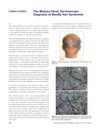
January 2012 in “International Journal of Trichology” A man with Woolly Hair Syndrome had very curly, fragile hair, and doctors used a special scalp examination to diagnose him without invasive tests.
13 citations
,
January 2001 in “Pediatric dermatology” A dark-haired Chinese girl had hair that looked banded under certain light but was normal under a microscope.
 February 2024 in “Journal of Dermatological Science”
 Curved hair can develop when hair cells merge abnormally during growth.
 8 citations
,
December 2020 in “Scientific reports”
8 citations
,
December 2020 in “Scientific reports” Selective breeding caused the unique curly hair in Mangalitza pigs.
 18 citations
,
July 2003 in “Dermatologic Surgery”
18 citations
,
July 2003 in “Dermatologic Surgery” The conclusion is that creating natural-looking hair restoration requires replicating natural scalp whorl patterns and inserting grafts at specific angles.
 November 2023 in “Journal of Dermatological Science”
 A new computer tool quickly measures hair thickness differences in people with common types of hair loss.
9 citations
,
April 2019 in “Journal of Structural Biology” Keratin fibers in hair twist left-handed.
95 citations
,
October 2007 in “International Journal of Dermatology” A new method accurately classifies hair types, showing global hair diversity.
June 2014 in “Professional Beauty” 4 citations
,
July 2010 in “International Journal of Cosmetic Science” Curved human hair has different structures on its convex and concave sides.
5 citations
,
October 2018  8 citations
,
March 2019 in “Progress in Human Geography”
8 citations
,
March 2019 in “Progress in Human Geography” Hair significantly shapes body identity and social interactions, influencing how we perceive and relate to our bodies.
 February 2023 in “EAS Journal of Medicine and Surgery”
 Most Idoma people have a curved hairline due to genetics.
 September 2023 in “International journal of Unani and integrative medicine”
 Hair loss patterns are linked to temperament and can help diagnose it.
June 2023 in “Zenodo (CERN European Organization for Nuclear Research)” 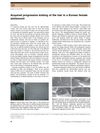 1 citations
,
October 2012 in “The Journal of Dermatology”
1 citations
,
October 2012 in “The Journal of Dermatology” A Korean girl developed kinky hair without known cause or effective treatment.
10 citations
,
June 2019 in “Cosmetics” Mixed-race individuals have hair with varied shapes and more root damage.
27 citations
,
September 1988 in “PubMed” Hair follicle shape determines hair type: curly, straight, or in-between.
1 citations
,
July 1935 in “Nature” Animal hair can curl tightly on its own, especially in foxes, due to changes in keratin.
65 citations
,
May 2006 in “Journal of Structural Biology” Hair curliness is due to uneven distribution of different cortices within the hair fiber.
7 citations
,
June 2018 in “Journal of the American Academy of Dermatology” The document suggests finding a simpler, cheaper way to diagnose Uncombable Hair Syndrome.
2 citations
,
March 1942 in “JAMA” 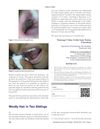 January 2012 in “International Journal of Trichology”
 Two siblings have a rare genetic condition causing curly, coarse hair.
37 citations
,
June 2000 in “Experimental dermatology” The Lanceolate hair-J mutation in mice mimics human hair disorders like Netherton's syndrome.
 18 citations
,
April 2004 in “The journal of investigative dermatology/Journal of investigative dermatology”
18 citations
,
April 2004 in “The journal of investigative dermatology/Journal of investigative dermatology” Skin patterns are formed by simple reaction-diffusion mechanisms.
 March 2026 in “Scholarly Horizons University of Minnesota Morris Undergraduate Journal”
 Hair in art is often seen as repulsive when detached from the body.
April 2016 in “Journal of the American Academy of Dermatology” A 4-year-old girl had a rare hair disorder affecting only part of her scalp.
12 citations
,
September 2012 in “Computer Graphics Forum” The method improves hair animation from video by combining image techniques and simulations.
December 2025 in “ILDS-DEV”  March 2025 in “Journal of Craniofacial Surgery”
 Natural hairline asymmetry should be embraced for better-looking hair transplants.