July 2009 in “International Journal of Cosmetic Science” Japanese women's curved hair has an uneven internal structure and varied amino acid composition.
 18 citations
,
April 2004 in “The journal of investigative dermatology/Journal of investigative dermatology”
18 citations
,
April 2004 in “The journal of investigative dermatology/Journal of investigative dermatology” Skin patterns are formed by simple reaction-diffusion mechanisms.
3 citations
,
October 1994 in “Medical Molecular Morphology” The lower part of rat vibrissa hair gets more blood and is well-protected for growth.
March 2018 in “Journal of Experimental Biology” Hair curliness is caused by the arrangement and length of two different cell types.
37 citations
,
June 2000 in “Experimental dermatology” The Lanceolate hair-J mutation in mice mimics human hair disorders like Netherton's syndrome.
91 citations
,
December 2006 in “Proceedings of the National Academy of Sciences” Hair patterns in mice are controlled by both a global system dependent on Fz6 and a local self-organizing system.
 January 1961 in “The Journal of Anthropological Society of Nippon”
 Hair form in mixed-blood families varies due to hereditary twist-knots and pigment formation.
 January 2002 in “Proceedings of The Japanese Society of Animal Models for Human Diseases”
 Keratin2-6g is crucial for hair follicle development, with mutations causing cell degeneration and vacuolation.
2 citations
,
January 2010 Tianzhu white yak hair varies in structure and density between fuzz and coarse hair.
13 citations
,
October 2008 in “PubMed” Japanese women's curved hair has an uneven internal structure and varying amino acid composition.
7 citations
,
April 2000 in “Mammalian Genome” A new mutation in mice causes crooked whiskers and messy hair.
 8 citations
,
December 2020 in “Scientific reports”
8 citations
,
December 2020 in “Scientific reports” Selective breeding caused the unique curly hair in Mangalitza pigs.
 February 2024 in “Journal of Dermatological Science”
 Curved hair can develop when hair cells merge abnormally during growth.
2 citations
,
March 2024 in “Pediatric Dermatology” Two siblings have a rare hair condition caused by a new genetic variant.
 17 citations
,
June 2012 in “Journal of experimental zoology. Part B, Molecular and developmental evolution”
17 citations
,
June 2012 in “Journal of experimental zoology. Part B, Molecular and developmental evolution” Hair in mammals likely evolved from glandular structures, not scales.
January 2025 in “Arquivo Brasileiro de Medicina Veterinária e Zootecnia” Agoutis in captivity have more resting (telogen) hairs than growing (anagen) hairs, regardless of season or gender.
 19 citations
,
October 1985 in “British Journal of Dermatology”
19 citations
,
October 1985 in “British Journal of Dermatology” The document concludes that unruly hair can be congenital or acquired, often lacks specific treatments, and can be managed with oils and short hairstyles.
24 citations
,
January 2018 in “Development” Frizzled 3 and Frizzled 6 together control the orientation of mouse hair follicles.
October 2024 in “Skin Research and Technology” Pili annulati causes zebra-striped hair but doesn't affect hair strength or quality of life.
 2 citations
,
March 1977 in “Journal of animal science/Journal of animal science ... and ASAS reference compendium”
2 citations
,
March 1977 in “Journal of animal science/Journal of animal science ... and ASAS reference compendium” Defective mink guard hairs have split tips and missing cuticle cells, causing a metallic sheen.
 6 citations
,
February 2013 in “Veterinary Dermatology”
6 citations
,
February 2013 in “Veterinary Dermatology” A young cat had a rare hair condition with twisted hair shafts but stayed healthy.
 7 citations
,
August 2009 in “Applied Mathematics and Mechanics-English Edition”
7 citations
,
August 2009 in “Applied Mathematics and Mechanics-English Edition” Hair fibers have fractal patterns with properties related to the golden mean, which may affect their functionality.
33 citations
,
September 1987 in “American Journal of Medical Genetics” Uncombable hair is inherited dominantly with complete penetrance.
 5 citations
,
March 2009 in “Pediatric Dermatology”
5 citations
,
March 2009 in “Pediatric Dermatology” The study found that pili bifurcati causes hair to intermittently split into two branches, each with its own outer layer.
5 citations
,
January 2009 in “International Journal of Trichology” Two siblings had a rare hair condition with banded hair, which doesn't need treatment.
 January 1957 in “Nihon Chikusan Gakkaiho”
 Rabbit hair color is influenced by the shape and distribution of pigment granules.
1 citations
,
August 2015 in “PubMed” Human hair's strength comes from a honeycomb-like structure and macrofibrils.
1 citations
,
January 2018 in “International Journal of Trichology” Circle hairs are harmless, spiral-shaped body hairs that don't need medical treatment.
 24 citations
,
November 1978 in “Biochemistry”
24 citations
,
November 1978 in “Biochemistry” α-type filaments in guinea pig hair follicles have unique structural features.
 1 citations
,
January 2018 in “Acta dermato-venereologica”
1 citations
,
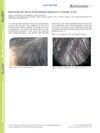
January 2018 in “Acta dermato-venereologica” A teenager's hair with alternating white and dark bands, known as Pili annulati, is a genetic condition that is usually harmless and often considered attractive.