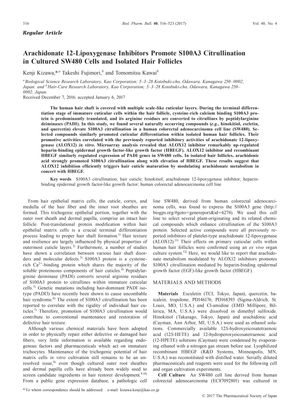
TLDR Inhibiting ALOX12 can help hair cuticle maturation by increasing S100A3 citrullination.
The study demonstrated that several naturally occurring compounds, such as hinokitiol, escletin, and quercetin, increased S100A3 citrullination in SW480 cells and promoted cuticular differentiation in isolated human hair follicles. These effects were linked to the inhibition of arachidonate 12-lipoxygenase (ALOX12), which up-regulated heparin-binding epidermal growth factor-like growth factor (HBEGF) and regulated PADI gene expression. Additionally, arachidonic acid promoted S100A3 citrullination and elevated HBEGF in isolated hair follicles, suggesting that ALOX12 inhibition could effectively trigger hair cuticle maturation by modulating arachidonate metabolism in conjunction with HBEGF.
119 citations
,
November 2016 in “American journal of human genetics” Mutations in three genes cause Uncombable Hair Syndrome, leading to frizzy hair that can't be combed flat.
 130 citations
,
August 2015 in “Experimental Dermatology”
130 citations
,
August 2015 in “Experimental Dermatology” Human hair follicle organ culture is a useful model for hair research with potential for studying hair biology and testing treatments.
 16 citations
,
May 2015 in “Tissue Engineering Part C-methods”
16 citations
,
May 2015 in “Tissue Engineering Part C-methods” A two-step method was created in 2015 to make more cells that help with hair growth, but they need to be combined with other cells for 4 days to actually form new hair.
5 citations
,
September 2013 62 citations
,
December 2007 in “Journal of biological chemistry/The Journal of biological chemistry” A specific chemical change in the S100A3 protein leads to the formation of a four-part structure important for hair formation.
 7 citations
,
November 2004 in “International Journal of Cosmetic Science”
7 citations
,
November 2004 in “International Journal of Cosmetic Science” Hair breaks differently when wet or dry and is affected by its condition and treatments like perms and bleaching.
 19 citations
,
October 1996 in “Dermatologic Clinics”
19 citations
,
October 1996 in “Dermatologic Clinics” Dermal papilla cells are key for hair growth and could help us understand and treat hair loss.
41 citations
,
July 1994 in “Journal of Dermatological Science” Hair follicle cells need complex interactions to fully differentiate.