TLDR Hair loss increases with age; alcohol raises risk, more female partners lowers it.
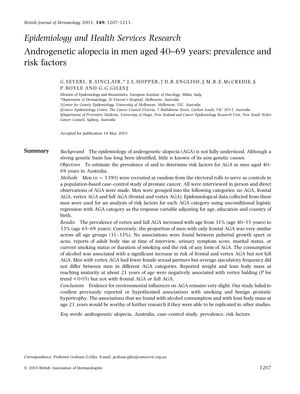
This study aimed to estimate the prevalence and risk factors of androgenetic alopecia (AGA) in men aged 40-69 years in Australia. The study found that the prevalence of vertex and full AGA increased with age, while the proportion of men with only frontal AGA was similar across all age groups. Alcohol consumption was associated with an increased risk of both frontal and vertex AGA, while the lifetime number of female sexual partners was negatively associated with vertex AGA. The study concluded that the prevalence of vertex AGA increases with age, while the prevalence of only frontal AGA appears to be constant. The study suggests that future research on the determinants of AGA should preferably be couched within prospective cohort studies.

157 citations
,
July 2001 in “British Journal of Dermatology” AGA more common in men, Koreans have lower rates and unique patterns.
26 citations
,
June 2000 in “Journal of The American Academy of Dermatology” Men with balding at age 45 had higher IGF-1 and lower IGFBP-3, suggesting these factors might be important in male pattern baldness.
35 citations
,
January 2000 in “Dermatology” Hair loss common in Norwegian men, affecting self-esteem and life quality.
179 citations
,
September 1998 in “BMJ” Hair loss in men is common, treatable, but not curable.
54 citations
,
May 1998 in “Urology” Men with enlarged prostates often have more severe baldness.
2 citations
,
January 2020 in “Journal of The European Academy of Dermatology and Venereology” Balding men have harder scalps.
16 citations
,
June 2008 in “Springer eBooks” Over 50% of women over 50 experience hair loss, with minoxidil being the only proven effective treatment.
151 citations
,
May 2014 in “American Journal of Clinical Dermatology” Effective treatments for male pattern baldness include oral finasteride and topical minoxidil, while topical minoxidil is best for female pattern baldness.
45 citations
,
September 2018 in “International Journal of Women's Dermatology” PRP shows promise for hair loss treatment, with three initial monthly injections and maintenance every 3-6 months.
7 citations
,
March 2020 in “Lasers in Medical Science” LLLT is a safe, promising hair loss treatment, but more research needed.
Nourkrin® with Marilex® may significantly increase hair growth and alopecia could be an early sign of metabolic syndrome.